Chakraborty Anya, Chakrabarti Bhismadev
Centre for Integrative Neuroscience and Neurodynamics, School of Psychology and Clinical Language Sciences, University of Reading, Reading, United Kingdom.
Front Psychol. 2018 Feb 13;9:121. doi: 10.3389/fpsyg.2018.00121. eCollection 2018.
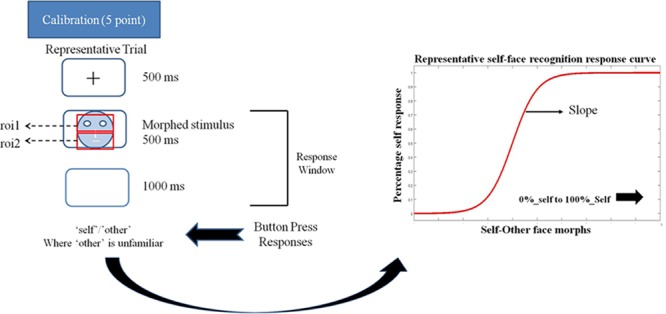
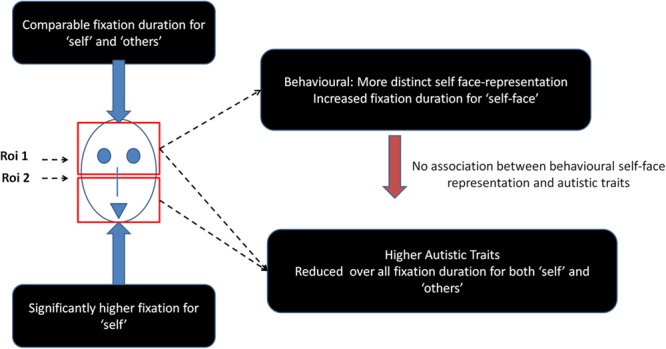
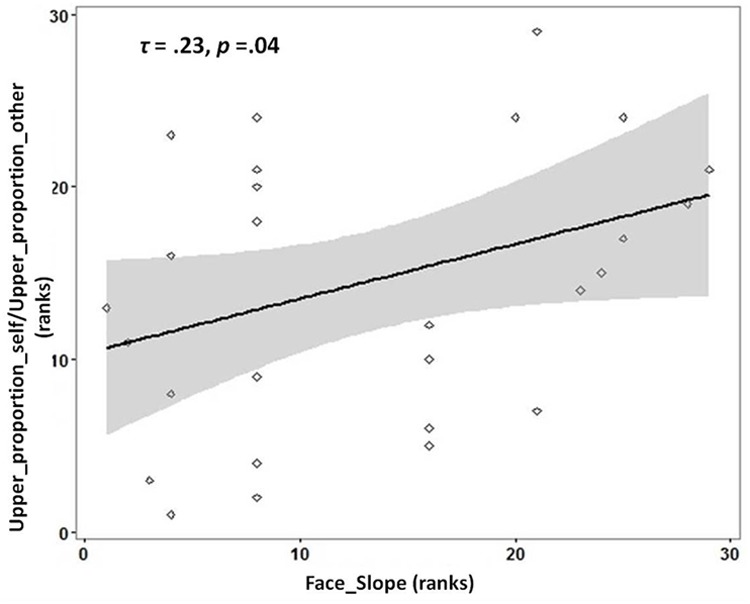
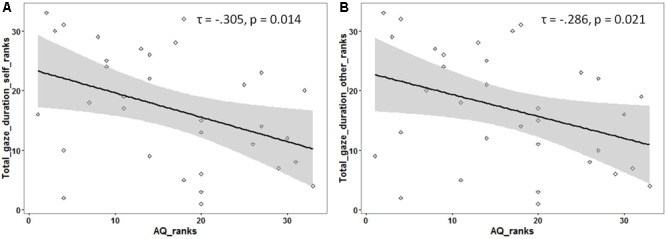
We live in an age of 'selfies.' Yet, how we look at our own faces has seldom been systematically investigated. In this study we test if the visual processing of the highly familiar self-face is different from other faces, using psychophysics and eye-tracking. This paradigm also enabled us to test the association between the psychophysical properties of self-face representation and visual processing strategies involved in self-face recognition. Thirty-three adults performed a self-face recognition task from a series of self-other face morphs with simultaneous eye-tracking. Participants were found to look longer at the lower part of the face for self-face compared to other-face. Participants with a more distinct self-face representation, as indexed by a steeper slope of the psychometric response curve for self-face recognition, were found to look longer at upper part of the faces identified as 'self' vs. those identified as 'other'. This result indicates that self-face representation can influence where we look when we process our own vs. others' faces. We also investigated the association of autism-related traits with self-face processing metrics since autism has previously been associated with atypical self-processing. The study did not find any self-face specific association with autistic traits, suggesting that autism-related features may be related to self-processing in a domain specific manner.
我们生活在一个“自拍”的时代。然而,我们如何看待自己的脸却很少得到系统的研究。在这项研究中,我们使用心理物理学和眼动追踪技术来测试高度熟悉的自我面孔的视觉处理是否与其他面孔不同。这种范式还使我们能够测试自我面孔表征的心理物理特性与自我面孔识别中涉及的视觉处理策略之间的关联。33名成年人在进行眼动追踪的同时,从一系列自我与他人面孔融合图像中完成一项自我面孔识别任务。结果发现,与他人面孔相比,参与者在自我面孔上注视面部下部的时间更长。自我面孔识别心理测量反应曲线斜率更陡,表明自我面孔表征更明显的参与者,在识别为“自我”的面孔上部比识别为“他人”的面孔上部注视时间更长。这一结果表明,自我面孔表征会影响我们在处理自己与他人面孔时的注视位置。由于之前自闭症与非典型自我处理有关,我们还研究了自闭症相关特征与自我面孔处理指标之间的关联。该研究未发现任何与自闭症特征相关的自我面孔特定关联,这表明自闭症相关特征可能以领域特定的方式与自我处理相关。