Health Management and Policy, School of Public Health, University of Michigan, Ann Arbor, Michigan.
Department of Internal Medicine, University of Michigan, Ann Arbor, Michigan.
J Am Geriatr Soc. 2018 Apr;66(4):742-747. doi: 10.1111/jgs.15316. Epub 2018 Feb 28.
To assess the economic effect and cost effectiveness of a targeted catheter-associated urinary tract infection (CAUTI) prevention intervention in the nursing home (NH) setting.
Randomized clinical trial.
Community-based NHs (N=12).
NH residents with indwelling urinary catheters (N=418).
Standard care versus infection prevention program involving barrier precautions, active surveillance, and NH staff education.
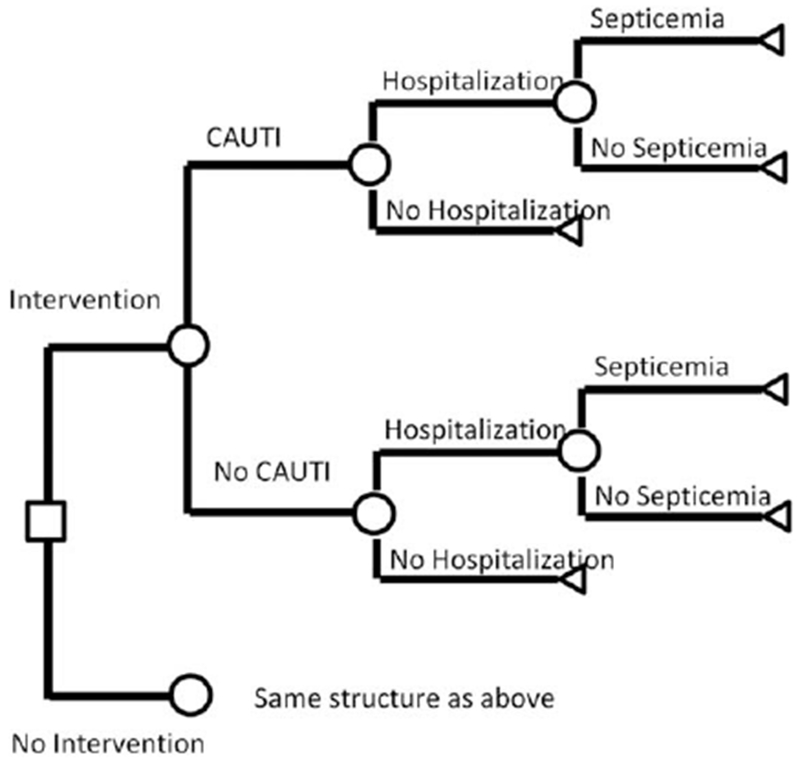
Costs of the intervention, costs of disease, and health outcomes were used to calculate an incremental cost-effectiveness ratio for the intervention. Data came from intervention results and the literature and outcomes were analyzed over one year.
A 120-bed NH would have program costs of $20,279/year. The cost of disease treatment would be reduced by $54,316 per year, resulting in a $34,037 net cost savings. Most of this savings would come from fewer CAUTI hospitalizations ($39,180), with $15,136 in savings from CAUTI care within the NH. The intervention also yielded a gain of 0.197 quality-adjusted life-years (QALYs). Taking into account uncertainty in all parameters suggests there is an 85% chance that the intervention is cost-saving.
The CAUTI prevention program is expected to benefit payers by reducing costs and improving health outcomes. Because the savings accrue to payers and not to NHs, payers such as Medicare and private insurers may want to provide incentives for NHs to implement such programs.
clinicaltrials.gov Identifier: NCT01062841.
评估针对疗养院(NH)中与导管相关的尿路感染(CAUTI)的目标预防干预措施的经济效果和成本效益。
随机临床试验。
以社区为基础的 NH(N=12)。
NH 中有留置导尿管的居民(N=418)。
标准护理与感染预防计划,包括屏障预防措施、主动监测和 NH 工作人员教育。
干预措施的成本、疾病成本和健康结果用于计算干预措施的增量成本效益比。数据来自干预结果和文献,结果在一年内进行分析。
一家拥有 120 张床位的 NH 每年将有 20279 美元的项目成本。每年治疗疾病的费用将减少 54316 美元,从而节省 34037 美元的净成本。这些节省主要来自于减少 CAUTI 住院治疗(39180 美元),而 NH 内的 CAUTI 护理节省了 15136 美元。该干预措施还获得了 0.197 个质量调整生命年(QALY)。考虑到所有参数的不确定性表明,该干预措施有 85%的可能性具有成本效益。
CAUTI 预防计划有望通过降低成本和改善健康结果使支付方受益。由于节省的费用归支付方所有,而不归 NH 所有,因此 Medicare 和私人保险公司等支付方可能希望为 NH 实施此类计划提供激励措施。
clinicaltrials.gov 标识符:NCT01062841。