Poverty, Health, and Nutrition Division, International Food Policy Research Institute, Washington, DC.
Division of Nutritional Sciences, Charles H Dyson School of Applied Economics and Management, and Cornell Statistical Consulting Unit, Cornell University, Ithaca, NY.
J Nutr. 2018 Feb 1;148(2):259-266. doi: 10.1093/jn/nxx048.
Although self-efficacy is a potential determinant of feeding and care behaviors, there is limited empirical analysis of the role of maternal self-efficacy in low- and middle-income countries. In the context of behavior change interventions (BCIs) addressing complementary feeding (CF), it is possible that maternal self-efficacy can mediate or enhance intervention impacts.
In the context of a BCI in Bangladesh, we studied the role of maternal self-efficacy for CF (MSE-CF) for 2 CF behaviors with the use of a theoretically grounded empirical model of determinants to illustrate the potential roles of MSE-CF.
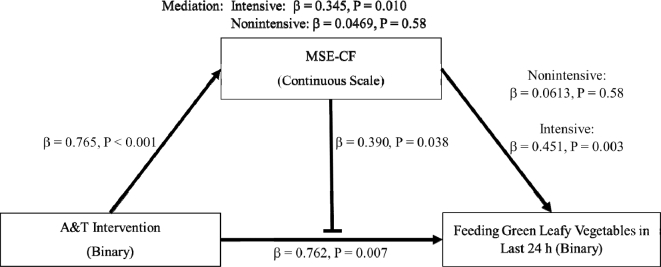
We developed and tested a locally relevant scale for MSE-CF and included it in a survey (n = 457 mothers of children aged 6-24 mo) conducted as part of a cluster-randomized evaluation. Qualitative research was used to inform the selection of 2 intervention-targeted behaviors: feeding green leafy vegetables in the last 24 h (GLV) and on-time introduction of egg (EGG) between 6 and 8 mo of age. We then examined direct, mediated, and potentiated paths of MSE-CF in relation to the impacts of the BCI on these behaviors with the use of regression and structural equation modeling.
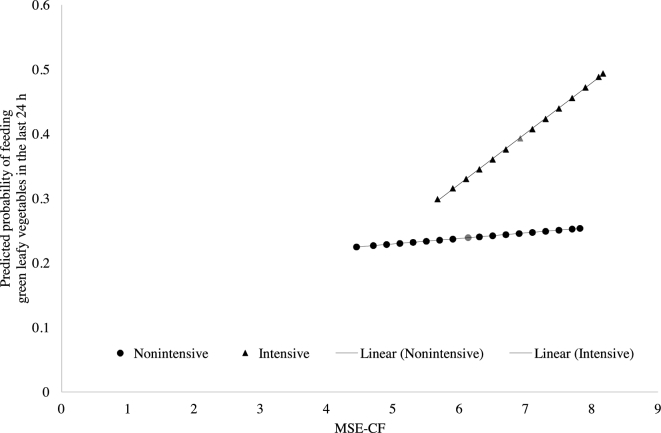
GLV and EGG were higher in the intensive group than in the nonintensive control group (16.0 percentage points for GLV; P < 0.001; 11.2 percentage points for EGG; P = 0.037). For GLV, MSE-CF mediated (β = 0.345, P = 0.010) and potentiated (β = 0.390, P = 0.038) the effect of the intensive group. In contrast, MSE-CF did not mediate or potentiate the effect of the intervention on EGG.
MSE-CF was a significant mediator and potentiator for GLV but not for EGG. The divergent findings highlight the complex determinants of individual specific infant and young child feeding behaviors. The study shows the value of measuring behavioral determinants, such as MSE-CF, that affect a caregiver's capability to adopt intervention-targeted behaviors.
尽管自我效能感是喂养和护理行为的潜在决定因素,但在中低收入国家,对母亲自我效能感在这方面作用的实证分析十分有限。在针对补充喂养(CF)的行为改变干预(BCI)背景下,母亲自我效能感有可能起到中介或增强干预效果的作用。
在孟加拉国的一项 BCI 中,我们使用一个基于理论的决定因素实证模型来研究 CF 母亲自我效能感(MSE-CF)对 2 种 CF 行为的作用,以说明 MSE-CF 的潜在作用。
我们开发并测试了一个适用于当地情况的 MSE-CF 量表,并将其纳入一项作为群组随机评估一部分的调查(n=457 名 6-24 月龄儿童的母亲)。我们采用定性研究来为选择 2 种干预目标行为提供信息:在过去 24 小时内喂食绿叶蔬菜(GLV)和在 6-8 月龄时按时引入鸡蛋(EGG)。然后,我们使用回归和结构方程模型来检验 MSE-CF 与 BCI 对这些行为的影响之间的直接、中介和增强路径。
密集组的 GLV 和 EGG 均高于非密集对照组(GLV 高出 16.0 个百分点;P<0.001;EGG 高出 11.2 个百分点;P=0.037)。对于 GLV,MSE-CF 起中介作用(β=0.345,P=0.010)和增强作用(β=0.390,P=0.038)。相比之下,MSE-CF 对干预对 EGG 的效果没有中介或增强作用。
MSE-CF 是 GLV 的重要中介和增强因素,但不是 EGG 的中介和增强因素。这两种截然不同的发现强调了个体特定婴幼儿喂养行为的复杂决定因素。该研究表明,衡量 MSE-CF 等行为决定因素的价值,这些因素影响护理人员采取干预目标行为的能力。