Moorfields Eye Hospital, City Road, London, United Kingdom.
Keratoconus Research Institute, Department of Ophthalmology, St. Thomas' Hospital, London, United Kingdom.
Invest Ophthalmol Vis Sci. 2018 Feb 1;59(2):1058-1065. doi: 10.1167/iovs.17-22994.
To investigate riboflavin concentration on enzymatic resistance following corneal cross-linking (CXL).
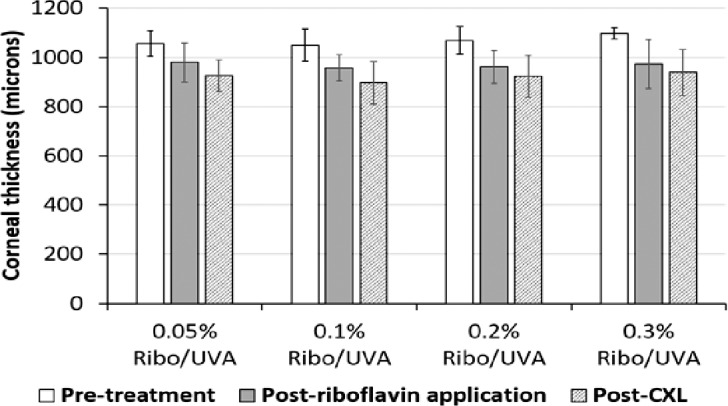
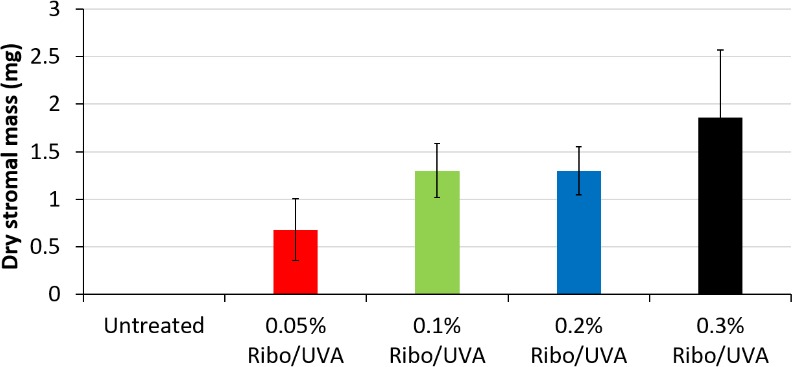
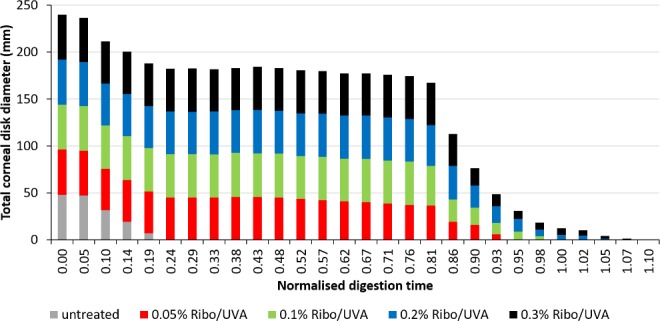
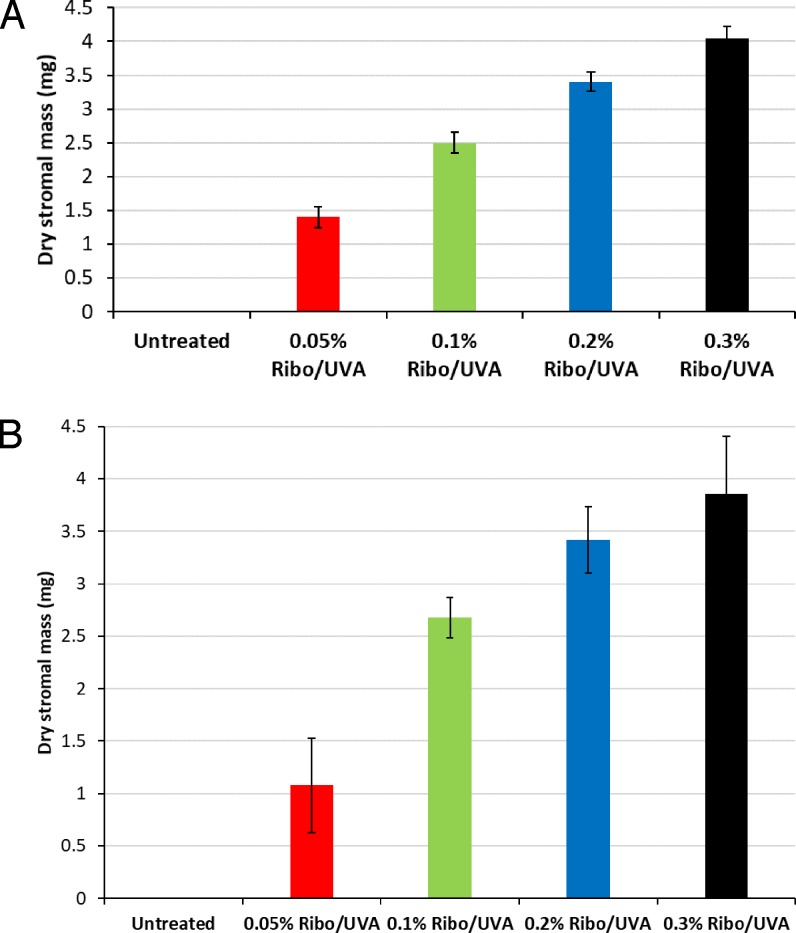
Ninety-six porcine eyes were divided into five groups in two treatment runs. Group 1 remained untreated. Group 2 received riboflavin 0.05%, group 3 riboflavin 0.1%, group 4 riboflavin 0.2%, and group 5 riboflavin 0.3%. Treated eyes underwent CXL with ultraviolet A at 9 mW/cm2 for 10 minutes. Eight-millimeter discs from each cornea were submerged in pepsin digest solution. In the first run, disc diameters were measured daily. After 10 days, dry weights were recorded from five samples in each group. In the second run, dry weights were recorded in five samples in each group at 10 and 20 days.
CXL-treated corneas took longer to digest than untreated (P < 0.001). Although eyes treated with higher riboflavin concentrations generally took longer to digest, there were no significant differences between groups (P = 0.3). Dry weights at 10 days demonstrated, with each increase in concentration, an increase in weight of residual undigested tissue (P < 0.001). In the second run, with each increase in riboflavin concentration there was an increase in weight of residual tissue (P < 0.001) at 10 days. At 20 days, the dry weight was lower with 0.05% riboflavin compared to 0.3% (P < 0.001) and 0.2% and 0.1% solutions (P < 0.05), with no other difference between groups.
There is a consistent dose-response curve with higher concentrations of riboflavin achieving greater CXL efficacy, suggesting that manipulation of riboflavin dosage as well as the UVA protocol can be used to optimize CXL.
研究核黄素浓度对角膜交联(CXL)后酶抗性的影响。
96 只猪眼分为两组进行两种处理。第 1 组未处理。第 2 组给予核黄素 0.05%,第 3 组给予核黄素 0.1%,第 4 组给予核黄素 0.2%,第 5 组给予核黄素 0.3%。处理后的眼睛用 9 mW/cm2 的紫外线 A 照射 10 分钟。从每只角膜中取出 8 毫米的圆盘,浸入胃蛋白酶消化液中。在第一次运行中,每天测量圆盘直径。10 天后,记录每组 5 个样本的干重。在第二次运行中,第 10 天和第 20 天记录每组 5 个样本的干重。
与未处理的相比,经 CXL 处理的角膜消化时间更长(P < 0.001)。虽然用较高核黄素浓度处理的眼睛通常需要更长的时间来消化,但各组之间没有显著差异(P = 0.3)。第 10 天的干重显示,随着浓度的增加,残留未消化组织的重量增加(P < 0.001)。在第二次运行中,随着核黄素浓度的增加,第 10 天残留组织的重量增加(P < 0.001)。第 20 天,与 0.3%和 0.2%核黄素溶液相比,0.05%核黄素溶液的干重较低(P < 0.001),与 0.1%核黄素溶液相比无差异(P < 0.05),各组之间无其他差异。
较高浓度的核黄素呈现一致的剂量反应曲线,能达到更高的 CXL 疗效,这表明可以通过调整核黄素剂量和 UVA 方案来优化 CXL。