Department of Gynecology, Escola Paulista de Medicina, Universidade Federal de São Paulo, São Paulo, Brazil.
Laboratory of Molecular and Structural Gynecology (LIM 58) of Disciplina de Ginecologia, Departamento de Obstetrícia e Ginecologia, Hospital das Clínicas, Faculdade de Medicina da Universidade de São Paulo, Avenida Dr Arnaldo, 455- sala 2113, São Paulo, SP, Zip Code 01246903, Brazil.
J Ovarian Res. 2018 Mar 1;11(1):18. doi: 10.1186/s13048-018-0392-1.
Metformin influences insulin receptor signaling, which might interfere with the proliferation of ovarian follicular structures and steroidogenesis. We hypothesize that reductions in glucose and insulin levels might interfere with CYP-17 expression and histomorphological changes in an androgenized rat model. The aim of this study was to analyze the effect of metformin on CYP-17 expression, follicular dynamics, and proliferative parameters in neonatally androgenized female rats.
Thirty-six newborn rats were randomly allocated to the following three groups on the third day of life: control (CG, n = 12), androgenized (GA, n = 12), and androgenized + metformin (GAmet, n = 12). The GA and GAmet animals were administered 0.1 mL of testosterone propionate (1.25 mg/animal) diluted in castor oil (vehicle) in a single dose; the CG rats received a subcutaneous injection of the vehicle in the dorsum. After 90 days, gavage treatment was initiated, distilled water was administered to the CG and GA rats, and metformin (150 mg/kg) was administered to the GAmet animals. The treatment was administered daily for six weeks. Following anesthesia, blood was drawn for biochemical measurements, and the ovaries were removed for histological and immunohistochemical analyses of Ki67, VEGFA and CYP17 expression. The glucose and insulin levels were also measured.
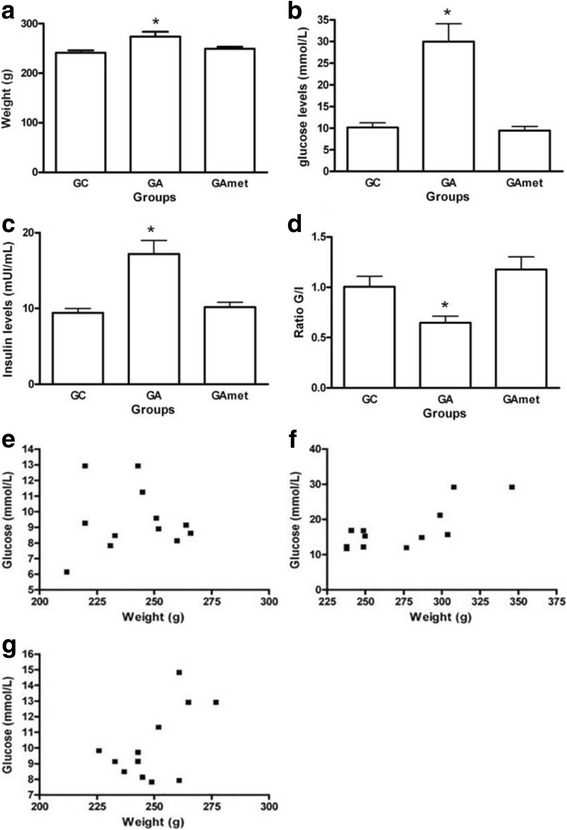
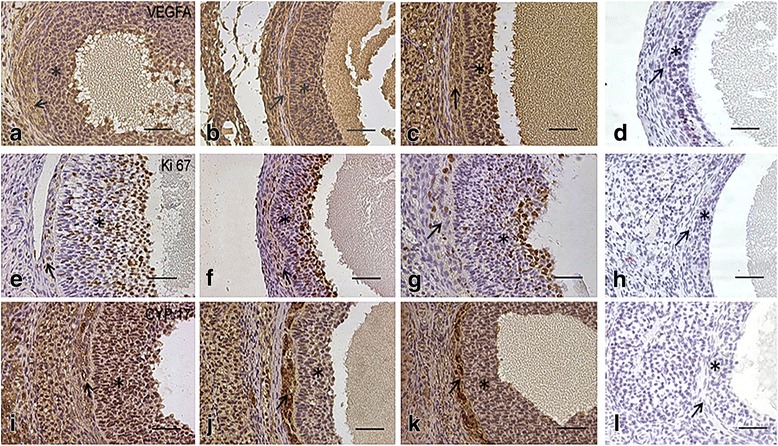
The comparison of the GA and GAmet animals revealed that metformin decreased the weight as well as the glucose and insulin levels, slowed the proliferation of the theca interna and interstitial cells, as evidenced by Ki-67 and VEGF-A expression, and diminished CYP17 expression in the analyzed ovarian structures. In addition, metformin reduced the number of degenerating follicles and interstitial cells and improved angiogenesis.
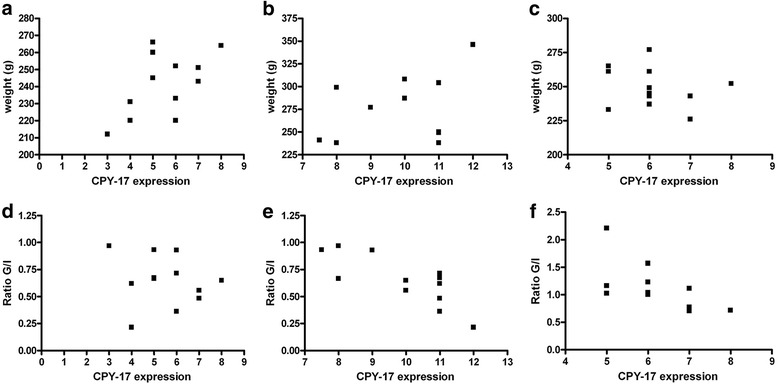
Metformin improves the carbohydrate metabolism, reduces proliferation, and decreases CYP-17 expression in the follicular structures of androgenized rats.
二甲双胍会影响胰岛素受体信号转导,这可能会干扰卵巢卵泡结构和类固醇生成。我们假设降低葡萄糖和胰岛素水平可能会干扰雄激素化大鼠模型中 CYP-17 的表达和组织形态学变化。本研究旨在分析二甲双胍对新生期雄激素化雌性大鼠 CYP-17 表达、卵泡动力学和增殖参数的影响。
36 只新生大鼠在出生后第 3 天随机分为以下三组:对照组(CG,n=12)、雄激素化组(GA,n=12)和雄激素化+二甲双胍组(GAmet,n=12)。GA 和 GAmet 组动物一次性给予 0.1 mL 己酸孕酮(1.25mg/动物)稀释于蓖麻油(载体)中;CG 组大鼠背部皮下注射载体。90 天后开始灌胃治疗,CG 和 GA 组给予蒸馏水,GAmet 组给予二甲双胍(150mg/kg)。治疗每天进行 6 周。麻醉后采血进行生化测量,并切除卵巢进行 Ki67、VEGFA 和 CYP17 表达的组织学和免疫组织化学分析。还测量了血糖和胰岛素水平。
GA 和 GAmet 动物的比较表明,二甲双胍降低了体重以及血糖和胰岛素水平,通过 Ki-67 和 VEGF-A 表达减缓了间质细胞和间质细胞的增殖,并降低了分析卵巢结构中的 CYP17 表达。此外,二甲双胍减少了退化卵泡和间质细胞的数量,并改善了血管生成。
二甲双胍改善了雄激素化大鼠的碳水化合物代谢,降低了增殖,并降低了卵泡结构中的 CYP-17 表达。