Husted Gitte Reventlov, Weis Janne, Teilmann Grete, Castensøe-Seidenfaden Pernille
Pediatric and Adolescent Department, Nordsjællands Hospital, University of Copenhagen, Hillerød, Denmark.
Department of Neonatology, Rigshospitalet, University of Copenhagen, Copenhagen, Denmark.
JMIR Mhealth Uhealth. 2018 Feb 28;6(2):e43. doi: 10.2196/mhealth.8876.
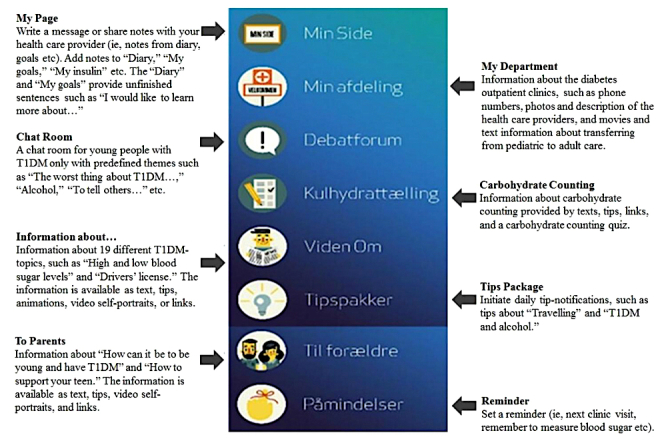
Adequate self-management is the cornerstone of preventing type 1 diabetes mellitus (T1DM) complications. However, T1DM self-management is challenging for young people, who often struggle during the transition from childhood to adulthood. The mobile health (mHealth) app Young with Diabetes (YWD) was developed in collaboration with young people to enhance their T1DM self-management during this transition.
The purpose of this study was to explore the influence of YWD on young people's self-management during a 12-month period.
A qualitative explorative approach was used, comprising a purposive sample of 20 young people (11 females and 9 males, ages 15 to 23 years, with app use of 3 to 64 days) from 3 pediatric and 3 adult departments. Participants were interviewed individually using a semistructured interview guide. Data were collected from January to March 2017 and analyzed using thematic analysis.
A total of 5 themes were identified: (1) not feeling alone anymore ("we are in this together"); (2) gaining competence by sharing experiences and practical knowledge ("they know what they are talking about"); (3) feeling safer ("it's just a click away"); (4) breaking the ice by starting to share thoughts and feelings and asking for help ("it is an outstretched hand"); and (5) lack of motivating factors ("done with the app"). Young people reported that YWD promoted self-management by peer-to-peer social support, exchanging messages with health care providers, and sharing YWD with parents. Participants recommended YWD as a supplement to self-management for newly diagnosed young people with T1DM and suggested improvements in app content and functionality.
The mHealth app YWD has the potential to support self-management. In particular, peer-to-peer support reduced feelings of loneliness and helped young people to gain knowledge and skills for managing T1DM. A need exists for alternative ways to train health care providers in using YWD and to support collaboration between young people and their parents to further improve young people's self-management of T1DM.
充分的自我管理是预防1型糖尿病(T1DM)并发症的基石。然而,T1DM自我管理对年轻人来说具有挑战性,他们在从童年向成年过渡期间常常遇到困难。移动健康(mHealth)应用程序“糖尿病青年(YWD)”是与年轻人合作开发的,旨在在这一过渡期间增强他们的T1DM自我管理能力。
本研究的目的是探讨YWD在12个月期间对年轻人自我管理的影响。
采用定性探索性方法,从3个儿科和3个成人科室选取了20名年轻人(11名女性和9名男性,年龄15至23岁,使用该应用程序3至64天)作为目的抽样。使用半结构化访谈指南对参与者进行单独访谈。数据于2017年1月至3月收集,并采用主题分析法进行分析。
共确定了5个主题:(1)不再感到孤单(“我们同舟共济”);(2)通过分享经验和实用知识获得能力(“他们知道自己在说什么”);(3)感觉更安全(“只需点击一下即可”);(4)通过开始分享想法和感受以及寻求帮助打破僵局(“这是一只伸出的援手”);(5)缺乏激励因素(“不再使用该应用程序”)。年轻人报告称,YWD通过同伴间的社会支持、与医疗保健提供者交换信息以及与父母分享YWD来促进自我管理。参与者推荐YWD作为新诊断的T1DM年轻患者自我管理的补充,并建议改进应用程序的内容和功能。
移动健康应用程序YWD有支持自我管理的潜力。特别是,同伴支持减少了孤独感,并帮助年轻人获得了管理T1DM的知识和技能。需要有其他方法来培训医疗保健提供者使用YWD,并支持年轻人与其父母之间的合作,以进一步改善年轻人对T1DM的自我管理。