Müller Klaus, Smielik Ievgen, Hütwohl Jan-Marco, Gierszewski Stefanie, Witte Klaudia, Kuhnert Klaus-Dieter
Department of Electrical Engineering & Computer Science, Institute of Real-Time Learning Systems, University of Siegen, Hölderlinstraße 3, Siegen, 57076, GermanyResearch Group of Ecology and Behavioral Biology, Institute of Biology, University of Siegen, Adolf-Reichwein-Straße 2, Siegen, 57068, Germany.
Curr Zool. 2017 Feb;63(1):55-64. doi: 10.1093/cz/zow106. Epub 2016 Nov 3.
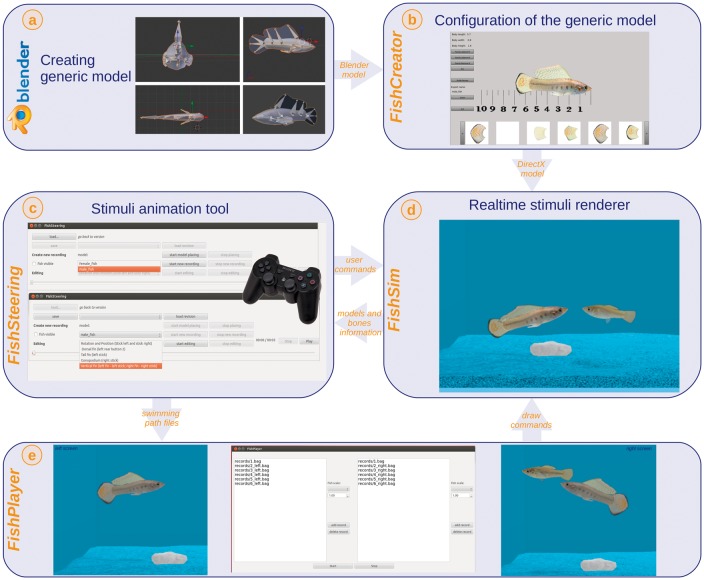
Animal behavior researchers often face problems regarding standardization and reproducibility of their experiments. This has led to the partial substitution of live animals with artificial virtual stimuli. In addition to standardization and reproducibility, virtual stimuli open new options for researchers since they are easily changeable in morphology and appearance, and their behavior can be defined. In this article, a novel toolchain to conduct behavior experiments with fish is presented by a case study in sailfin mollies . As the toolchain holds many different and novel features, it offers new possibilities for studies in behavioral animal research and promotes the standardization of experiments. The presented method includes options to design, animate, and present virtual stimuli to live fish. The designing tool offers an easy and user-friendly way to define size, coloration, and morphology of stimuli and moreover it is able to configure virtual stimuli randomly without any user influence. Furthermore, the toolchain brings a novel method to animate stimuli in a semiautomatic way with the help of a game controller. These created swimming paths can be applied to different stimuli in real time. A presentation tool combines models and swimming paths regarding formerly defined playlists, and presents the stimuli onto 2 screens. Experiments with live sailfin mollies validated the usage of the created virtual 3D fish models in mate-choice experiments.
动物行为研究人员在其实验的标准化和可重复性方面常常面临问题。这导致了用人工虚拟刺激部分替代活体动物。除了标准化和可重复性之外,虚拟刺激为研究人员开辟了新的选择,因为它们在形态和外观上易于改变,并且其行为可以被定义。在本文中,通过帆鳍茉莉鱼的案例研究展示了一种用于进行鱼类行为实验的新型工具链。由于该工具链具有许多不同的新颖特性,它为动物行为研究提供了新的可能性,并促进了实验的标准化。所展示的方法包括设计、制作动画以及向活鱼呈现虚拟刺激的选项。设计工具提供了一种简单且用户友好的方式来定义刺激的大小、颜色和形态,而且它能够在没有任何用户干预的情况下随机配置虚拟刺激。此外,该工具链带来了一种借助游戏控制器以半自动方式为刺激制作动画的新方法。这些创建的游动路径可以实时应用于不同的刺激。呈现工具根据先前定义的播放列表将模型和游动路径组合起来,并将刺激呈现到两个屏幕上。用活的帆鳍茉莉鱼进行的实验验证了所创建的虚拟3D鱼模型在配偶选择实验中的用途。