Osio Amélie, Xu Shuo, El Bouchtaoui Morad, Leboeuf Christophe, Gapihan Guillaume, Lemaignan Christine, Bousquet Guilhem, Lebbé Céleste, Janin Anne, Battistella Maxime
Pathology Department, Hôpital St Louis, APHP, Paris, France.
Université Paris Diderot, Inserm, UMR_S1165, Paris, France.
Oncotarget. 2018 Jan 3;9(9):8478-8488. doi: 10.18632/oncotarget.23899. eCollection 2018 Feb 2.
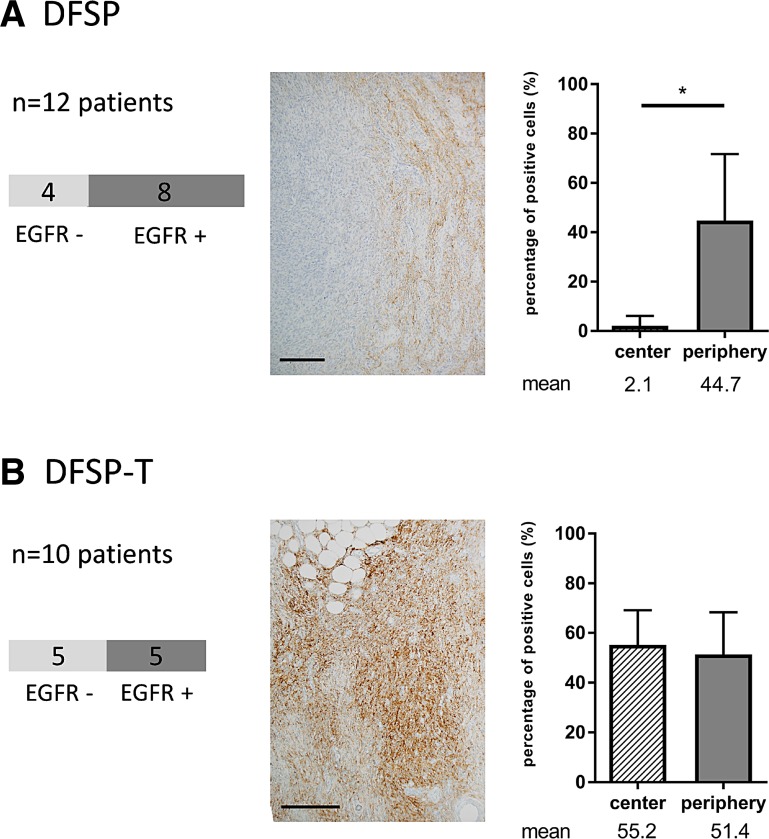
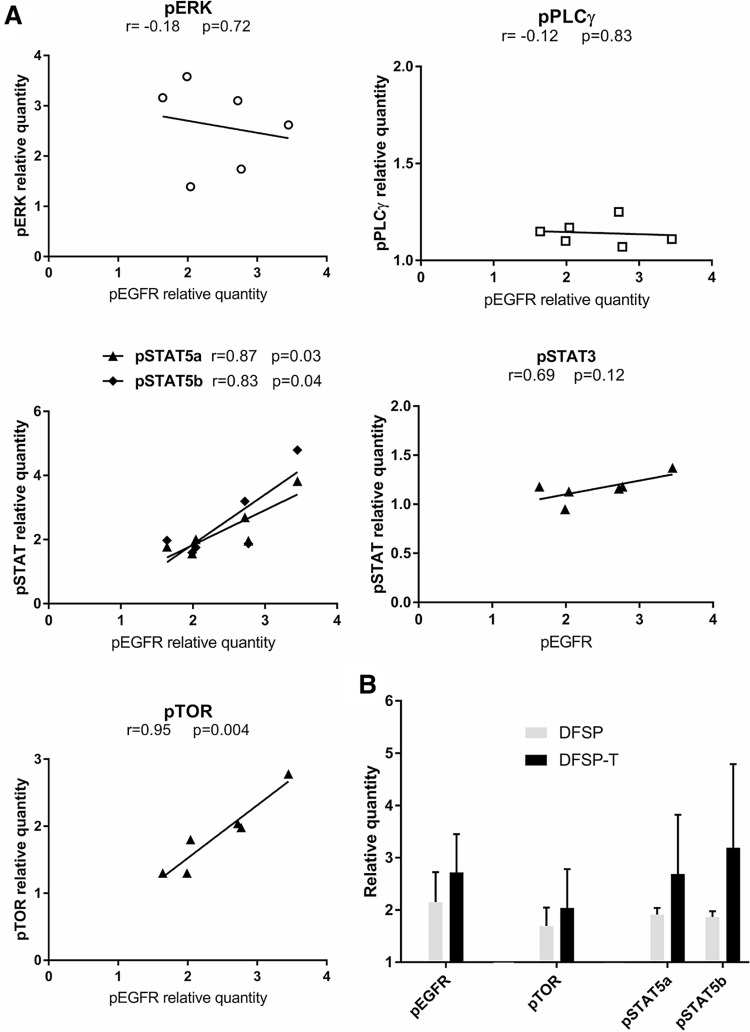
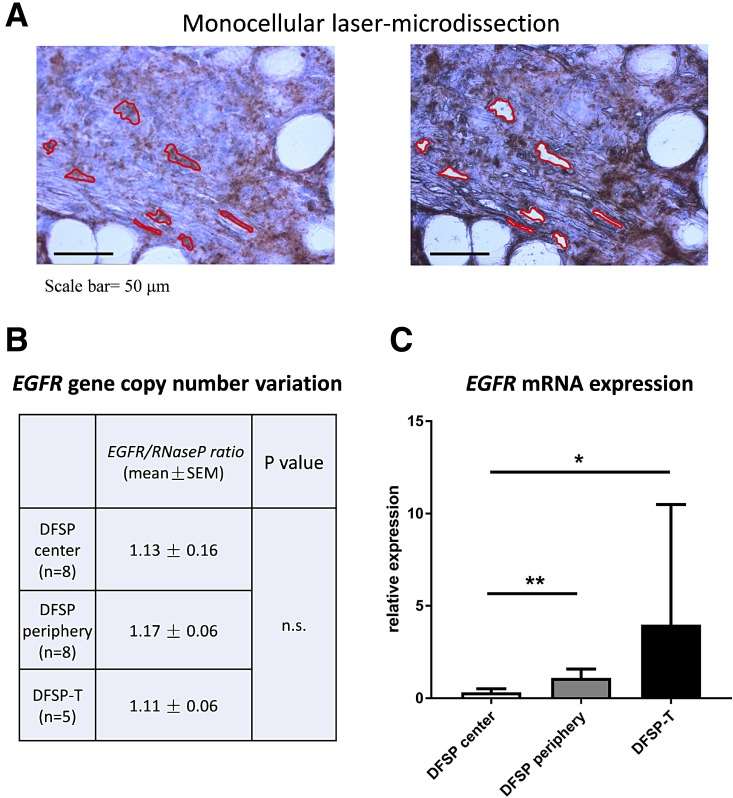
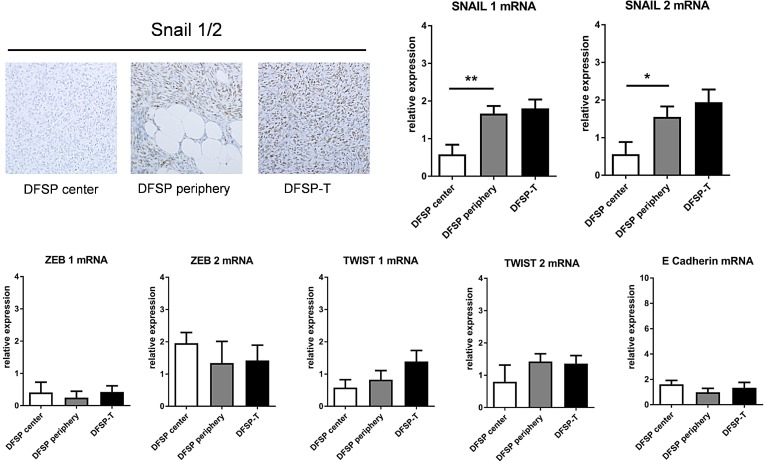
Dermatofibrosarcoma protuberans (DFSP), amounting to 6% of all soft tissue sarcomas, has a slow growth rate, contrasting with a likelihood for local recurrence and a 10-20% evolution to higher-grade sarcoma, or "transformed DFSP" (DFSP-T). At molecular level, the characteristic COL1A1-PDGFB rearrangement, leading to sustained PDGFR signaling, is not linked to the evolutive potential. Here, we studied EGFR, another tyrosine kinase receptor, using laser-microdissection to select the different histologic components of DFSP (DFSP center, DFSP infiltrative periphery, DFSP-T higher-grade sarcoma), in 22 patients followed over 3 to 156 months. EGFR protein and mRNA were expressed in 13/22 patients with DFSP or DFSP-T, and increased with tumor progression, both in microdissected areas of higher-grade sarcomas and in microdissected areas of local extension. No cancer-associated gene mutation or copy-number variation, nor any hotspot mutations were found in any microdissected area. Among epithelial-mesenchymal transition factors tested, SNAIL 1/2 had the same expression pattern as EGFR while ZEB1/2 or TWIST1/2 did not. Using a proteome profiler phospho-kinase array on 3 DFSP and 3 DFSP-T cryopreserved tissue samples, EGFR phosphorylation was detected in each case. Among EGFR downstream pathways, we found positive correlations between phosphorylation levels of EGFR and STAT5a/b (r = 0.87, < 0.05) and TOR (r = 0.95, < 0.01), but not ERK in the MAPK pathway (r = -0.18, > 0.70). We thus demonstrated that in DFSP evolution to high grade sarcoma, EGFR and SNAIL were involved, with EGFR activation and signaling through TOR and STAT5a/b downstream effectors, which could lead on to new therapies for advanced DFSP.
隆突性皮肤纤维肉瘤(DFSP)占所有软组织肉瘤的6%,生长缓慢,但有局部复发的可能,且有10% - 20%的几率演变为高级别肉瘤,即“转化型DFSP”(DFSP - T)。在分子水平上,导致PDGFR信号持续的特征性COL1A1 - PDGFB重排与演变潜能并无关联。在此,我们研究了另一种酪氨酸激酶受体EGFR,通过激光显微切割选取DFSP的不同组织学成分(DFSP中心、DFSP浸润边缘、DFSP - T高级别肉瘤),对22例患者进行了3至156个月的随访。EGFR蛋白和mRNA在13/22例DFSP或DFSP - T患者中表达,并随肿瘤进展而增加,在高级别肉瘤的显微切割区域以及局部扩展的显微切割区域均是如此。在任何显微切割区域均未发现与癌症相关的基因突变或拷贝数变异,也未发现任何热点突变。在所检测的上皮 - 间质转化因子中,SNAIL 1/2与EGFR具有相同的表达模式,而ZEB1/2或TWIST1/2则不然。使用蛋白质组分析磷酸激酶阵列对3份DFSP和3份DFSP - T冷冻保存组织样本进行检测,每份样本均检测到EGFR磷酸化。在EGFR下游通路中,我们发现EGFR与STAT5a/b的磷酸化水平之间存在正相关(r = 0.87,P < 0.05)以及与TOR存在正相关(r = 0.95,P < 0.01),但在MAPK通路中与ERK不存在正相关(r = -0.18,P > 0.70)。因此,我们证明在DFSP演变为高级别肉瘤的过程中,EGFR和SNAIL参与其中,EGFR通过TOR和STAT5a/b下游效应器激活并发出信号,这可能会带来针对晚期DFSP的新疗法。