Programa de Recerca en Càncer, Institut Hospital del Mar d'Investigacions Mèdiques, Barcelona, Spain.
Servicio de Anatomía Patológica, Fundación Jiménez Díaz, Madrid, Spain.
Neoplasia. 2014 May;16(5):413-21. doi: 10.1016/j.neo.2014.05.002. Epub 2014 Jun 16.
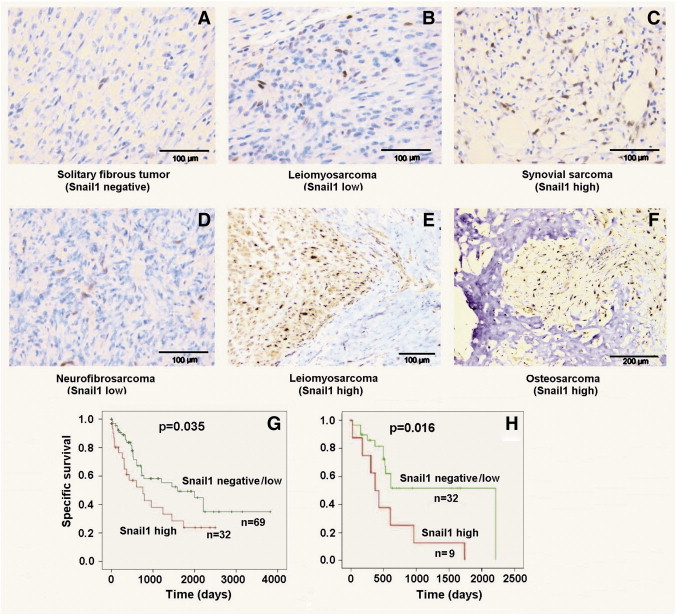
Snail1 transcriptional repressor is a major inducer of epithelial-to mesenchymal transition but is very limitedly expressed in adult animals. We have previously demonstrated that Snail1 is required for the maintenance of mesenchymal stem cells (MSCs), preventing their premature differentiation. Now, we show that Snail1 controls the tumorigenic properties of mesenchymal cells. Increased Snail1 expression provides tumorigenic capabilities to fibroblastic cells; on the contrary, Snail1 depletion decreases tumor growth. Genetic depletion of Snail1 in MSCs that are deficient in p53 tumor suppressor downregulates MSC markers and prevents the capability of these cells to originate sarcomas in immunodeficient SCID mice. Notably, an analysis of human sarcomas shows that, contrarily to epithelial tumors, these neoplasms display high Snail1 expression. This is particularly clear for undifferentiated tumors, which are associated with poor outcome. Together, our results indicate a role for Snail1 in the generation of sarcomas.
蜗牛 1 转录阻遏物是上皮细胞向间充质转化的主要诱导物,但在成年动物中表达非常有限。我们之前已经证明,Snail1 对于维持间充质干细胞(MSCs)是必需的,可以防止它们过早分化。现在,我们发现 Snail1 控制间充质细胞的致瘤特性。Snail1 表达增加为成纤维细胞提供了致瘤能力;相反,Snail1 的耗竭会降低肿瘤的生长。在缺乏 p53 肿瘤抑制物的 MSC 中遗传耗竭 Snail1 会下调 MSC 标志物,并防止这些细胞在免疫缺陷性 SCID 小鼠中起源肉瘤。值得注意的是,对人类肉瘤的分析表明,与上皮性肿瘤相反,这些肿瘤显示出高 Snail1 表达。对于未分化的肿瘤尤其明显,这些肿瘤与不良预后相关。总之,我们的研究结果表明 Snail1 在肉瘤的发生中起作用。