Université de Reims Champagne-Ardenne UMR-I 02 INERIS-URCA-ULH SEBIO Unité Stress Environnementaux et, BIOsurveillance des milieux aquatiques UFR Sciences Exactes et Naturelles, Campus du Moulin de la Housse, BP 1039 51687 Reims CEDEX, France.
RIKILT, Wageningen Research, Akkermaalsbos 2, 6708 WB Wageningen, The Netherlands.
Toxins (Basel). 2018 Mar 1;10(3):106. doi: 10.3390/toxins10030106.
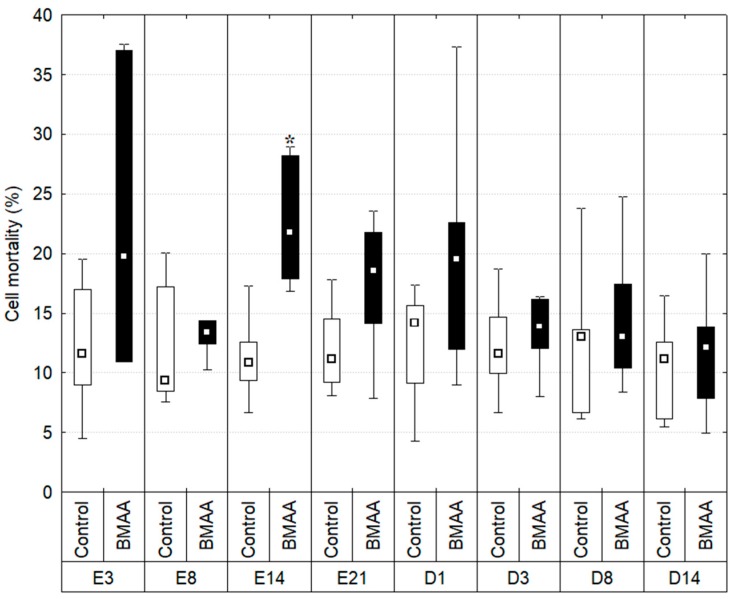
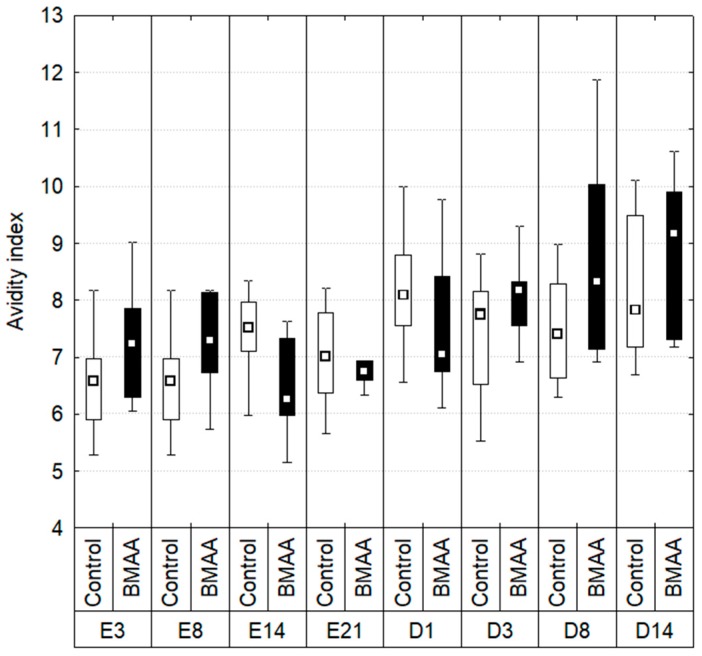
The environmental neurotoxin β--Methylamino-l-alanine (BMAA) has been pointed out to be involved in human neurodegenerative diseases. This molecule is known to be bioaccumulated by bivalves. However, little data about its toxic effects on freshwater mussels is available, particularly on the hemolymphatic compartment and its hemocyte cells involved in various physiological processes such as immune defenses, digestion and excretion, tissue repair, and shell production. Here we exposed to dissolved BMAA, at the environmental concentration of 7.5 µg of /mussel/3 days, during 21 days followed by 14 days of depuration in clear water, with the objective of assessing the BMAA presence in the hemolymphatic compartment, as well as the impact of the hemocyte cells in terms of potential cytotoxicity, immunotoxicity, and genotoxiciy. Data showed that hemocytes were in contact with BMAA. The presence of BMAA in hemolymph did not induce significant effect on hemocytes phagocytosis activity. However, significant DNA damage on hemocytes occurred during the first week (days 3 and 8) of BMAA exposure, followed by an increase of hemocyte mortality after 2 weeks of exposure. Those effects might be an indirect consequence of the BMAA-induced oxidative stress in cells. However, DNA strand breaks and mortality did not persist during the entire exposure, despite the BMAA persistence in the hemolymph, suggesting potential induction of some DNA-repair mechanisms.
环境神经毒素β-甲基氨基-L-丙氨酸(BMAA)已被指出与人类神经退行性疾病有关。这种分子已知被双壳类生物累积。然而,关于其对淡水贻贝的毒性影响的数据很少,特别是关于参与各种生理过程的血淋巴腔及其血细胞,如免疫防御、消化和排泄、组织修复和壳生产。在这里,我们将贻贝暴露于溶解的 BMAA 中,环境浓度为 7.5 µg/贻贝/3 天,持续 21 天,然后在清水中进行 14 天的净化,目的是评估 BMAA 在血淋巴腔中的存在情况,以及血细胞在潜在细胞毒性、免疫毒性和遗传毒性方面的影响。数据显示血细胞与 BMAA 接触。BMAA 在血淋巴中的存在对血细胞吞噬活性没有显著影响。然而,在 BMAA 暴露的第一周(第 3 天和第 8 天),血细胞发生了显著的 DNA 损伤,随后在暴露 2 周后,血细胞死亡率增加。这些影响可能是细胞中 BMAA 诱导的氧化应激的间接后果。然而,尽管 BMAA 持续存在于血淋巴中,但 DNA 链断裂和死亡率并没有在整个暴露期间持续存在,这表明可能诱导了一些 DNA 修复机制。