Yamamoto So, Uno Shigeyasu
Department of Electrical and Electronic Engineering, Ritsumeikan University, Kusatsu, Shiga 525-8577, Japan.
Sensors (Basel). 2018 Feb 28;18(3):730. doi: 10.3390/s18030730.
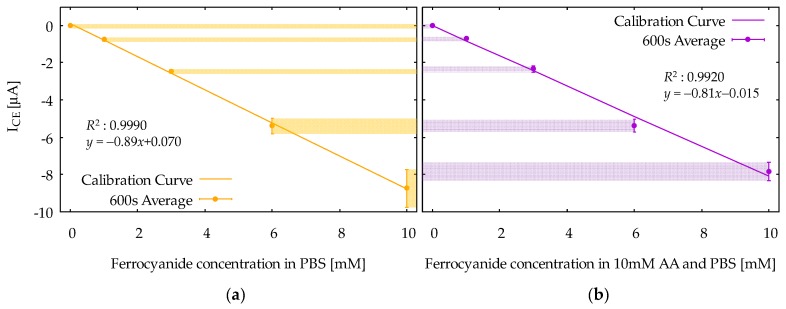
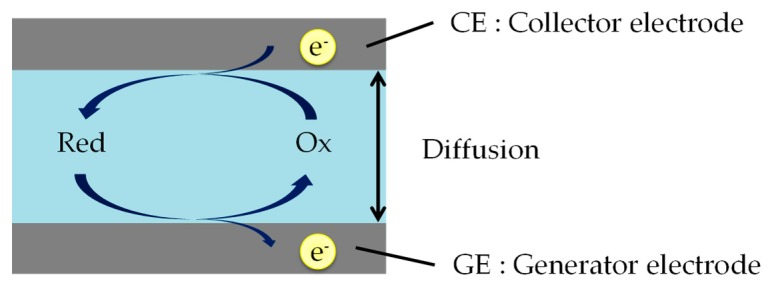
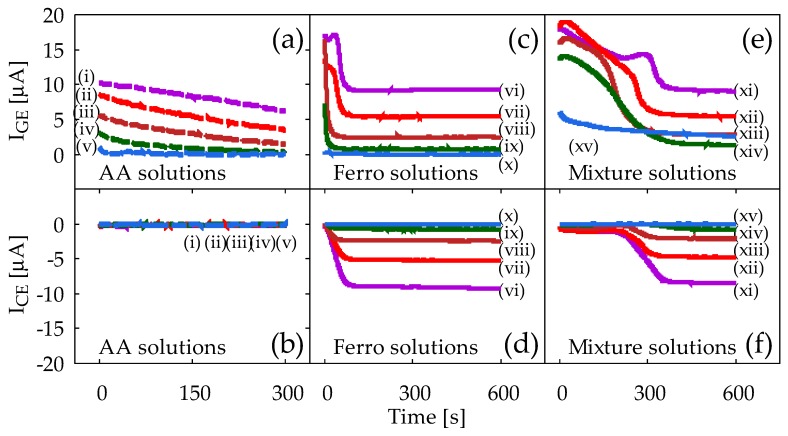
This paper describes a paper-based biochemical sensor that realizes redox cycling with close interelectrode distance. Two electrodes, the generator and collector electrodes, can detect steady-state oxidation and reduction currents when suitable potential is held at each electrode. The sensor has two gold plates on both sides of a piece of chromatography paper and defines the interelectrode distance by the thickness of the paper (180 μm) without any micro-fabrication processes. Our proposed sensor geometry has successfully exhibited signatures of redox cycling. As a result, the concentration of ferrocyanide as reversible redox molecules was successfully quantified under the interference by ascorbic acid as a strong irreversible reducing agent. This was possible because the ascorbic acids are completely consumed by the irreversible reaction, while maintaining redox cycling of reversible ferrocyanide. This suggests that a sensor based on the redox cycling method will be suitable for detecting target molecules at low concentration.
本文描述了一种基于纸张的生化传感器,该传感器通过紧密的电极间距实现氧化还原循环。两个电极,即发生器电极和收集器电极,当在每个电极上保持合适的电位时,可以检测稳态氧化电流和还原电流。该传感器在一张色谱纸的两侧有两个金板,通过纸张的厚度(180μm)来定义电极间距,无需任何微加工工艺。我们提出的传感器几何结构成功地展现出氧化还原循环的特征。结果,作为可逆氧化还原分子的亚铁氰化物浓度在作为强不可逆还原剂的抗坏血酸的干扰下被成功定量。这是可能的,因为抗坏血酸通过不可逆反应被完全消耗,同时保持可逆亚铁氰化物的氧化还原循环。这表明基于氧化还原循环方法的传感器将适用于检测低浓度的目标分子。