Department of Neurology, China Medical University Hospital, China Medical University School of Medicine, Taichung, Taiwan.
College of Medicine, China Medical University, Taichung, Taiwan.
PLoS One. 2018 Mar 2;13(3):e0193783. doi: 10.1371/journal.pone.0193783. eCollection 2018.
Idiopathic Parkinson's disease (IPD) is a progressive neurodegenerative disorder characterized by typical motor impairment. However, lower urinary tract symptoms, including urinary urgency or frequency, which are non-motor phenomena, occur frequently among patients with IPD. In this study, we assess the risk of overactive bladder (OAB) in patients with IPD.
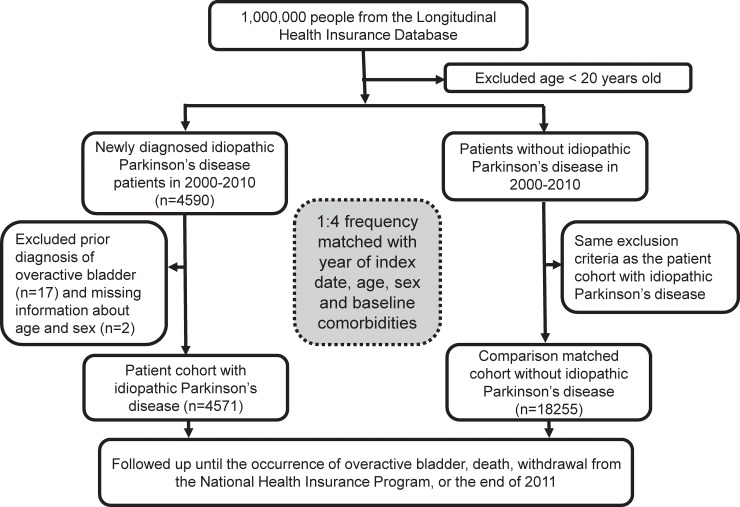
The National Health Insurance Research Database of Taiwan was used to identify patients with IPD (IPD cohort) and four-fold controls (non-IPD cohort) from 2000 to 2010. The non-IPD cohort was matched according to age, sex, and baseline comorbidities, including benign prostate hyperplasia, stress incontinence, diabetes, and cerebrovascular diseases. The occurrence of OAB was monitored until the end of 2011. Hazard ratios of OAB were estimated using Cox proportional hazards regression models.
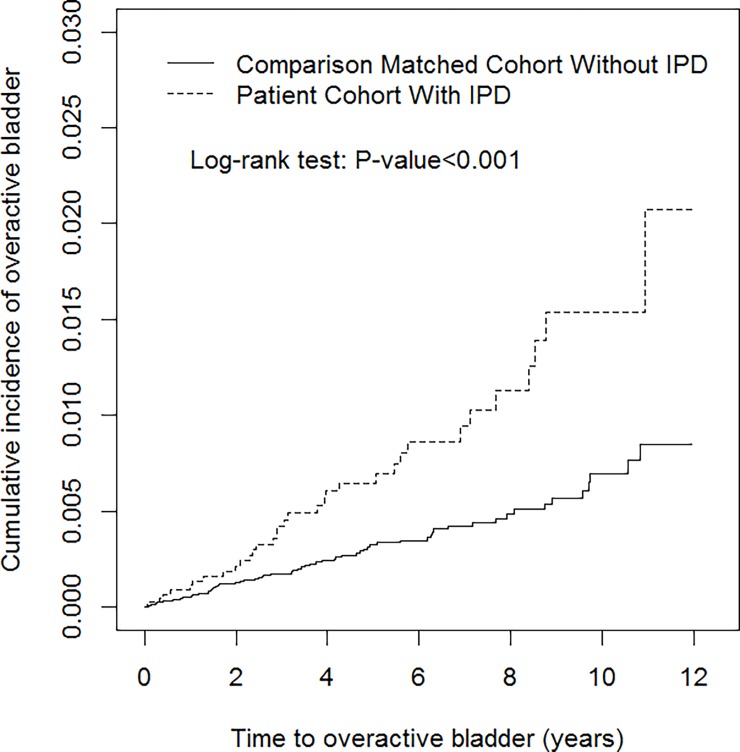
In total, 4,571 and 18,255 patients were included in IPD and non-IPD cohorts, respectively. Results showed a significantly higher overall incidence rate of OAB in the IPD cohort compared with the non-IPD cohort (14.5 vs. 6.37 per 10,000 person-years), with a 2.3-fold increased risk of OAB (95% confidence interval [CI] = 1.51-3.51) after controlling for benign prostate hyperplasia and stress incontinence. The mean follow-up period for the IPD cohort was 5.0 years. This cohort study showed that the cumulative incidence of OAB was 0.65% at the fifth year and 1.54% at the tenth year after IPD diagnosis; this risk was highest in the age group 65-74 years.
This study reveals that IPD is independently associated with an increased risk of OAB in patients with IPD. The probability of OAB was 1.54% over a 10-year period after IPD diagnosis; the risk of OAB is considered to be age-dependent and most substantial in patients aged 65-74 years.
特发性帕金森病(IPD)是一种进行性神经退行性疾病,其特征为典型的运动障碍。然而,包括尿急或尿频在内的下尿路症状(非运动现象)常发生于 IPD 患者中。本研究旨在评估 IPD 患者发生膀胱过度活动症(OAB)的风险。
本研究使用台湾全民健康保险研究数据库,于 2000 年至 2010 年期间确定了 IPD 患者(IPD 队列)和四倍对照者(非 IPD 队列)。非 IPD 队列根据年龄、性别以及基线合并症(良性前列腺增生、压力性尿失禁、糖尿病和脑血管疾病)进行匹配。OAB 的发生情况一直监测至 2011 年底。采用 Cox 比例风险回归模型估计 OAB 的风险比。
共纳入 4571 名 IPD 患者和 18255 名非 IPD 患者。结果显示,与非 IPD 队列相比,IPD 队列的 OAB 总发生率显著更高(14.5 比 6.37/10000 人年),在校正良性前列腺增生和压力性尿失禁后,OAB 的风险增加了 2.3 倍(95%置信区间[CI]:1.51-3.51)。IPD 队列的平均随访时间为 5.0 年。本队列研究显示,在 IPD 诊断后第 5 年和第 10 年,OAB 的累积发生率分别为 0.65%和 1.54%;在年龄 65-74 岁的患者中,该风险最高。
本研究表明,IPD 与 IPD 患者的 OAB 风险增加独立相关。在 IPD 诊断后 10 年内,OAB 的发生率为 1.54%;OAB 的风险被认为是年龄依赖性的,在 65-74 岁的患者中最为显著。