University of California, Davis, Department of Psychology, One Shields Ave. Davis, CA 95616, USA.
University of California, Davis, Department of Psychology, One Shields Ave. Davis, CA 95616, USA.
Horm Behav. 2019 Feb;108:94-104. doi: 10.1016/j.yhbeh.2018.02.011. Epub 2018 Mar 12.
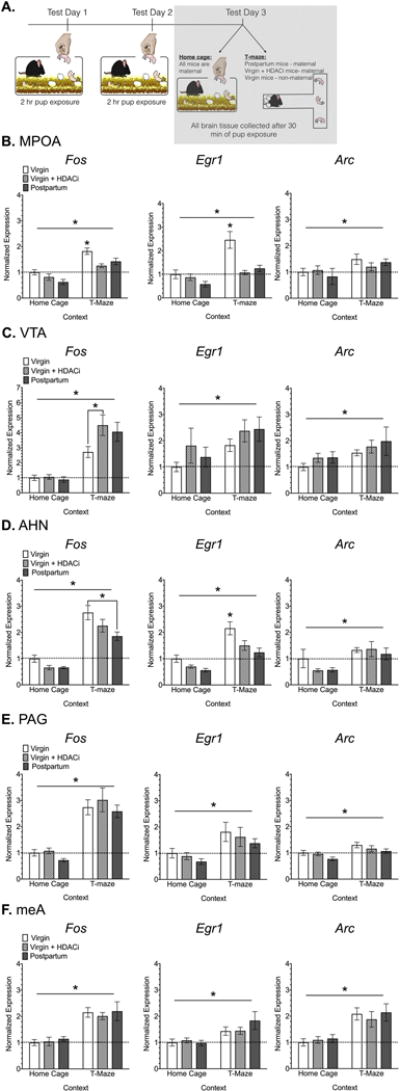
The peripartum period is associated with the onset of behaviors that shelter, feed and protect young offspring from harm. The neural pathway that regulates caregiving behaviors has been mapped in female rats and is conserved in mice. However, rats rely on late gestational hormones to shift their perception of infant cues from aversive to attractive, whereas laboratory mice are "spontaneously" maternal, but their level of responding depends on experience. For example, pup-naïve virgin female mice readily care for pups in the home cage, but avoid pups in a novel environment. In contrast, pup-experienced virgin mice care for pups in both contexts. Thus, virgin mice rely on experience to shift their perception of infant cues from aversive to attractive in a novel context. We hypothesize that alterations in immediate early gene activation may underlie the experience-driven shift in which neural pathways (fear/avoidance versus maternal/approach) are activated by pups to modulate context-dependent changes in maternal responding. Here we report that the effects of sodium butyrate, a drug that allows for an amplification of experience-induced histone acetylation and gene expression in virgins, are comparable to the natural onset of caregiving behaviors in postpartum mice and induce postpartum-like patterns of immediate early gene expression across brain regions. These data suggest that pups can activate a fear/defensive circuit in mice and experience-driven improvements in caregiving behavior could be regulated in part through decreased activation of this pathway.
围产期与行为的发生有关,这些行为可以保护幼崽免受伤害。调节养育行为的神经通路在雌性大鼠中已经被描绘出来,并在小鼠中得到了保守。然而,大鼠依赖于晚期妊娠激素来改变它们对婴儿线索的感知,从厌恶到吸引,而实验室小鼠是“自发的”母性的,但它们的反应程度取决于经验。例如,新生的未交配的雌性小鼠很容易在自己的笼子里照顾幼崽,但会避免在新环境中的幼崽。相比之下,有经验的未交配的雌性小鼠在这两种情况下都会照顾幼崽。因此,未交配的雌性小鼠依赖于经验来改变它们对婴儿线索的感知,从新环境中的厌恶到吸引。我们假设,早期基因激活的改变可能是导致神经通路(恐惧/回避与母性/接近)被幼崽激活的经验驱动转变的基础,从而调节母性行为对环境变化的依赖性。在这里,我们报告说,丁酸钠的作用,一种可以放大处女体内经验诱导的组蛋白乙酰化和基因表达的药物,与产后小鼠中养育行为的自然发生相当,并在整个大脑区域诱导产后样的早期基因表达模式。这些数据表明,幼崽可以在小鼠中激活恐惧/防御回路,而通过经验驱动改善养育行为可能部分通过该途径的激活减少来调节。