Department of Hematology, Zhongshan Hospital Fudan University, Shanghai, 200032, China.
Department of Transfusion Medicine, Zhongshan Hospital Fudan University, Shanghai, 200032, China.
J Transl Med. 2018 Mar 2;16(1):48. doi: 10.1186/s12967-018-1424-8.
Although impaired myeloid-derived suppressor cells (MDSCs) recently have been studied in immune thrombocytopenia (ITP), another myeloid-derived cell population signified as M2 macrophages has not been investigated properly in ITP patients. In the present study, we intended to determine the features of circulating M2-like macrophages, to examine its relationship with MDSCs, and to explore their prognostic values in ITP.
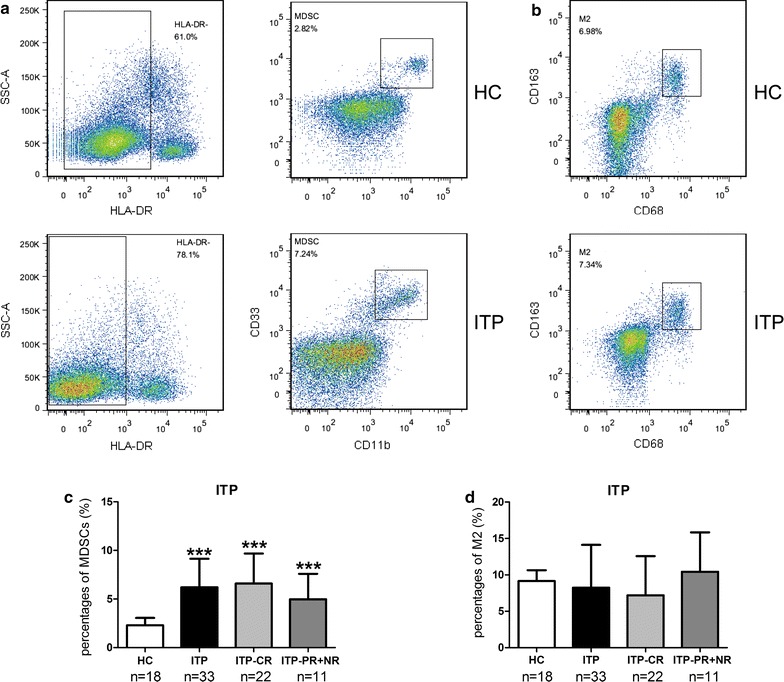
Peripheral blood mononuclear cells from healthy controls and primary ITP patients were isolated to test the circulating M2-like macrophages and MDSCs. The circulating M2-like macrophage population defined as CD68CD163 and circulating MDSC population as CD11bCD33HLA-DR were determined by flow cytometry. Plasma inflammatory cytokines were measured by multiplex ELISA.
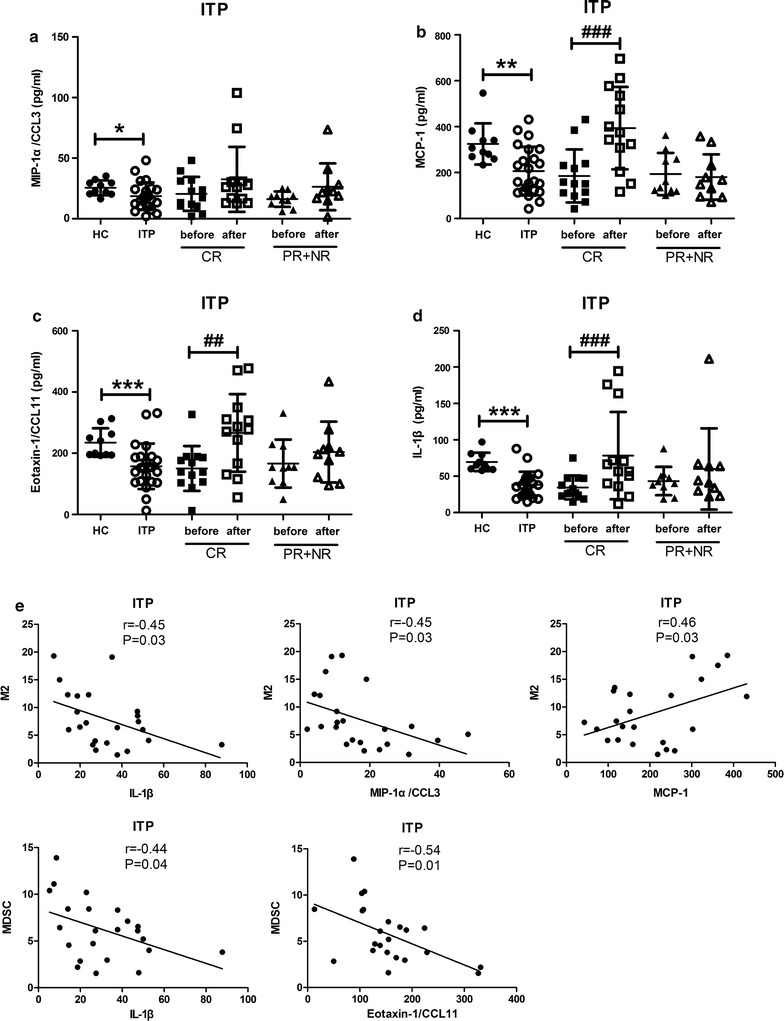
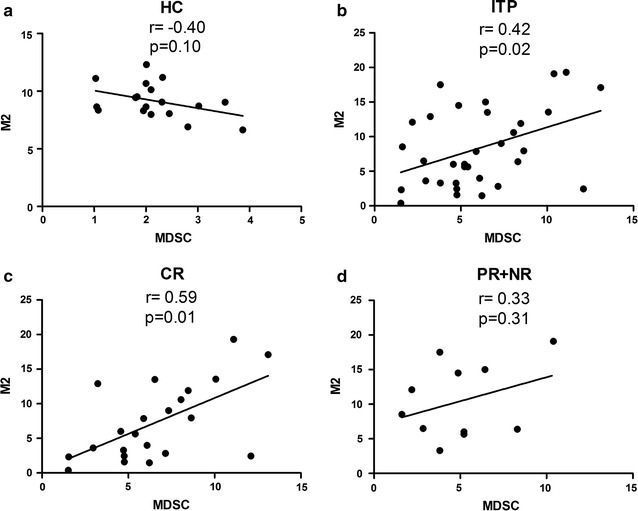
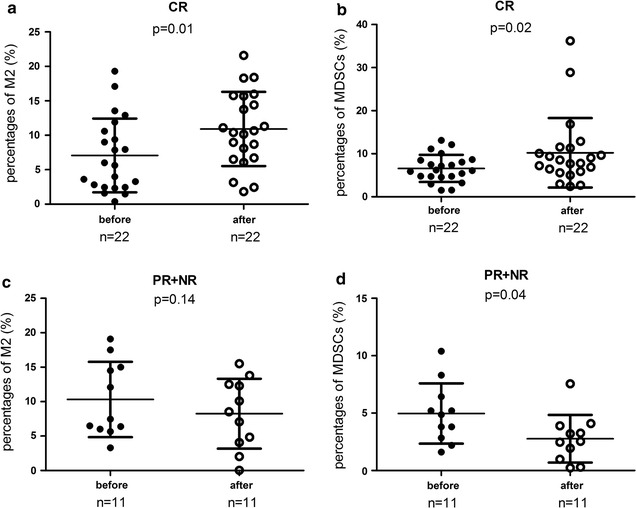
The percentages of MDSCs were found to be expanded in newly diagnosed patients of ITP, especially among those of the complete response (CR) group (p < 0.0001). Positive linear correlation was verified between percentages of M2-like macrophages and MDSCs. The same correlation was also determined in the CR group. After treatment, the percentages of M2-like macrophages and MDSCs were both increased significantly in CR group, while those patients among the PR + NR group manifested a significant numeric decrease of MDSCs but only a moderate decrease in M2-like macrophages. MIP-1α/CCL3 was negatively correlated with M2-like macrophages while MCP-1 possessed a positive correlation with M2-like macrophages, eotaxin-1/CCL11 was negatively correlated with MDSCs and interleukin-1β (IL-1β) was found to be negatively correlated with both M2-like macrophages and MDSCs.
The present findings indicated critical roles of both circulating M2-like macrophages and MDSCs in ITP. The positive correlation between them might be related to inflammatory factors-mediated bidirectional interactions or partially due to their similar background patterns during differentiation. MIP-1α/CCL3, MCP-1, eotaxin-1/CCL11 and IL-1β might play a critical role in the expansion of both M2 macrophages and MDSCs population in ITP patients, which deserves further investigation.
虽然髓系来源的抑制性细胞(MDSCs)在免疫性血小板减少症(ITP)中已得到深入研究,但另一种髓系来源的细胞群体 M2 巨噬细胞在 ITP 患者中尚未得到充分研究。在本研究中,我们旨在确定循环 M2 样巨噬细胞的特征,研究其与 MDSCs 的关系,并探讨其在 ITP 中的预后价值。
分离健康对照者和初诊 ITP 患者的外周血单个核细胞,检测循环 M2 样巨噬细胞和 MDSCs。采用流式细胞术检测循环 M2 样巨噬细胞群(CD68+CD163+)和循环 MDSC 群(CD11b+CD33+HLA-DR-)。采用多重酶联免疫吸附试验(ELISA)检测血浆炎性细胞因子。
新诊断的 ITP 患者中 MDSCs 的比例增加,尤其是完全缓解(CR)组(p<0.0001)。M2 样巨噬细胞和 MDSCs 的比例之间存在正相关。CR 组也存在同样的相关性。治疗后,CR 组 M2 样巨噬细胞和 MDSCs 的比例均显著增加,而部分 PR+NR 组的 MDSCs 数量显著减少,而 M2 样巨噬细胞仅适度减少。MIP-1α/CCL3 与 M2 样巨噬细胞呈负相关,而 MCP-1 与 M2 样巨噬细胞呈正相关,嗜酸性粒细胞趋化因子 1/CCL11 与 MDSCs 呈负相关,白细胞介素-1β(IL-1β)与 M2 样巨噬细胞和 MDSCs 均呈负相关。
本研究结果表明,循环 M2 样巨噬细胞和 MDSCs 在 ITP 中均发挥重要作用。它们之间的正相关可能与炎症因子介导的双向相互作用有关,或者部分原因是它们在分化过程中具有相似的背景模式。MIP-1α/CCL3、MCP-1、嗜酸性粒细胞趋化因子 1/CCL11 和白细胞介素-1β 可能在 ITP 患者中 M2 巨噬细胞和 MDSCs 群体的扩增中发挥关键作用,值得进一步研究。