Maldonado-Martín Sara, Jayo-Montoya Jon Ander, Matajira-Chia Tatiana, Villar-Zabala Beatriz, Goiriena Juan José, Aispuru G Rodrigo
Department of Physical Education and Sport, Faculty of Education and Sport, Physical Activity and Sport Sciences Section, University of the Basque Country (UPV/EHU), Portal de Lasarte, 71, 01007, Vitoria-Gasteiz, Araba/Álava, Basque Country, Spain.
Cardiology Department, Santiago Apóstol Hospital, Miranda de Ebro, Burgos, Spain.
Trials. 2018 Mar 2;19(1):156. doi: 10.1186/s13063-018-2529-3.
Exercise therapy has long been used for rehabilitation purposes after myocardial infarction (MI) and the benefit of regular physical exercise is also well-established. High-intensity interval training (HIIT) has been proposed to be more effective than continuous exercise for improving exercise capacity and health-related adaptations to low-volume (LV) and HIIT are also known. Furthermore, the Mediterranean diet (Mediet) has been widely reported to be a model of healthy eating for its contribution to a favorable health status and a better quality of life, reducing overall mortality. This study will investigate the effects of different HIIT programs (high-volume [HV] vs LV) and Mediet recommendations in clinical condition, cardiorespiratory fitness, biomarkers, ventricular function, and perception of quality of life after MI, and compared to an attention control group that is recommended to Mediet and physical activity without supervision sessions.
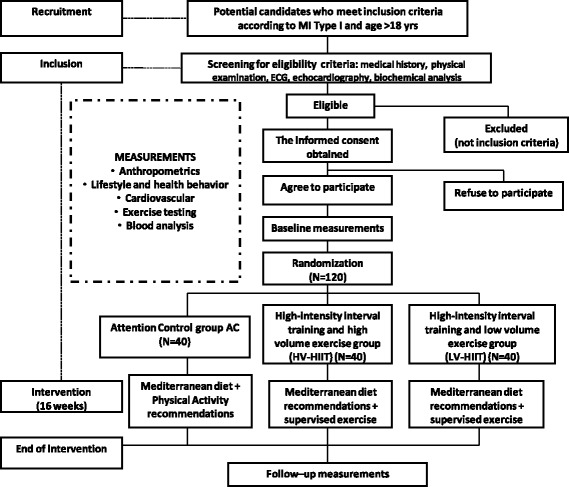
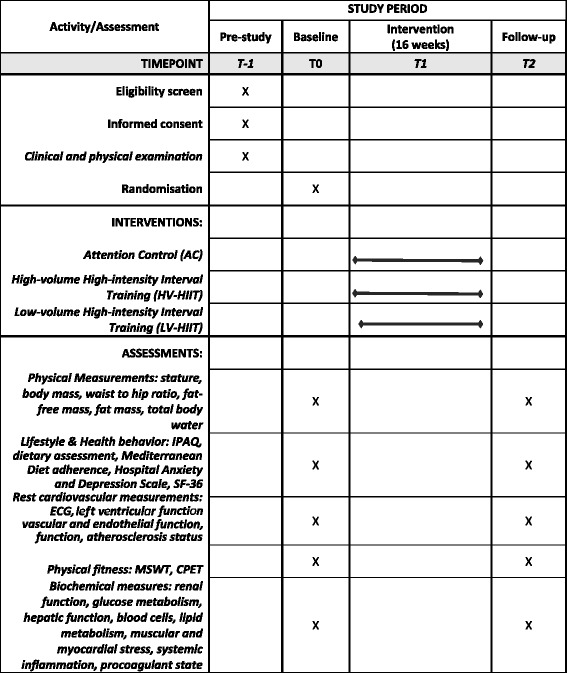
METHODS/DESIGN: In this randomized controlled trial, cardiorespiratory fitness, anthropometry, central and peripheral cardiovascular variables, biochemical and nutritional condition, and quality of life will be assessed before and after 16 weeks of intervention in 177 participants diagnosed with MI type 1. All participants will be randomly (1:1:1) assigned to the attention control group or two exercise groups (Mediet recommendations plus supervised aerobic exercise two days/week: (1) HV (40 min) HIIT group and (2) LV (20 min) HIIT group.
This study will be the first clinical trial comparing the effects of two different volumes of HIIT programs with Mediet recommendations for people after MI. The results of this study will provide good evidence for physical rehabilitation in this population.
ClinicalTrials.gov, NCT02876952 . Registered on 24 August 2016.
运动疗法长期以来一直用于心肌梗死(MI)后的康复目的,定期体育锻炼的益处也已得到充分证实。有人提出,高强度间歇训练(HIIT)在提高运动能力方面比持续运动更有效,并且低运动量(LV)和HIIT对健康相关适应的益处也为人所知。此外,地中海饮食(Mediet)因其对良好健康状况和更高生活质量的贡献、降低总体死亡率而被广泛报道为健康饮食的典范。本研究将调查不同的HIIT方案(高运动量[HV]与LV)和Mediet建议对MI后临床状况、心肺适能、生物标志物、心室功能和生活质量感知的影响,并与建议采用Mediet和无监督体育活动的注意力控制组进行比较。
方法/设计:在这项随机对照试验中,将对177名被诊断为1型MI的参与者在干预16周前后的心肺适能、人体测量、中枢和外周心血管变量、生化和营养状况以及生活质量进行评估。所有参与者将被随机(1:1:1)分配到注意力控制组或两个运动组(Mediet建议加每周两天的有监督有氧运动:(1)HV(40分钟)HIIT组和(2)LV(20分钟)HIIT组)。
本研究将是第一项比较两种不同运动量的HIIT方案与Mediet建议对MI后人群影响的临床试验。本研究结果将为该人群的身体康复提供有力证据。
ClinicalTrials.gov,NCT02876952。于2016年8月24日注册。