Senn Charlene Y, Eliasziw Misha, Hobden Karen L, Newby-Clark Ian R, Barata Paula C, Radtke H Lorraine, Thurston Wilfreda E
Department of Psychology/Women's and Gender Studies Program, University of Windsor, Windsor, Ontario, Canada.
Department of Public Health and Community Medicine, Tufts University, Boston, MA, USA.
Psychol Women Q. 2017 Jun;41(2):147-162. doi: 10.1177/0361684317690119. Epub 2017 Mar 2.
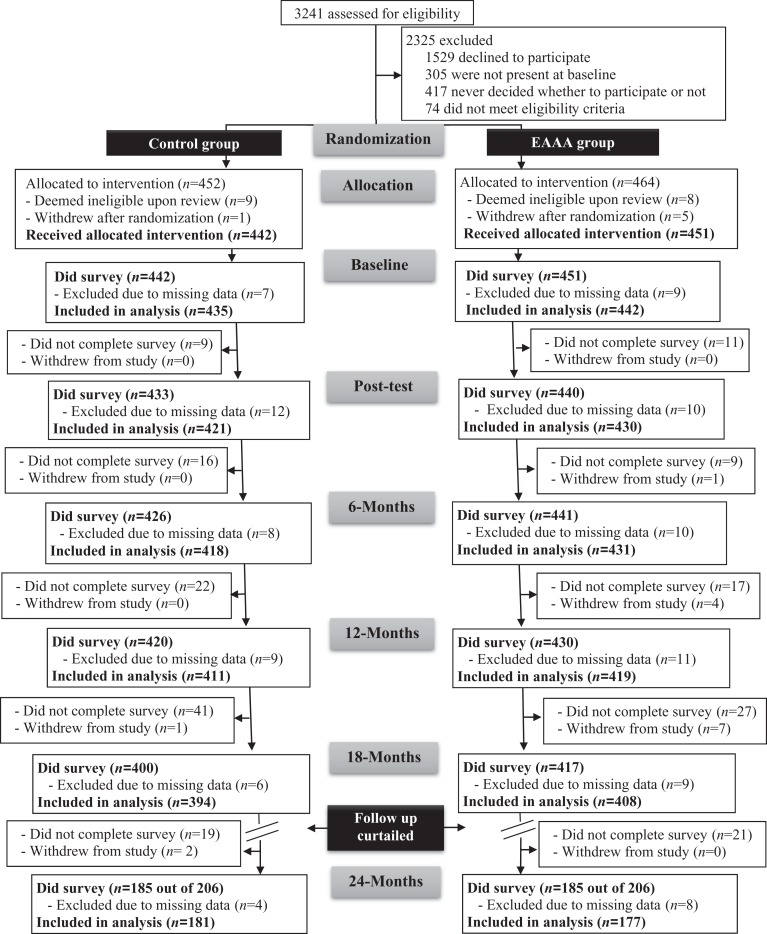
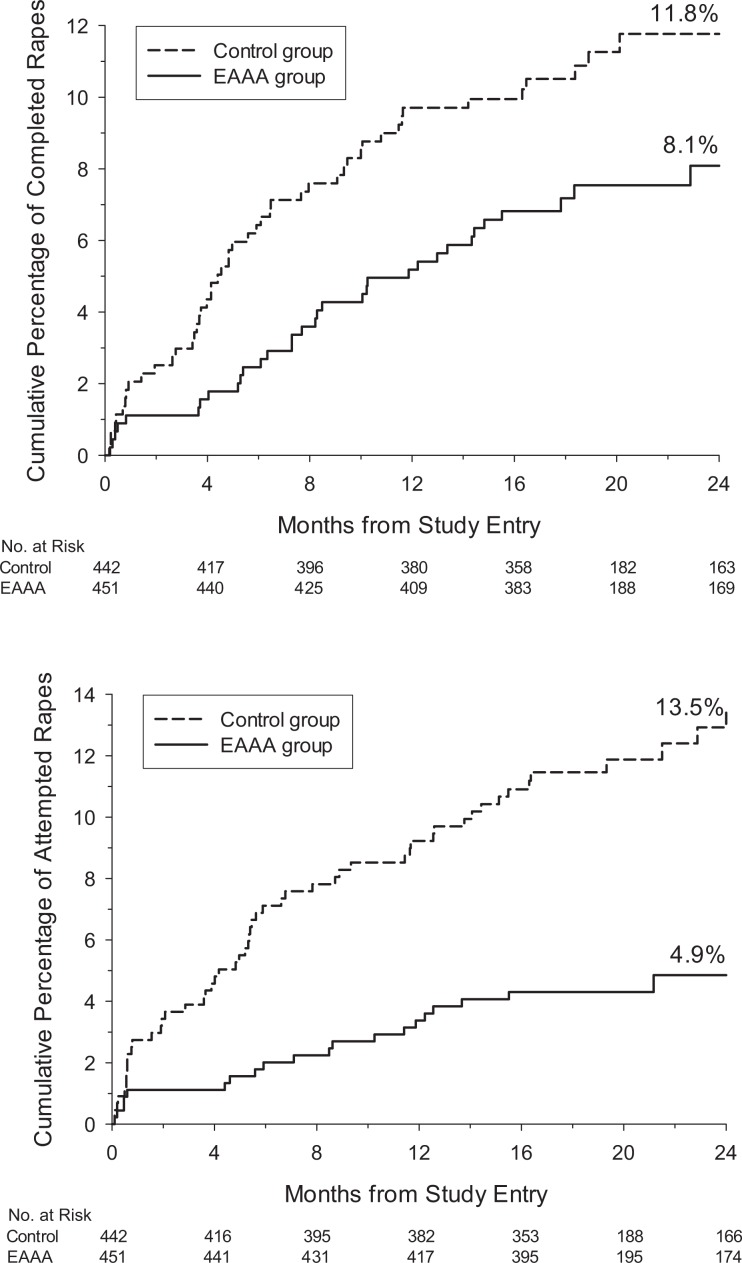
We report the secondary outcomes and longevity of efficacy from a randomized controlled trial that evaluated a novel sexual assault resistance program designed for first-year women university students. Participants ( = 893) were randomly assigned to receive the Enhanced Assess, Acknowledge, Act (EAAA) program or a selection of brochures (control). Perception of personal risk, self-defense self-efficacy, and rape myth acceptance was assessed at baseline; 1-week postintervention; and 6-, 12-, 18-, and 24-month postrandomization. Risk detection was assessed at 1 week, 6 months, and 12 months. Sexual assault experience and knowledge of effective resistance strategies were assessed at all follow-ups. The EAAA program produced significant increases in women's perception of personal risk, self-defense self-efficacy, and knowledge of effective (forceful verbal and physical) resistance strategies; the program also produced decreases in general rape myth acceptance and woman blaming over the entire 24-month follow-up period. Risk detection was significantly improved for the intervention group at post-test. The program significantly reduced the risk of completed and attempted rape, attempted coercion, and nonconsensual sexual contact over the entire follow-up period, yielding reductions between 30% and 64% at 2 years. The EAAA program produces long-lasting changes in secondary outcomes and in the incidence of sexual assault experienced by women students. Universities can reduce the harm and the negative health consequences that young women experience as a result of campus sexual assault by implementing this program. .
我们报告了一项随机对照试验的次要结果和疗效持久性,该试验评估了一项为大学一年级女生设计的新型性侵犯抵抗计划。参与者(n = 893)被随机分配接受强化评估、确认、行动(EAAA)计划或一系列宣传册(对照组)。在基线、干预后1周、随机分组后6个月、12个月、18个月和24个月评估个人风险感知、自卫自我效能感和对强奸谬见的接受程度。在1周、6个月和12个月评估风险检测情况。在所有随访中评估性侵犯经历和有效抵抗策略的知识。EAAA计划使女性对个人风险的感知、自卫自我效能感以及对有效(有力的言语和身体)抵抗策略的知识显著增加;在整个24个月的随访期内,该计划还使对强奸谬见的总体接受程度和对女性的指责减少。干预组在测试后风险检测有显著改善。在整个随访期内,该计划显著降低了既遂和未遂强奸、未遂强迫和非自愿性接触的风险,在2年时降低了30%至64%。EAAA计划在次要结果和女学生遭受性侵犯的发生率方面产生了持久的变化。大学可以通过实施该计划减少年轻女性因校园性侵犯而遭受的伤害和负面健康后果。