Beattie James, Al-Khafaji Hasanain, Noer Pernille R, Alkharobi Hanaa Esa, Alhodhodi Aishah, Meade Josephine, El-Gendy Reem, Oxvig Claus
Division of Oral Biology, Leeds School of Dentistry, Level 7 Wellcome Trust Brenner Building, University of Leeds, St James University Hospital, Leeds, United Kingdom.
Department of Molecular Biology and Genetics, Aarhus University, Aarhus, Denmark.
Front Endocrinol (Lausanne). 2018 Feb 16;9:31. doi: 10.3389/fendo.2018.00031. eCollection 2018.
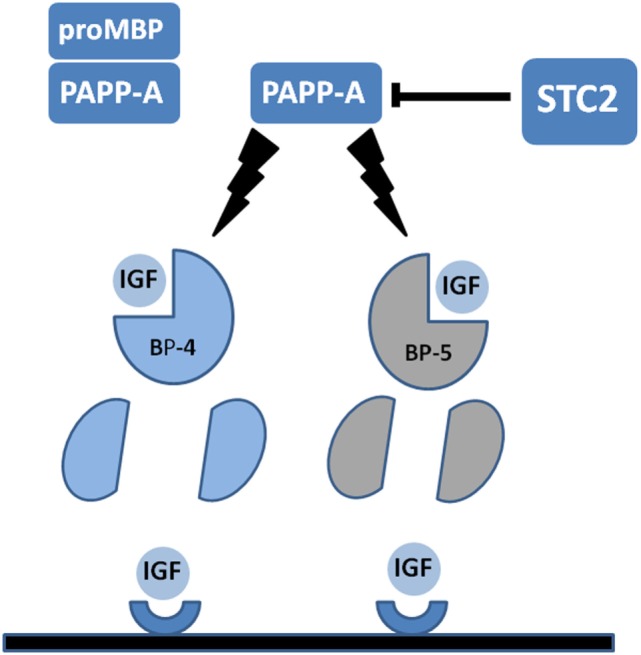
The insulin-like growth factor (IGF) axis is required for the differentiation, development, and maintenance of bone tissue. Accordingly, dysregulation of this axis is associated with various skeletal pathologies including growth abnormalities and compromised bone structure. It is becoming increasingly apparent that the action of the IGF axis must be viewed holistically taking into account not just the actions of the growth factors and receptors, but also the influence of soluble high affinity IGF binding proteins (IGFBPs).There is a recognition that IGFBPs exert IGF-dependent and IGF-independent effects in bone and other tissues and that an understanding of the mechanisms of action of IGFBPs and their regulation in the pericellular environment impact critically on tissue physiology. In this respect, a group of IGFBP proteinases (which may be considered as ancillary members of the IGF axis) play a crucial role in regulating IGFBP function. In this model, cleavage of IGFBPs by specific proteinases into fragments with lower affinity for growth factor(s) regulates the partition of IGFs between IGFBPs and cell surface IGF receptors. In this review, we examine the importance of IGFBP function in bone tissue with special emphasis on the role of pregnancy associated plasma protein-A (PAPP-A). We examine the function of PAPP-A primarily as an IGFBP-4 proteinase and present evidence that PAPP-A induced cleavage of IGFBP-4 is potentially a key regulatory step in bone metabolism. We also highlight some recent findings with regard to IGFBP-2 and IGFBP-5 (also PAPP-A substrates) function in bone tissue and briefly discuss the actions of the other three IGFBPs (-1, -3, and -6) in this tissue. Although our main focus will be in bone we will allude to IGFBP activity in other cells and tissues where appropriate.
胰岛素样生长因子(IGF)轴对于骨组织的分化、发育和维持是必需的。因此,该轴的失调与各种骨骼疾病相关,包括生长异常和骨结构受损。越来越明显的是,必须从整体上看待IGF轴的作用,不仅要考虑生长因子和受体的作用,还要考虑可溶性高亲和力IGF结合蛋白(IGFBPs)的影响。人们认识到,IGFBPs在骨骼和其他组织中发挥IGF依赖性和IGF非依赖性作用,并且了解IGFBPs的作用机制及其在细胞周围环境中的调节对组织生理学至关重要。在这方面,一组IGFBP蛋白酶(可被视为IGF轴的辅助成员)在调节IGFBP功能中起关键作用。在这个模型中,特定蛋白酶将IGFBPs切割成与生长因子亲和力较低的片段,调节IGFs在IGFBPs和细胞表面IGF受体之间的分配。在这篇综述中,我们研究了IGFBP功能在骨组织中的重要性,特别强调了妊娠相关血浆蛋白-A(PAPP-A)的作用。我们主要研究PAPP-A作为IGFBP-4蛋白酶的功能,并提供证据表明PAPP-A诱导的IGFBP-4切割可能是骨代谢中的一个关键调节步骤。我们还强调了关于IGFBP-2和IGFBP-5(也是PAPP-A的底物)在骨组织中功能的一些最新发现,并简要讨论了其他三种IGFBPs(-1、-3和-6)在该组织中的作用。虽然我们的主要重点将是骨骼,但我们也将在适当的时候提及IGFBP在其他细胞和组织中的活性。