Department of Immunobiology, Yale University School of Medicine, New Haven, CT, United States.
Front Immunol. 2018 Feb 16;9:303. doi: 10.3389/fimmu.2018.00303. eCollection 2018.
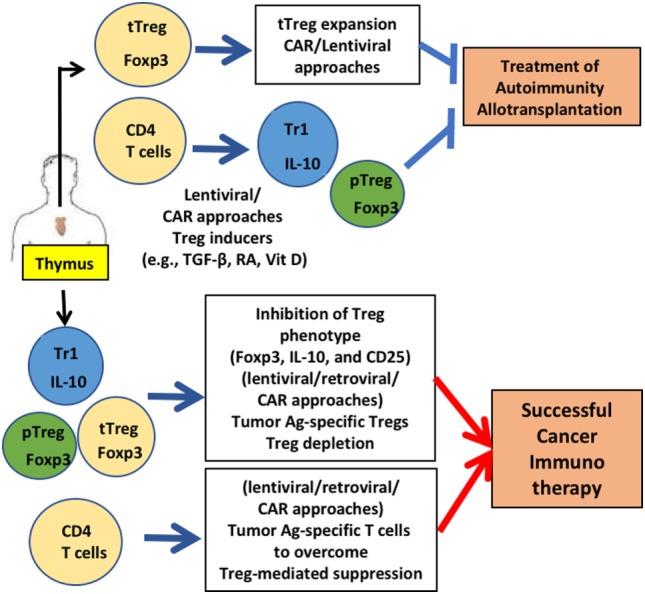
Regulatory T cells (Tregs) are an important subset of adaptive immune cells and control immune reactions for maintaining homeostasis. Tregs are generated upon their encounter with self or non-self-antigen and mediate tolerance or suppress aberrant immune responses. A high level of specificity of Tregs to recognize antigen(s) suggested their instrumental potential to treat various inflammatory diseases. This review will first introduce seminal basic research findings in the field of Tregs over the last two decades pertinent to therapeutic approaches in progress. We will then discuss the previous approaches to use Tregs for therapeutic purposes and the more recent development of gene-modification approaches. The suppressive function of Tregs has been studied intensively in clinical settings, including cancer, autoimmunity, and allotransplantation. In cancer, Tregs are often aberrantly increased in their number, and their suppressor function inhibits mounting of effective antitumor immune responses. We will examine potential approaches of using gene-modified Tregs to treat cancer. In autoimmunity and allotransplantation, chronic inflammation due to inherent genetic defects in the immune system or mismatch between organ donor and recipient results in dysfunction of Tregs, leading to inflammatory diseases or rejection, respectively. Since the recognition of antigen is a central part in Treg function and their therapeutic use, the modulation of T cell receptor specificity will be discussed. Finally, we will focus on future novel strategies employing the therapeutic potential of Tregs using gene modification to broaden our perspective.
调节性 T 细胞(Tregs)是适应性免疫细胞的一个重要亚群,可控制免疫反应以维持体内平衡。Tregs 在与自身或非自身抗原相遇时产生,并介导耐受或抑制异常免疫反应。Tregs 对识别抗原(s)具有高度特异性,这表明它们具有治疗各种炎症性疾病的潜在作用。本综述将首先介绍过去二十年中与正在进行的治疗方法相关的 Tregs 领域的重要基础研究发现。然后,我们将讨论以前用于治疗目的的 Tregs 方法和最近基因修饰方法的发展。Tregs 的抑制功能在临床环境中,包括癌症、自身免疫和同种异体移植中得到了深入研究。在癌症中,Tregs 的数量常常异常增加,其抑制功能抑制了有效的抗肿瘤免疫反应的产生。我们将研究使用基因修饰的 Tregs 治疗癌症的潜在方法。在自身免疫和同种异体移植中,由于免疫系统的固有遗传缺陷或器官供体和受体之间的不匹配导致慢性炎症,导致 Tregs 功能障碍,分别导致炎症性疾病或排斥反应。由于抗原识别是 Treg 功能及其治疗用途的核心部分,因此将讨论 T 细胞受体特异性的调节。最后,我们将重点关注使用基因修饰利用 Tregs 的治疗潜力的未来新策略,以拓宽我们的视野。