Centre for Inflammatory Diseases, Monash University Department of Medicine, Monash Medical Centre, Clayton, VIC 3168, Australia.
Int J Mol Sci. 2020 Sep 23;21(19):7015. doi: 10.3390/ijms21197015.
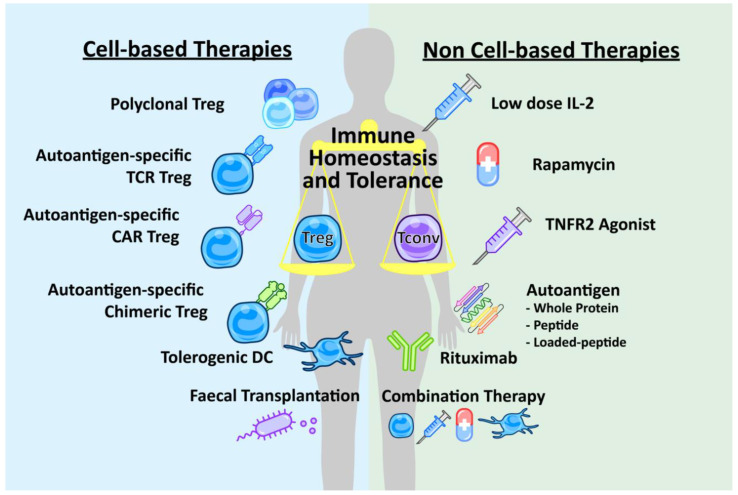
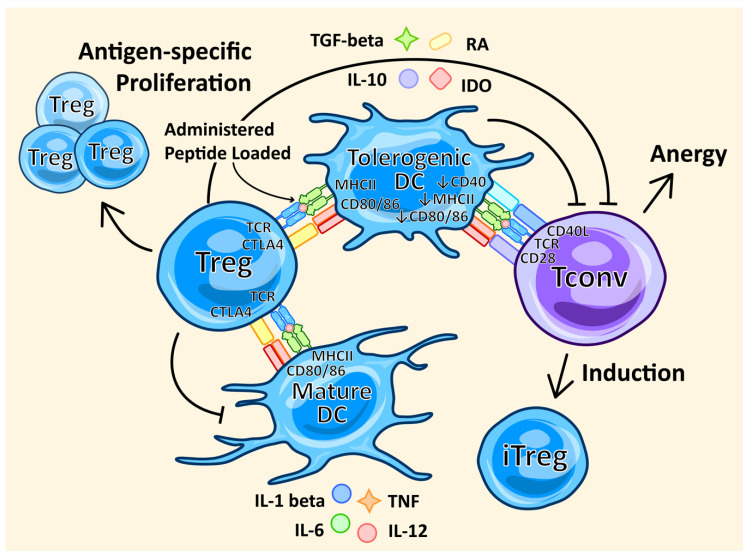
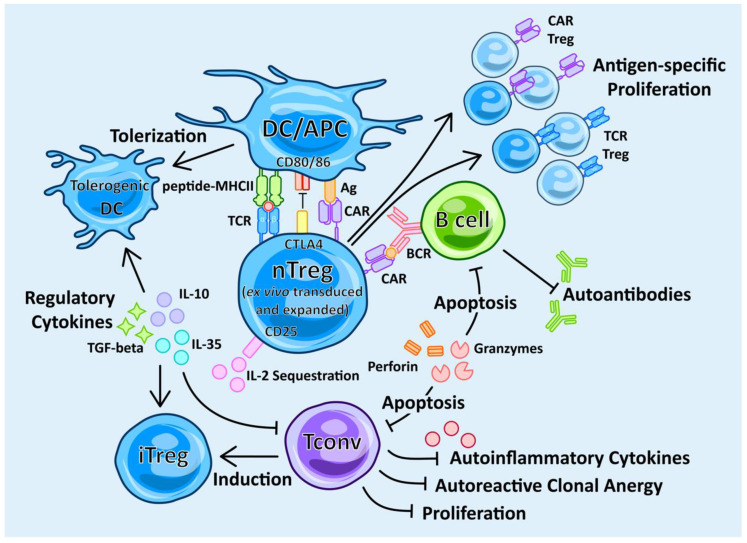
Regulatory T cells (Tregs) are a small yet critical subset of CD4+ T cells, which have the role of maintaining immune homeostasis by, for example, regulating self-tolerance, tumor immunity, anti-microbial resistance, allergy and transplantation rejection. The suppressive mechanisms by which Tregs function are varied and pleiotropic. The ability of Tregs to maintain self-tolerance means they are critical for the control and prevention of autoimmune diseases. Irregularities in Treg function and number can result in loss of tolerance and autoimmune disease. Restoring immune homeostasis and tolerance through the promotion, activation or delivery of Tregs has emerged as a focus for therapies aimed at curing or controlling autoimmune diseases. Such therapies have focused on the Treg cell subset by using drugs to suppress T effector cells and promote Tregs. Other approaches have trialed inducing tolerance by administering the autoantigen via direct administration, by transient expression using a DNA vector, or by antigen-specific nanoparticles. More recently, cell-based therapies have been developed as an approach to directly or indirectly enhance Treg cell specificity, function and number. This can be achieved indirectly by transfer of tolerogenic dendritic cells, which have the potential to expand antigen-specific Treg cells. Treg cells can be directly administered to treat autoimmune disease by way of polyclonal Tregs or Tregs transduced with a receptor with high affinity for the target autoantigen, such as a high affinity T cell receptor (TCR) or a chimeric antigen receptor (CAR). This review will discuss the strategies being developed to redirect autoimmune responses to a state of immune tolerance, with the aim of the prevention or amelioration of autoimmune disease.
调节性 T 细胞(Tregs)是 CD4+T 细胞中的一个小而关键的亚群,其作用是通过调节自身免疫耐受、肿瘤免疫、抗微生物耐药性、过敏和移植排斥等方式维持免疫稳态。Tregs 发挥功能的抑制机制多种多样且具有多效性。Tregs 维持自身耐受的能力意味着它们对于控制和预防自身免疫性疾病至关重要。Treg 功能和数量的异常可导致耐受丧失和自身免疫性疾病。通过促进、激活或输送 Tregs 来恢复免疫稳态和耐受已成为治疗自身免疫性疾病的重点。这些治疗方法侧重于 Treg 细胞亚群,通过使用药物抑制 T 效应细胞并促进 Tregs。其他方法尝试通过直接给药、使用 DNA 载体进行短暂表达或通过抗原特异性纳米颗粒来诱导耐受。最近,细胞疗法已被开发为一种直接或间接增强 Treg 细胞特异性、功能和数量的方法。这可以通过转移具有潜在扩增抗原特异性 Treg 细胞能力的耐受性树突状细胞来间接实现。Treg 细胞可以通过输注多克隆 Tregs 或转导高亲和力靶自身抗原受体(如高亲和力 T 细胞受体(TCR)或嵌合抗原受体(CAR))的 Tregs 来直接用于治疗自身免疫性疾病。这篇综述将讨论正在开发的策略,以将自身免疫反应重定向到免疫耐受状态,旨在预防或改善自身免疫性疾病。