Dermody Sarah S, McClernon F Joseph, Benowitz Neal, Luo Xianghua, Tidey Jennifer W, Smith Tracy T, Vandrey Ryan, Hatsukami Dorothy, Donny Eric C
Centre for Addiction and Mental Health.
Department of Psychiatry and Behavioral Sciences, Duke University School of Medicine.
Exp Clin Psychopharmacol. 2018 Jun;26(3):223-232. doi: 10.1037/pha0000179. Epub 2018 Mar 5.
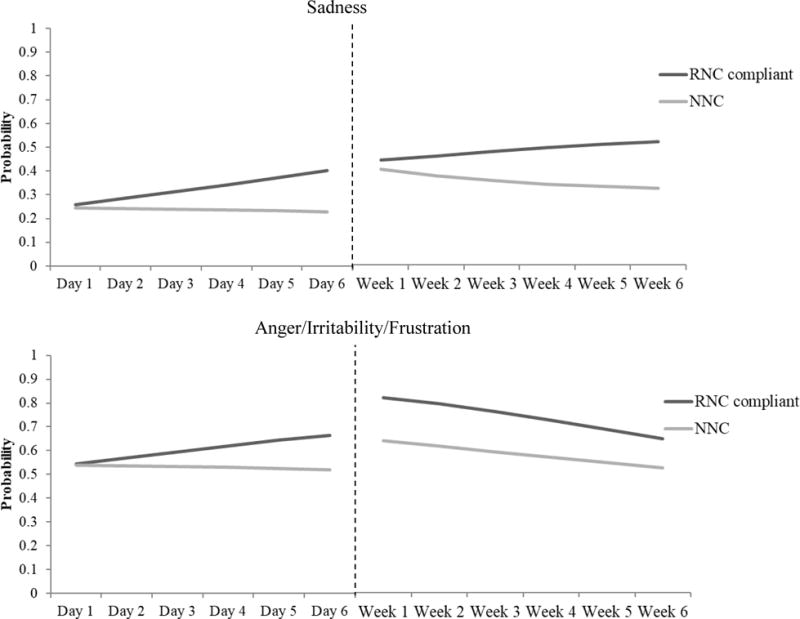
In the United States, the Food and Drug Administration (FDA) has initiated a public dialogue about reducing the nicotine content of cigarettes. A reduced-nicotine standard could increase withdrawal symptoms among current smokers. We examined the impact of switching smokers to cigarettes that varied in nicotine content on withdrawal symptoms over 6 weeks. A secondary analysis (N = 839) of a 10-site, double-blind clinical trial of nontreatment-seeking smokers was completed. Participants were instructed to smoke study cigarettes, containing 0.4 to 15.8 mg of nicotine/g of tobacco, for 6 weeks and were then abstinent overnight. Using latent growth curves, trajectories of individual withdrawal symptoms were compared between the reduced nicotine content (RNC) conditions and a normal nicotine content (NNC) condition. Path analyses compared symptoms after overnight abstinence. Relative to NNC cigarettes, participants smoking RNC cigarettes had increased anger/irritability/frustration and increased appetite/weight gain during the initial weeks, but the symptoms resolved by Week 6. Individuals who were biochemically verified as adherent with using only the 0.4 mg/g cigarettes had higher sadness levels (Cohen's d = .40) at Week 6 compared with the NNC condition, although symptoms were mild. After a post-Week 6 overnight abstinence challenge, some RNC conditions relative to NNC condition exhibited reduced withdrawal. Individuals who were biochemically confirmed as adherent to the lowest nicotine condition experienced only mild and transient symptom elevations. Thus, a reduced-nicotine standard for cigarettes produced a relatively mild and temporary increase in withdrawal among nontreatment-seeking smokers (ClinicalTrials.gov No. NCT01681875). (PsycINFO Database Record
在美国,食品药品监督管理局(FDA)已启动了一场关于降低香烟尼古丁含量的公开对话。降低尼古丁标准可能会增加当前吸烟者的戒断症状。我们研究了将吸烟者换成尼古丁含量不同的香烟对6周内戒断症状的影响。完成了一项针对10个地点、不寻求治疗的吸烟者的双盲临床试验的二次分析(N = 839)。参与者被指示吸食含0.4至15.8毫克尼古丁/克烟草的研究用香烟,为期6周,然后过夜戒烟。使用潜在增长曲线,比较了低尼古丁含量(RNC)条件和正常尼古丁含量(NNC)条件下个体戒断症状的轨迹。路径分析比较了过夜戒烟后的症状。与NNC香烟相比,吸食RNC香烟的参与者在最初几周内愤怒/易怒/沮丧情绪增加,食欲/体重增加,不过这些症状在第6周时消失。经生化验证仅使用0.4毫克/克香烟的个体在第6周时与NNC条件相比悲伤程度更高(科恩d值 = 0.40),尽管症状较轻。在第6周后的过夜戒烟挑战后,一些RNC条件与NNC条件相比戒断症状有所减轻。经生化确认坚持使用最低尼古丁条件的个体仅经历了轻微且短暂的症状升高。因此,香烟的低尼古丁标准在不寻求治疗的吸烟者中产生了相对轻微且暂时的戒断症状增加(ClinicalTrials.gov编号:NCT01681875)。(PsycINFO数据库记录