Department of Biomedical Science, Graduate School, Kyung Hee University, 26 Kyungheedae-ro, Dongdaemun-gu, Seoul 02447, Republic of Korea.
Department of Applied Chemistry, College of Applied Sciences, Kyung Hee University, Deogyeong-daero, Giheung-gu, Yongin-si, Gyeonggi-do 17104, Republic of Korea.
Oxid Med Cell Longev. 2018 Feb 4;2018:1873962. doi: 10.1155/2018/1873962. eCollection 2018.
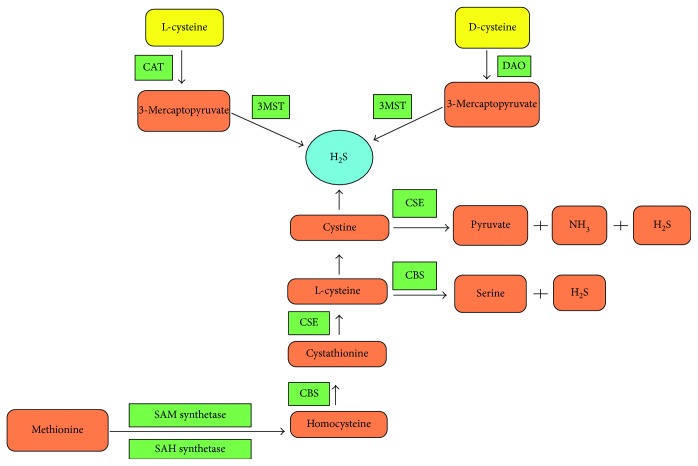
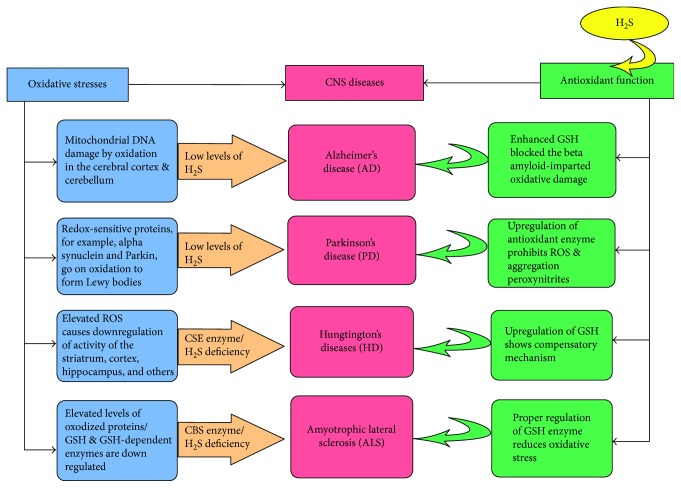
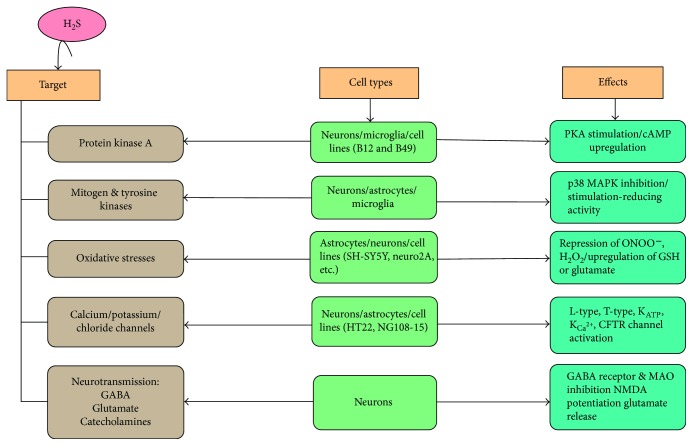
Hydrogen sulfide (HS), a toxic gaseous molecule, plays a physiological role in regulating homeostasis and cell signaling. HS is produced from cysteine by enzymes, such as cystathionine -synthase (CBS), cystathionine -lyase (CSE), cysteine aminotransferase (CAT), and 3-mercaptopyruvate sulfurtransferase (3MST). These enzymes regulate the overall production of HS in the body. HS has a cell-signaling function in the CNS and plays important roles in combating oxidative species such as reactive oxygen species (ROS) and reactive nitrogen species (RNS) in the body. HS is crucial for maintaining balanced amounts of antioxidants to protect the body from oxidative stress, and appropriate amounts of HS are required to protect the CNS in particular. The body regulates CBS, 3MST, and CSE levels in the CNS, and higher or lower levels of these enzymes cause various neurodegenerative diseases. This review discusses how HS protects the CNS by acting as an antioxidant that reduces excessive amounts of ROS and RNS. Additionally, HS regulates cell signaling to combat neuroinflammation and protect against central neurodegenerative diseases such as Alzheimer's disease (AD), Parkinson's disease (PD), Huntington's disease (HD), and amyotrophic lateral sclerosis (ALS).
硫化氢 (HS) 是一种有毒的气态分子,在调节体内平衡和细胞信号方面发挥着生理作用。HS 由胱氨酸通过胱硫醚 - 合酶 (CBS)、胱硫醚 - 裂解酶 (CSE)、半胱氨酸氨基转移酶 (CAT) 和 3-巯基丙酮酸硫转移酶 (3MST) 等酶产生。这些酶调节体内 HS 的总体产生。HS 在中枢神经系统中具有细胞信号功能,在抵抗体内的氧化物质(如活性氧 (ROS) 和活性氮 (RNS))方面发挥着重要作用。HS 对于维持抗氧化剂的平衡水平以保护身体免受氧化应激至关重要,并且需要适量的 HS 来特别保护中枢神经系统。身体调节中枢神经系统中的 CBS、3MST 和 CSE 水平,这些酶的水平过高或过低会导致各种神经退行性疾病。本综述讨论了 HS 如何通过充当抗氧化剂来减少过多的 ROS 和 RNS,从而保护中枢神经系统。此外,HS 还调节细胞信号以对抗神经炎症,并预防中枢神经退行性疾病,如阿尔茨海默病 (AD)、帕金森病 (PD)、亨廷顿病 (HD) 和肌萎缩侧索硬化症 (ALS)。