Siddique Shazia Mehmood, Lane-Fall Meghan, McConnell Matthew J, Jakhete Neha, Crismale James, Porges Stefanie, Khungar Vandana, Mehta Shivan J, Goldberg David, Li Zhiping, Schiano Thomas, Regan Linda, Orloski Clinton, Shea Judy A
Division of Gastroenterology and Hepatology Perelman School of Medicine, University of Pennsylvania Philadelphia PA.
Center for Healthcare Improvement and Patient Safety, Penn Medicine, University of Pennsylvania Philadelphia PA.
Hepatol Commun. 2018 Jan 26;2(3):237-244. doi: 10.1002/hep4.1141. eCollection 2018 Mar.
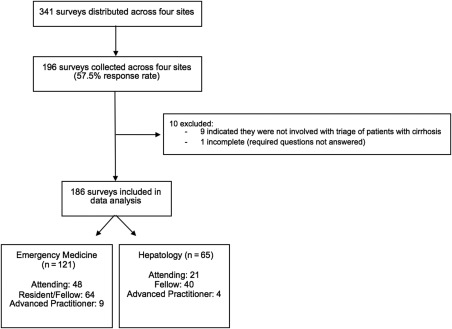
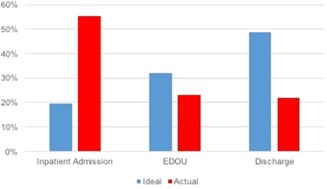
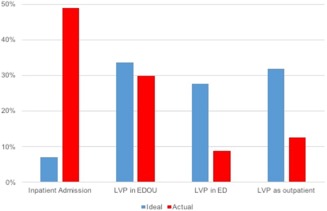
Patients with cirrhosis have high admission and readmission rates, and it is estimated that a quarter are potentially preventable. Little data are available regarding nonmedical factors impacting triage decisions in this patient population. This study sought to explore such factors as well as to determine provider perspectives on low-acuity clinical presentations to the emergency department, including ascites and hepatic encephalopathy. A survey was distributed in four liver transplant centers to both emergency medicine and hepatology providers, who included attending physicians, house staff, and advanced practitioners; 196 surveys were returned (estimated response rate 50.6%). Emergency medicine providers identified several influential nonmedical factors impacting inpatient triage decisions, including input from a hepatologist (77.7%), inadequate patient access to outpatient specialty care (68.6%), and patient need for diagnostic testing for a procedure (65.6%). When given patient-based scenarios of low-acuity cases, such as ascites requiring paracentesis, only 7.0% believed patients should be hospitalized while 48.9% said these patients would be hospitalized at their institution ( < 0.0001). For mild hepatic encephalopathy, the comparable numbers were 19.5% and 55.2%, respectively ( < 0.001). Several perceived barriers were cited for this discrepancy, including limited resources both in the outpatient setting and emergency department. Most providers believed that an emergency department observation unit protocol would influence triage toward an emergency department observation unit visit instead of inpatient admission for both ascites requiring large volume paracentesis (83.2%) and mild hepatic encephalopathy (79.4%). : Many nonmedical factors that influence inpatient triage for patients with cirrhosis could be targeted for quality improvement initiatives. In some scenarios, providers are limited by resource availability, which results in triage to an inpatient admission even when they believe this is not the most appropriate disposition. ( 2018;2:237-244).
肝硬化患者的入院和再入院率很高,据估计,四分之一的情况是有可能预防的。关于影响该患者群体分诊决策的非医疗因素,目前可用的数据很少。本研究旨在探讨这些因素,并确定医疗服务提供者对急诊科低 acuity 临床表现(包括腹水和肝性脑病)的看法。在四个肝移植中心向急诊医学和肝病学服务提供者发放了一份调查问卷,这些提供者包括主治医师、住院医生和高级执业人员;共收回 196 份调查问卷(估计回复率为 50.6%)。急诊医学服务提供者确定了几个影响住院分诊决策的有影响力的非医疗因素,包括肝病专家的意见(77.7%)、患者获得门诊专科护理的机会不足(68.6%)以及患者进行某项手术的诊断测试需求(65.6%)。当给出基于患者的低 acuity 病例场景时,如需要进行腹腔穿刺术的腹水患者,只有 7.0%的人认为患者应该住院,而 48.9%的人表示这些患者会在他们所在的机构住院(<0.0001)。对于轻度肝性脑病,相应的数字分别为 19.5%和 55.2%(<0.001)。针对这种差异列举了几个可感知的障碍,包括门诊和急诊科的资源有限。大多数服务提供者认为,急诊科观察单元协议会影响分诊,使需要进行大量腹腔穿刺术的腹水患者(83.2%)和轻度肝性脑病患者(79.4%)前往急诊科观察单元就诊而非住院。:许多影响肝硬化患者住院分诊的非医疗因素可作为质量改进举措的目标。在某些情况下,服务提供者受到资源可用性的限制,这导致即使他们认为这不是最合适的处置方式,患者仍被分诊为住院。(2018 年;2:237 - 244)