Institute for Immunity, Transplantation, and Infection, Stanford University School of Medicine, Stanford, CA, USA.
Center for Immuno-oncology, Dana-Farber Cancer Institute and Harvard Medical School, Boston, MA, USA.
J Immunother Cancer. 2018 Mar 6;6(1):18. doi: 10.1186/s40425-018-0328-8.
While immune checkpoint blockade has greatly improved clinical outcomes in diseases such as melanoma, there remains a need for predictive biomarkers to determine who will likely benefit most from which therapy. To date, most biomarkers of response have been identified in the tumors themselves. Biomarkers that could be assessed from peripheral blood would be even more desirable, because of ease of access and reproducibility of sampling.
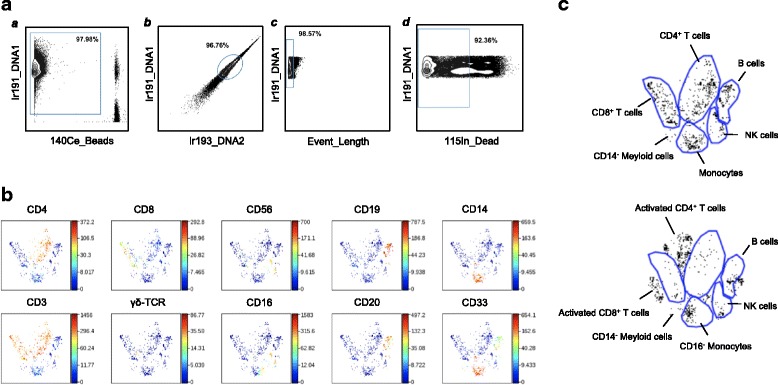
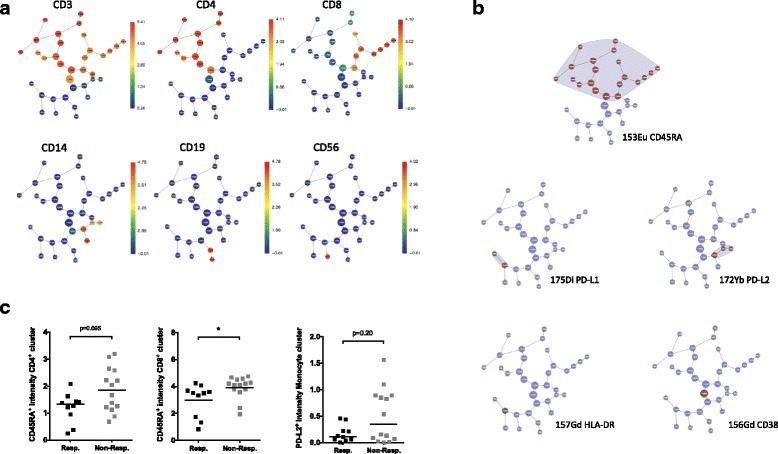
We used mass cytometry (CyTOF) to comprehensively profile peripheral blood of melanoma patients, in order to find predictive biomarkers of response to anti-CTLA-4 or anti-PD-1 therapy. Using a panel of ~ 40 surface and intracellular markers, we performed in-depth phenotypic and functional immune profiling to identify potential predictive biomarker candidates.
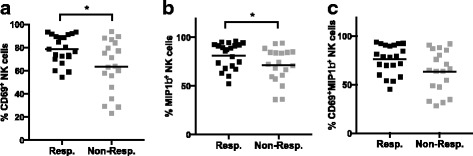
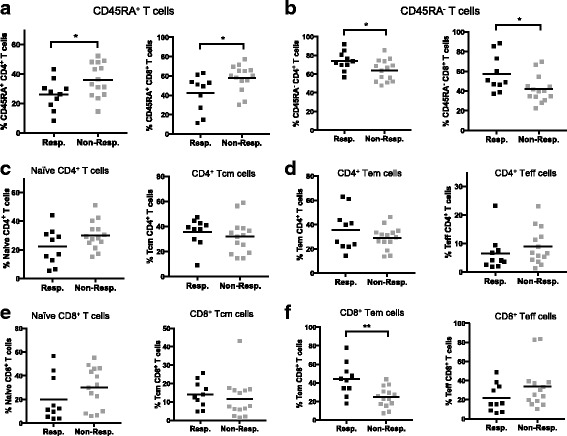
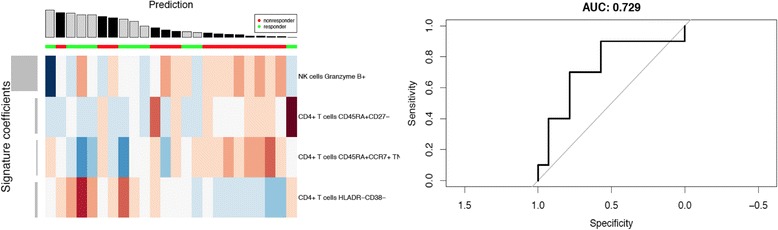
Immune profiling of baseline peripheral blood samples using CyTOF revealed that anti-CTLA-4 and anti-PD-1 therapies have distinct sets of candidate biomarkers. The distribution of CD4 and CD8 memory/non-memory cells and other memory subsets was different between responders and non-responders to anti-CTLA-4 therapy. In anti-PD-1 (but not anti-CTLA-4) treated patients, we discovered differences in CD69 and MIP-1β expressing NK cells between responders and non-responders. Finally, multivariate analysis was used to develop a model for the prediction of response.
Our results indicate that anti-CTLA-4 and anti-PD-1 have distinct predictive biomarker candidates. CD4 and CD8 memory T cell subsets play an important role in response to anti-CTLA-4, and are potential biomarker candidates. For anti-PD-1 therapy, NK cell subsets (but not memory T cell subsets) correlated with clinical response to therapy. These functionally active NK cell subsets likely play a critical role in the anti-tumor response triggered by anti-PD-1.
免疫检查点阻断在黑色素瘤等疾病的临床治疗中取得了巨大进展,但仍需要预测性生物标志物来确定哪种治疗最有可能使哪些患者受益。迄今为止,大多数反应生物标志物都是在肿瘤本身中确定的。如果能够从外周血中评估生物标志物,则会更加理想,因为这样更容易获得样本且可重复性更高。
我们使用质谱流式细胞术(CyTOF)全面分析黑色素瘤患者的外周血,以寻找对抗 CTLA-4 或抗 PD-1 治疗有反应的预测性生物标志物。使用约 40 个表面和细胞内标志物的面板,我们进行了深入的表型和功能免疫分析,以确定潜在的预测生物标志物候选物。
使用 CyTOF 对基线外周血样本进行免疫分析显示,抗 CTLA-4 和抗 PD-1 治疗具有不同的候选生物标志物集。抗 CTLA-4 治疗的反应者和无反应者之间的 CD4 和 CD8 记忆/非记忆细胞和其他记忆亚群的分布不同。在抗 PD-1(但不是抗 CTLA-4)治疗的患者中,我们发现反应者和无反应者之间 CD69 和 MIP-1β 表达 NK 细胞存在差异。最后,使用多元分析来建立反应预测模型。
我们的结果表明,抗 CTLA-4 和抗 PD-1 具有不同的预测性生物标志物候选物。CD4 和 CD8 记忆 T 细胞亚群在抗 CTLA-4 反应中起重要作用,是潜在的生物标志物候选物。对于抗 PD-1 治疗,NK 细胞亚群(而不是记忆 T 细胞亚群)与治疗的临床反应相关。这些功能活跃的 NK 细胞亚群可能在抗 PD-1 触发的抗肿瘤反应中发挥关键作用。