Keio University School of Medicine, Shinjuku-ku, Tokyo, Japan.
Tokyo Women's Medical University, Shinjuku-ku, Tokyo, Japan.
Arthritis Res Ther. 2018 Mar 7;20(1):42. doi: 10.1186/s13075-018-1536-9.
Sirukumab, a high-affinity human monoclonal antibody that selectively binds to interleukin-6, has demonstrated efficacy in the treatment of rheumatoid arthritis (RA) in global phase 1 and phase 2 studies. The present study evaluated the safety and efficacy of sirukumab, as monotherapy in Japanese patients with RA refractory to methotrexate or sulfasalazine.
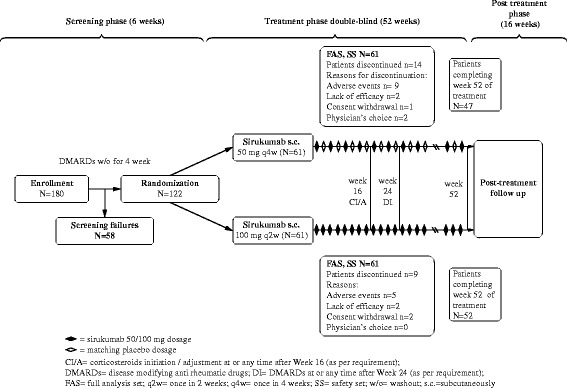
In this phase 3, double-blind study, 122 patients (age ≥ 20 years) were randomized (1:1, 61 patients in each arm) to sirukumab administered subcutaneously: 50 mg once every 4 weeks (q4w) or 100 mg once every 2 weeks (q2w) through 52 weeks. Disease-modifying anti-rheumatic drugs were allowed after 24 weeks. Safety was assessed and efficacy was evaluated using American College of Rheumatology (ACR) responses, Disease Activity Score C-reactive protein (DAS28-CRP) and Health Assessment Questionnaire-Disability Index (HAQ-DI).
Amongst the 122 randomized patients, 99 (81.1%) patients completed the study. Adverse events (AEs) were reported in 114/122 (93.4%) patients and serious AEs were reported in 9/122 (7.4%) patients. No deaths, major cardiovascular AEs, serious gastrointestinal perforations or tuberculosis cases were reported during this study period. Grade 3 hematologic abnormalities (neutropenia and leukopenia) were reported in seven patients and no grade 4 abnormalities were observed. ACR20 responses were observed within 2 weeks, achieved in 47/61 (77.0%, 50 mg q4w) patients and 44/61 (72.1%, 100 mg q2w) patients at week 16 and maintained through week 52. ACR50/70, DAS28-CRP and HAQ-DI responses were also maintained through week 52 in both groups.
Safety findings were comparable between the two treatment groups. The 52-week administration of sirukumab at 50 mg q4w and 100 mg q2w was generally tolerable and with measurable efficacy in Japanese patients with RA refractory to methotrexate and sulfasalazine.
NCT01689532 . Registered 18 September 2012.
西鲁单抗是一种高亲和力的人源单克隆抗体,能选择性地与白细胞介素-6 结合,在全球的 1 期和 2 期研究中已显示出对类风湿关节炎(RA)的疗效。本研究评估了西鲁单抗在对甲氨蝶呤或柳氮磺胺吡啶耐药的日本 RA 患者中的安全性和疗效,该药作为单药治疗。
在这项 3 期、双盲研究中,122 例(年龄≥20 岁)患者按 1:1 随机分为两组,分别接受皮下注射西鲁单抗:50mg 每 4 周(q4w)一次(61 例)或 100mg 每 2 周(q2w)一次(61 例),共 52 周。24 周后允许使用改善病情的抗风湿药物。采用美国风湿病学会(ACR)应答、疾病活动评分 C 反应蛋白(DAS28-CRP)和健康评估问卷残疾指数(HAQ-DI)评估安全性和疗效。
在 122 例随机患者中,99 例(81.1%)完成了研究。122 例患者中有 114 例(93.4%)报告了不良事件(AE),9 例(7.4%)报告了严重 AE。研究期间无死亡、重大心血管不良事件、严重胃肠道穿孔或结核病病例。7 例患者出现 3 级血液学异常(中性粒细胞减少和白细胞减少),未观察到 4 级异常。在第 2 周时观察到 ACR20 应答,在第 16 周时,50mg q4w 组有 47/61(77.0%)例患者和 100mg q2w 组有 44/61(72.1%)例患者达到应答,在第 52 周时仍保持应答。两组在第 52 周时 ACR50/70、DAS28-CRP 和 HAQ-DI 应答也得以维持。
两组的安全性发现相当。在对甲氨蝶呤和柳氮磺胺吡啶耐药的日本 RA 患者中,52 周给予西鲁单抗 50mg q4w 和 100mg q2w 的治疗是可耐受的,且具有可衡量的疗效。
NCT01689532。注册日期 2012 年 9 月 18 日。