Tsai Meng-Ning, Wu Ching-Lin, Tseng Lei-Pin, An Chih-Pei, Chen Hsueh-Chih
Department of Educational Psychology and Counseling, National Taiwan Normal University, Taipei, Taiwan.
Front Psychol. 2018 Feb 20;9:150. doi: 10.3389/fpsyg.2018.00150. eCollection 2018.
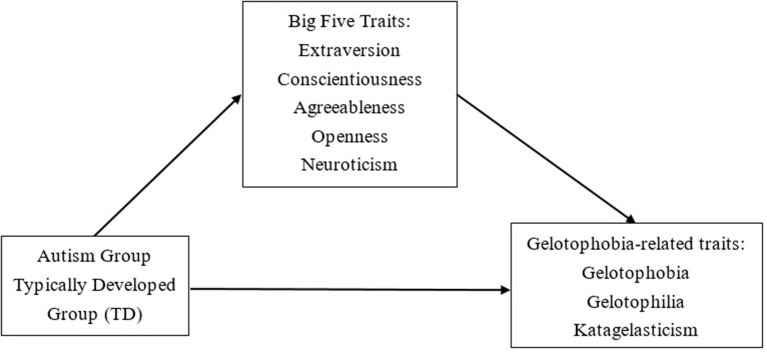
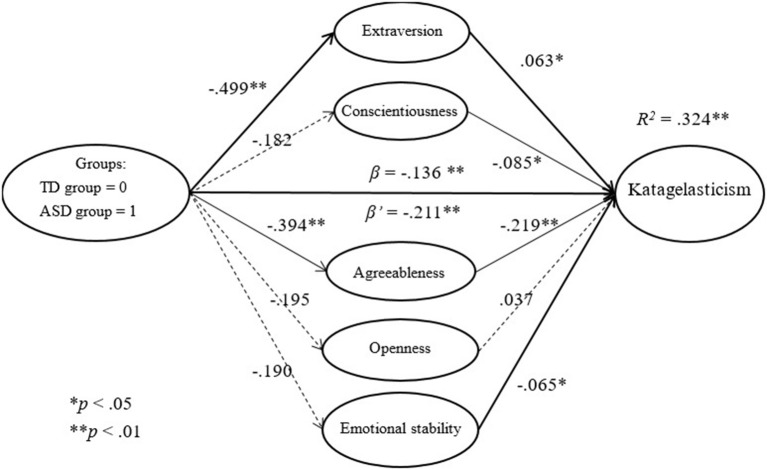
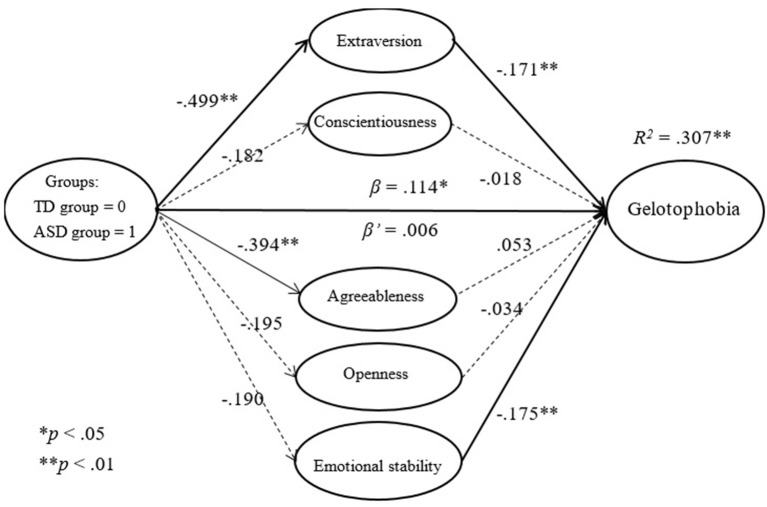
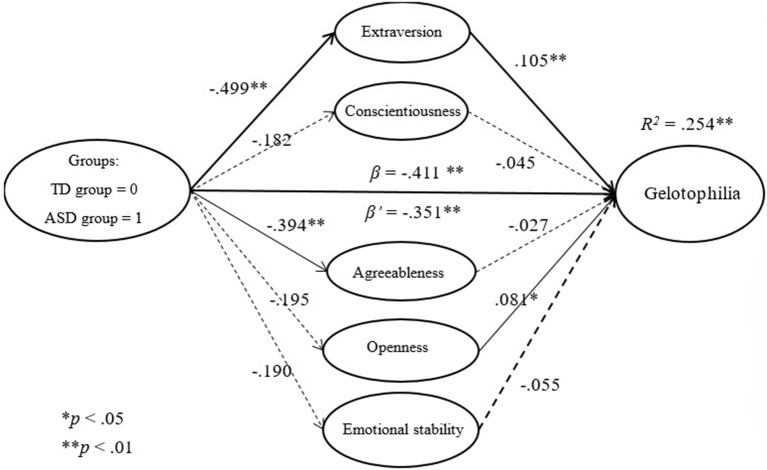
Previous research has shown that individuals with autism are frequently mocked in their childhood and are consequently more anxious about being ridiculed. Research has also shown that autistic individuals have a higher level of gelotophobia (fear of being laughed at) compared to typically developed individuals. However, recent studies have also found that gelotophobia is strongly related to personality, which suggests that personality is a factor that helps to create a higher level of gelotophobia in autistic individuals. To investigate whether this is the case, we recruited 279 Taiwanese high school students, 123 with autism spectrum disorder (ASD) and 156 typically developed students as a control group. Self-reporting questionnaires were used to gather data on the Big Five personality traits and on the gelotophobia-related traits of gelotophobia, gelotophilia, and katagelasticism. The results were analyzed and the two groups were compared for differences in gelotophobia and personality. The ASD group was found to have a higher level of gelotophobia than the typically developed group, but lower levels of gelotophilia and katagelasticism. Additionally, the ASD group was found to have lower levels of extraversion and agreeableness than the typically developed group, but no significant difference was found between the two groups in terms of conscientiousness, openness, and emotional stability. We then investigated the possible correlations between gelotophobia-related traits and the Big Five, and consequently the mediation effect of the Big Five on gelotophobia. The results show, firstly, that extraversion rather than ASD is a direct factor in gelotophobia. Secondly, the level of gelotophilia was partly influenced by autism but also to a certain extent by the level of extraversion. Lastly, the results indicate that autism and the level of agreeableness are in conflict when predicting the level of katagelasticism.
先前的研究表明,患有自闭症的个体在童年时期经常受到嘲笑,因此他们更容易担心被嘲笑。研究还表明,与发育正常的个体相比,自闭症个体的恐笑症(害怕被嘲笑)程度更高。然而,最近的研究也发现,恐笑症与人格密切相关,这表明人格是导致自闭症个体恐笑症程度更高的一个因素。为了调查是否如此,我们招募了279名台湾高中生,其中123名患有自闭症谱系障碍(ASD),156名发育正常的学生作为对照组。通过自我报告问卷收集关于大五人格特质以及与恐笑症相关的特质(包括恐笑症、喜笑症和对嘲笑的反应能力)的数据。对结果进行分析,并比较两组在恐笑症和人格方面的差异。结果发现,ASD组的恐笑症程度高于发育正常组,但喜笑症和对嘲笑的反应能力水平较低。此外,ASD组的外向性和宜人性水平低于发育正常组,但在尽责性、开放性和情绪稳定性方面,两组之间没有显著差异。然后,我们研究了与恐笑症相关的特质和大五人格之间可能的相关性,以及大五人格对恐笑症的中介作用。结果表明,首先,外向性而非ASD是恐笑症的直接因素。其次,喜笑症水平部分受自闭症影响,但也在一定程度上受外向性水平影响。最后,结果表明,在预测对嘲笑的反应能力水平时,自闭症和宜人性水平存在冲突。