Güntekin Bahar, Hanoğlu Lütfü, Güner Dilan, Yılmaz Nesrin H, Çadırcı Fadime, Mantar Nagihan, Aktürk Tuba, Emek-Savaş Derya D, Özer Fahriye F, Yener Görsev, Başar Erol
Department of Biophysics, School of International Medicine, Istanbul Medipol University, Istanbul, Turkey.
REMER, Clinical Electrophysiology, Neuroimaging and Neuromodulation Lab, Istanbul Medipol University, Istanbul, Turkey.
Front Psychol. 2018 Feb 21;9:170. doi: 10.3389/fpsyg.2018.00170. eCollection 2018.
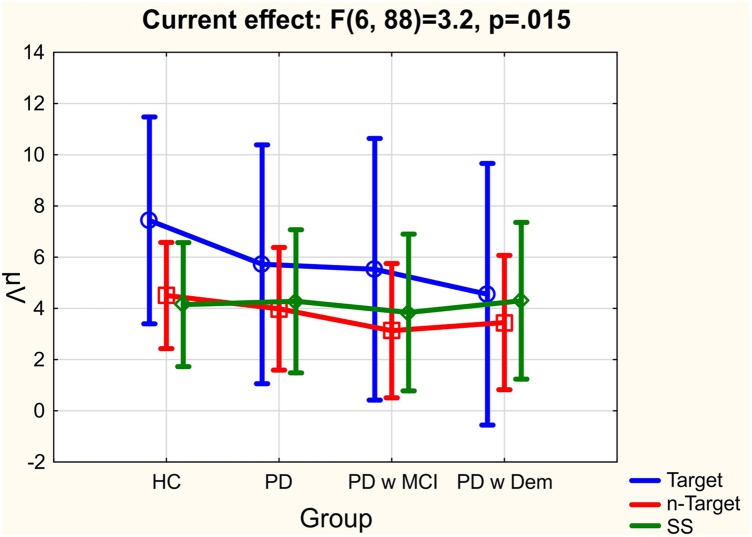
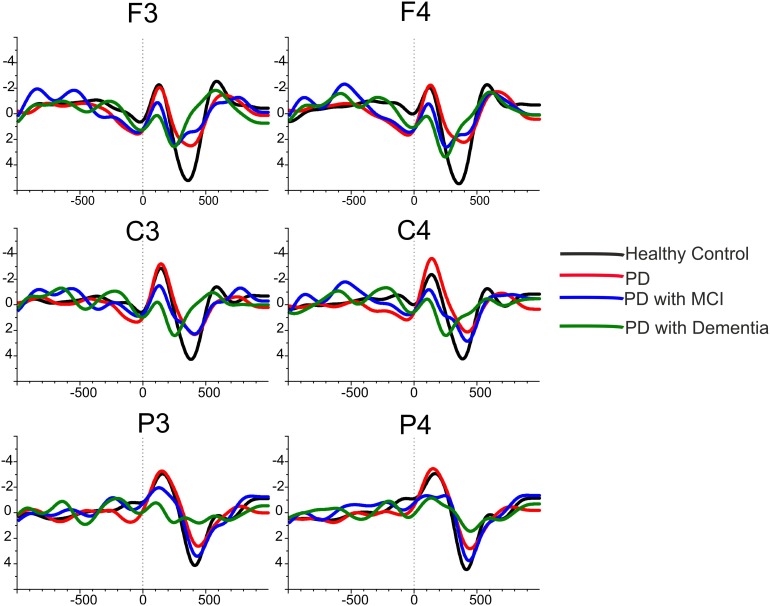
Parkinson's disease (PD) is a neurodegenerative disease that is characterized by loss of dopaminergic neurons in the substantia nigra. Mild Cognitive impairment (MCI) and dementia may come along with the disease. New indicators are necessary for detecting patients that are likely to develop dementia. Electroencephalogram (EEG) Delta responses are one of the essential electrophysiological indicators that could show the cognitive decline. Many research in literature showed an increase of delta responses with the increased cognitive load. Furthermore, delta responses were decreased in MCI and Alzheimer disease in comparison to healthy controls during cognitive paradigms. There was no previous study that analyzed the delta responses in PD patients with cognitive deficits. The present study aims to fulfill this important gap. 32 patients with Parkinson's disease (12 of them were without any cognitive deficits, 10 of them were PD with MCI, and 10 of them were PD with dementia) and 16 healthy subjects were included in the study. Auditory simple stimuli and Auditory Oddball Paradigms were applied. The maximum amplitudes of each subject's delta response (0.5-3.5 Hz) in 0-600 ms were measured for each electrode and for each stimulation. There was a significant stimulation × group effect [ = 3,21; < 0.015; [Formula: see text] = 0.180], which showed that the difference between groups was specific to the stimulation. Patients with Parkinson's disease (including PD without cognitive deficit, PD with MCI, and PD with dementia) had reduced delta responses than healthy controls upon presentation of target stimulation ( < 0.05, for all comparisons). On the other hand, this was not the case for non-target and simple auditory stimulation. Furthermore, delta responses gradually decrease according to the cognitive impairment in patients with PD. : The results of the present study showed that cognitive decline in PD could be represented with decreased event related delta responses during cognitive stimulations. Furthermore, the present study once more strengthens the hypothesis that decrease of delta oscillatory responses could be the candidate of a general electrophysiological indicator for cognitive impairment.
帕金森病(PD)是一种神经退行性疾病,其特征是黑质中多巴胺能神经元的丧失。轻度认知障碍(MCI)和痴呆可能伴随该疾病出现。需要新的指标来检测可能发展为痴呆的患者。脑电图(EEG)δ波反应是能够显示认知衰退的重要电生理指标之一。文献中的许多研究表明,随着认知负荷的增加,δ波反应会增强。此外,在认知范式期间,与健康对照组相比,MCI和阿尔茨海默病患者的δ波反应有所降低。以前没有研究分析过有认知缺陷的帕金森病患者的δ波反应。本研究旨在填补这一重要空白。本研究纳入了32名帕金森病患者(其中12名没有任何认知缺陷,10名患有帕金森病合并MCI,10名患有帕金森病合并痴呆)和16名健康受试者。应用了听觉简单刺激和听觉Oddball范式。测量了每个电极和每次刺激时每个受试者在0 - 600毫秒内δ波反应(0.5 - 3.5赫兹)的最大振幅。存在显著的刺激×组效应[F = 3.21;P < 0.015;η² = 0.180],这表明组间差异特定于刺激。在呈现目标刺激时,帕金森病患者(包括无认知缺陷的帕金森病患者、帕金森病合并MCI患者和帕金森病合并痴呆患者)的δ波反应比健康对照组降低(所有比较P < 0.05)。另一方面,非目标和简单听觉刺激的情况并非如此。此外,帕金森病患者的δ波反应根据认知障碍程度逐渐降低。本研究结果表明,帕金森病患者的认知衰退可以通过认知刺激期间事件相关δ波反应的降低来体现。此外,本研究再次强化了这样的假设,即δ波振荡反应的降低可能是认知障碍的一般电生理指标的候选者。