Zarantonello Victor, Silva Thiago P, Noyma Natália P, Gamalier Juliana P, Mello Mariana M, Marinho Marcelo M, Melo Rossana C N
Laboratory of Cellular Biology, Department of Biology, Federal University of Juiz de Fora, Juiz de Fora, Brazil.
Laboratory of Ecology and Physiology of Phytoplankton, Department of Plant Biology, Rio de Janeiro State University, Rio de Janeiro, Brazil.
Front Microbiol. 2018 Feb 21;9:272. doi: 10.3389/fmicb.2018.00272. eCollection 2018.
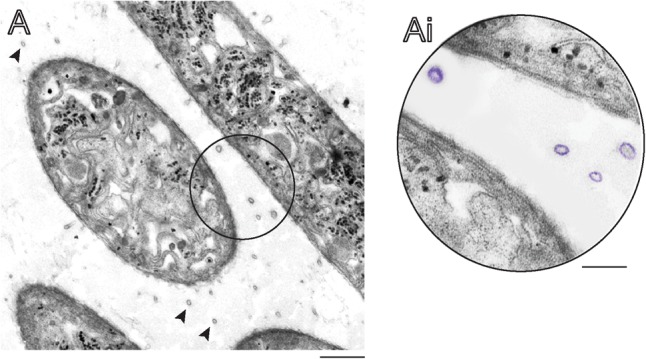
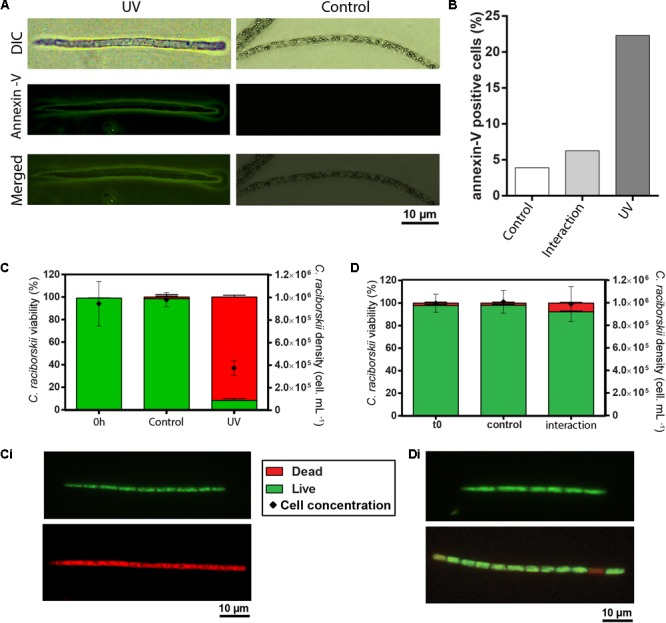
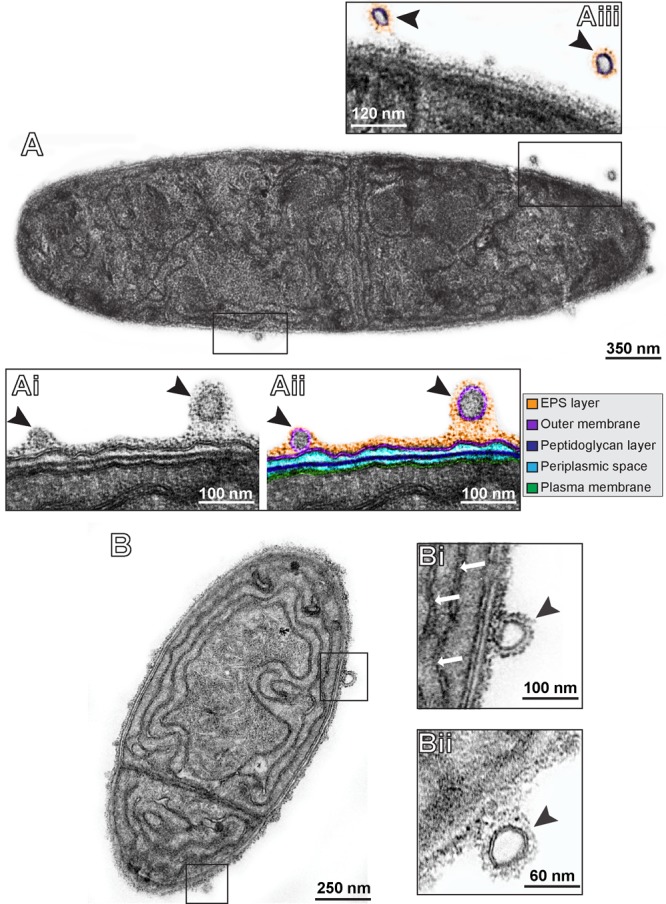
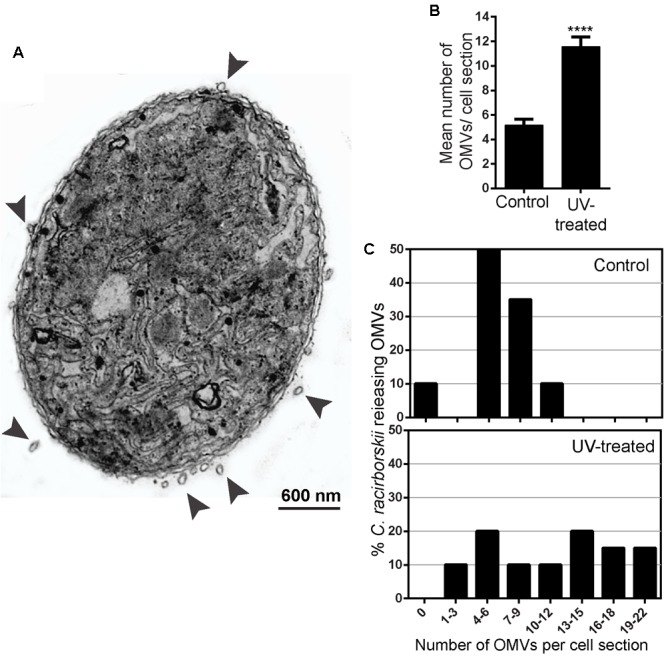
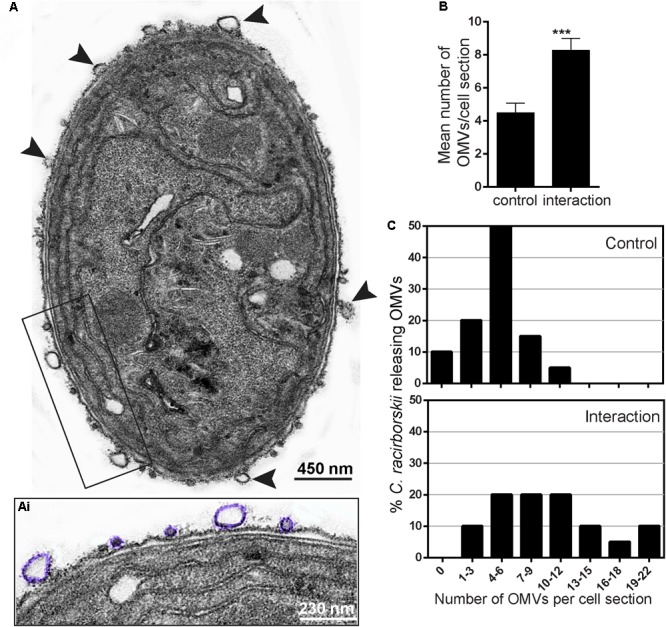
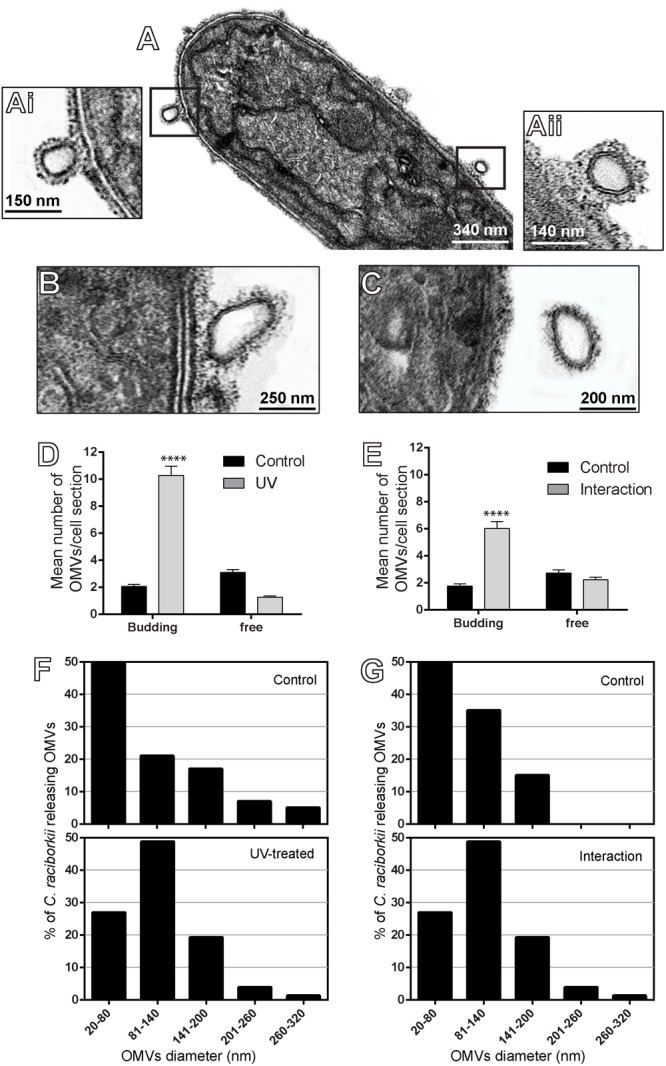
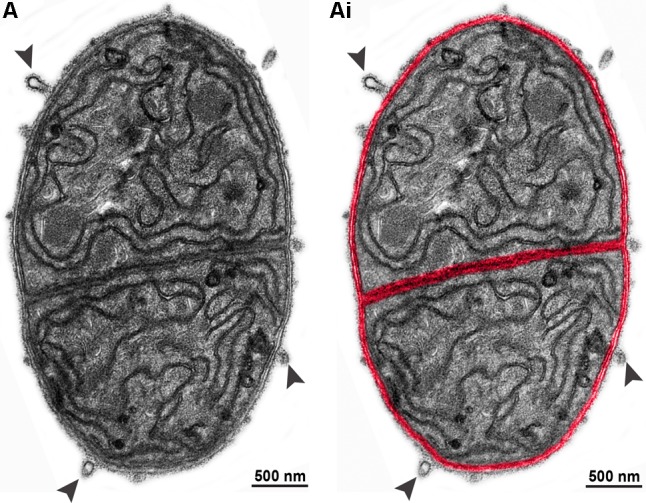
Secretion of membrane-limited vesicles, collectively termed extracellular vesicles (EVs), is an important biological process of both eukaryotic and prokaryotic cells. This process has been observed in bacteria, but remains to be better characterized at high resolution in cyanobacteria. In the present work, we address the release of EVs by (CYRF-01), a filamentous bloom-forming cyanobacterium, exposed to environmental stressors. First, non-axenic cultures of (CYRF-01) were exposed to ultraviolet radiation (UVA + UVB) over a 6 h period, which is known to induce structural damage to this species. Second, was co-cultured in interaction with another cyanobacterium species, (MIRF-01), over a 24 h period. After the incubation times, cell density and viability were analyzed, and samples were processed for transmission electron microscopy (TEM). Our ultrastructural analyses revealed that constitutively releases EVs from the outer membrane during its normal growth and amplifies such ability in response to environmental stressors. Both situations induced significant formation of outer membrane vesicles (OMVs) by compared to control cells. Quantitative TEM revealed an increase of 48% (UV) and 60% (interaction) in the OMV numbers compared to control groups. Considering all groups, the OMVs ranged in size from 20 to 300 nm in diameter, with most OMVs showing diameters between 20 and 140 nm. Additionally, we detected that OMV formation is accompanied by phosphatidylserine exposure, a molecular event also observed in EV-secreting eukaryotic cells. Altogether, we identified for the first time that has the competence to secrete OMVs and that under different stress situations the genesis of these vesicles is increased. The amplified ability of cyanobacteria to release OMVs may be associated with adaptive responses to changes in environmental conditions and interspecies cell communication.
膜限定性囊泡的分泌,统称为细胞外囊泡(EVs),是真核细胞和原核细胞的一个重要生物学过程。此过程已在细菌中观察到,但在蓝细菌中仍有待于在高分辨率下进行更好的表征。在本研究中,我们探讨了丝状水华形成蓝细菌(CYRF-01)在暴露于环境应激源时细胞外囊泡的释放情况。首先,将(CYRF-01)的非无菌培养物在6小时内暴露于紫外线辐射(UVA + UVB),已知这种辐射会对该物种造成结构损伤。其次,将(CYRF-01)与另一种蓝细菌物种(MIRF-01)在24小时内共同培养。在孵育时间结束后,分析细胞密度和活力,并对样品进行透射电子显微镜(TEM)处理。我们的超微结构分析表明,(CYRF-01)在正常生长过程中持续从外膜释放细胞外囊泡,并在响应环境应激源时增强这种能力。与对照细胞相比,这两种情况均诱导(CYRF-01)大量形成外膜囊泡(OMVs)。定量TEM显示,与对照组相比,OMV数量增加了48%(紫外线处理)和60%(相互作用处理)。考虑所有组,OMV的直径范围为20至300纳米,大多数OMV的直径在20至140纳米之间。此外,我们检测到OMV的形成伴随着磷脂酰丝氨酸的暴露,这是在分泌EV的真核细胞中也观察到的分子事件。总之,我们首次确定(CYRF-01)具有分泌OMV的能力,并且在不同的应激情况下这些囊泡的产生会增加。蓝细菌释放OMV的能力增强可能与对环境条件变化的适应性反应以及种间细胞通讯有关。