Stacey Nicholas, Summan Amit, Tugendhaft Aviva, Laxminarayan Ramanan, Hofman Karen
Priority Cost Effective Lessons for Systems Strengthening, School of Public Health, Faculty of Health Sciences, University of the Witwatersrand, Johannesburg, South Africa.
Center for Disease Dynamics Economics and Policy, Washington, District of Columbia, USA.
BMJ Glob Health. 2018 Jan 5;3(1):e000568. doi: 10.1136/bmjgh-2017-000568. eCollection 2018.
Excise taxes are policy tools that have been applied internationally with some success to reduce consumption of products adversely impacting population health including tobacco, alcohol and increasingly junk foods and sugary beverages. As in other low-income and middle-income countries, South Africa faces a growing burden of lifestyle diseases; accordingly we simulate the impact of multiple excise tax interventions in this setting.
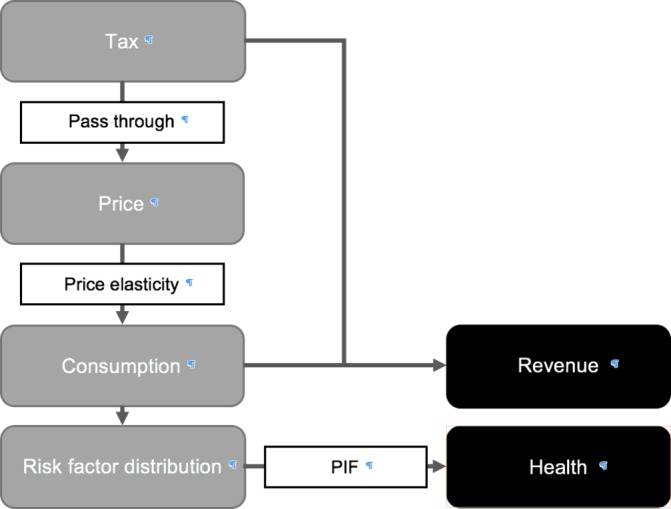
We construct a mathematical model to simulate the health and revenue effects of increased excise taxes, which is adaptable to a variety of settings given its limited data requirements. Applying the model to South Africa, we simulate the impact of increased tax rates on tobacco and beer and of the introduction of a tax on sugar-sweetened beverages (SSB). Drawing on surveys of product usage and risk factor prevalence, the model uses a potential impact fraction to simulate the health effects of tax interventions.
Adopting an excise rate of 60% on tobacco would result in a gain of 858 923 life-years (95% uncertainty interval (UI) 480 188 to 1 310 329), while adopting an excise rate of 25% on beer would result in a gain of 568 063 life-years (95% UI 412 110 to 775 560) and the adoption of a 20% tax on SSBs would result in a gain of 688 719 life-years (95% UI 321 788 to 1 079 653).
More aggressive excise tax policies on tobacco, beer and SSBs in South Africa could result in meaningful improvements in population health and raised revenue.
消费税是一种政策工具,在国际上已得到应用并取得了一定成效,用于减少对人群健康产生不利影响的产品消费,包括烟草、酒精,以及越来越多的垃圾食品和含糖饮料。与其他低收入和中等收入国家一样,南非面临着日益加重的生活方式疾病负担;因此,我们在此背景下模拟了多种消费税干预措施的影响。
我们构建了一个数学模型来模拟提高消费税对健康和税收的影响,鉴于其数据要求有限,该模型适用于多种情况。将该模型应用于南非,我们模拟了提高烟草和啤酒税率以及对含糖饮料(SSB)征税的影响。该模型利用产品使用情况调查和风险因素患病率,通过潜在影响分数来模拟税收干预措施对健康的影响。
对烟草采用60%的消费税税率将带来858923个生命年的增益(95%不确定区间(UI)为480188至1310329),对啤酒采用25%的消费税税率将带来568063个生命年的增益(95% UI为412110至775560),对含糖饮料征收20%的税将带来688719个生命年的增益(95% UI为321788至1079653)。
在南非对烟草、啤酒和含糖饮料实施更激进的消费税政策可能会显著改善人群健康状况并增加税收。