
利用小麦种子两面的高光谱数据确定种子活力的可靠方法。
A Reliable Methodology for Determining Seed Viability by Using Hyperspectral Data from Two Sides of Wheat Seeds.
机构信息
Department of Plant Genetics and Breeding, College of Agriculture, China Agricultural University/Beijing Key Laboratory of Crop Genetic Improvement/The Innovation Center (Beijing) of Crop Seed Sciences Ministry of Agriculture, Beijing 100193, China.
National R&D Center for Agro-Processing Equipments, College of Engineering, China Agricultural University, Beijing 100083, China.
出版信息
Sensors (Basel). 2018 Mar 8;18(3):813. doi: 10.3390/s18030813.
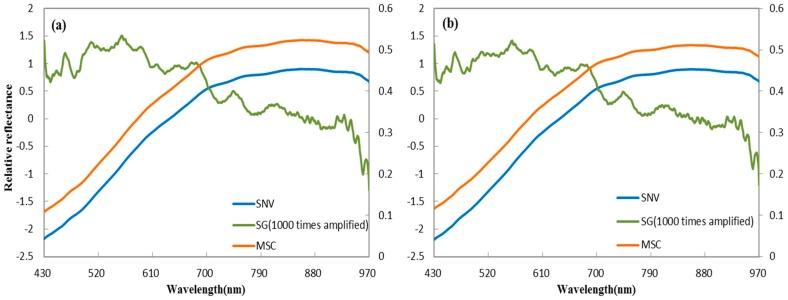
This study investigated the possibility of using visible and near-infrared (VIS/NIR) hyperspectral imaging techniques to discriminate viable and non-viable wheat seeds. Both sides of individual seeds were subjected to hyperspectral imaging (400-1000 nm) to acquire reflectance spectral data. Four spectral datasets, including the ventral groove side, reverse side, mean (the mean of two sides' spectra of every seed), and mixture datasets (two sides' spectra of every seed), were used to construct the models. Classification models, partial least squares discriminant analysis (PLS-DA), and support vector machines (SVM), coupled with some pre-processing methods and successive projections algorithm (SPA), were built for the identification of viable and non-viable seeds. Our results showed that the standard normal variate (SNV)-SPA-PLS-DA model had high classification accuracy for whole seeds (>85.2%) and for viable seeds (>89.5%), and that the prediction set was based on a mixed spectral dataset by only using 16 wavebands. After screening with this model, the final germination of the seed lot could be higher than 89.5%. Here, we develop a reliable methodology for predicting the viability of wheat seeds, showing that the VIS/NIR hyperspectral imaging is an accurate technique for the classification of viable and non-viable wheat seeds in a non-destructive manner.
本研究探讨了利用可见及近红外(VIS/NIR)高光谱成像技术区分有活力和无活力小麦种子的可能性。对单个种子的两面进行高光谱成像(400-1000nm)以获取反射光谱数据。使用了四个光谱数据集,包括腹沟面、反面、均值(每个种子两面光谱的平均值)和混合数据集(每个种子两面的光谱),来构建模型。使用偏最小二乘判别分析(PLS-DA)和支持向量机(SVM)构建分类模型,并结合一些预处理方法和连续投影算法(SPA),以识别有活力和无活力的种子。我们的结果表明,标准正态变量(SNV)-SPA-PLS-DA 模型对整个种子(>85.2%)和有活力种子(>89.5%)具有较高的分类准确性,且预测集基于仅使用 16 个波段的混合光谱数据集。使用该模型进行筛选后,种子批的最终发芽率可以高于 89.5%。本研究开发了一种可靠的方法来预测小麦种子的活力,表明 VIS/NIR 高光谱成像技术是一种非破坏性地对有活力和无活力小麦种子进行分类的准确技术。


 Zotero 插件