
利用LED诱导的高光谱反射成像对辣椒(Capsicum annuum L.)种子进行无损质量评估。
Non-destructive quality evaluation of pepper (Capsicum annuum L.) seeds using LED-induced hyperspectral reflectance imaging.
作者信息
Mo Changyeun, Kim Giyoung, Lee Kangjin, Kim Moon S, Cho Byoung-Kwan, Lim Jongguk, Kang Sukwon
机构信息
National Academy of Agricultural Science, Rural Development Administration, 150 Suinro, Gwonseon-gu, Suwon, Gyeonggi-do 441-100, Korea.
Environmental Microbiology and Food Safety Laboratory, BARC-East, Agricultural Research Service, US Department of Agriculture, 10300 Baltimore Avenue Beltsville, MD 20705, USA.
出版信息
Sensors (Basel). 2014 Apr 24;14(4):7489-504. doi: 10.3390/s140407489.
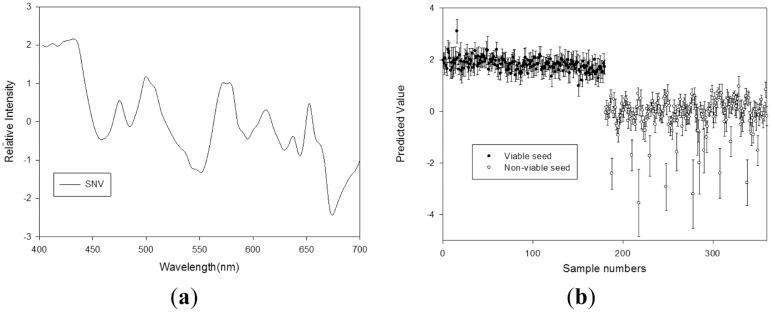
In this study, we developed a viability evaluation method for pepper (Capsicum annuum L.) seeds based on hyperspectral reflectance imaging. The reflectance spectra of pepper seeds in the 400-700 nm range are collected from hyperspectral reflectance images obtained using blue, green, and red LED illumination. A partial least squares-discriminant analysis (PLS-DA) model is developed to classify viable and non-viable seeds. Four spectral ranges generated with four types of LEDs (blue, green, red, and RGB), which were pretreated using various methods, are investigated to develop the classification models. The optimal PLS-DA model based on the standard normal variate for RGB LED illumination (400-700 nm) yields discrimination accuracies of 96.7% and 99.4% for viable seeds and nonviable seeds, respectively. The use of images based on the PLS-DA model with the first-order derivative of a 31.5-nm gap for red LED illumination (600-700 nm) yields 100% discrimination accuracy for both viable and nonviable seeds. The results indicate that a hyperspectral imaging technique based on LED light can be potentially applied to high-quality pepper seed sorting.
在本研究中,我们基于高光谱反射成像技术开发了一种辣椒(Capsicum annuum L.)种子活力评估方法。利用蓝色、绿色和红色发光二极管(LED)照明获取的高光谱反射图像,收集了400 - 700 nm范围内辣椒种子的反射光谱。建立了偏最小二乘判别分析(PLS - DA)模型,用于区分有活力种子和无活力种子。研究了使用四种类型LED(蓝色、绿色、红色和RGB)生成的四个光谱范围,这些光谱范围经过各种方法预处理后用于建立分类模型。基于RGB LED照明(400 - 700 nm)的标准正态变量的最优PLS - DA模型,对有活力种子和无活力种子的判别准确率分别为96.7%和99.4%。使用基于PLS - DA模型且具有31.5 nm间隔一阶导数的红色LED照明(600 - 700 nm)图像,对有活力种子和无活力种子的判别准确率均为100%。结果表明,基于LED光的高光谱成像技术有望应用于高质量辣椒种子分选。



 Zotero 插件