Neurobiology of Social Behavior Laboratory, Department of Psychology & Neuroscience Program, Michigan State University, East Lansing, MI 48824, USA.
Neurobiology of Social Behavior Laboratory, Department of Psychology & Neuroscience Program, Michigan State University, East Lansing, MI 48824, USA.
Curr Opin Neurobiol. 2018 Apr;49:132-140. doi: 10.1016/j.conb.2018.02.011. Epub 2018 Mar 5.
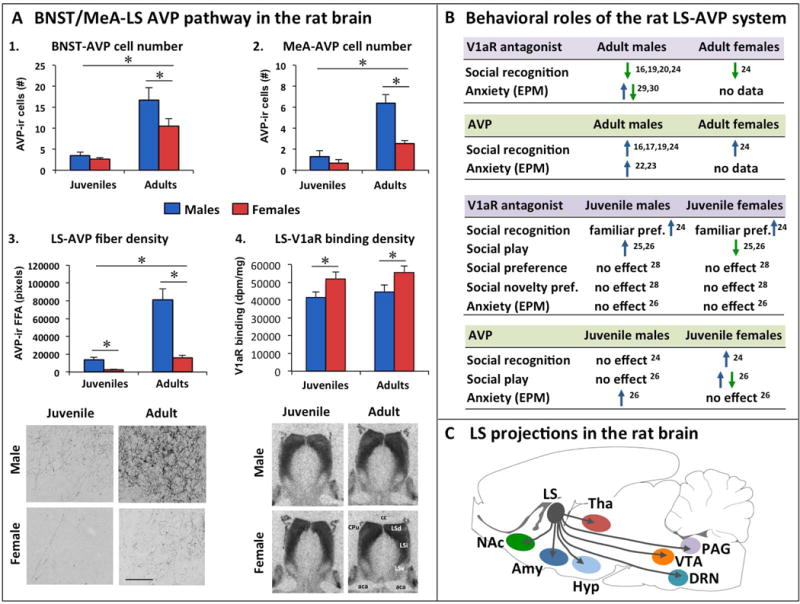
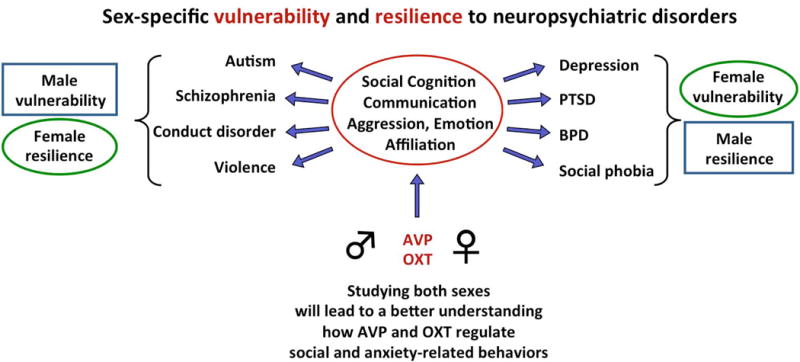
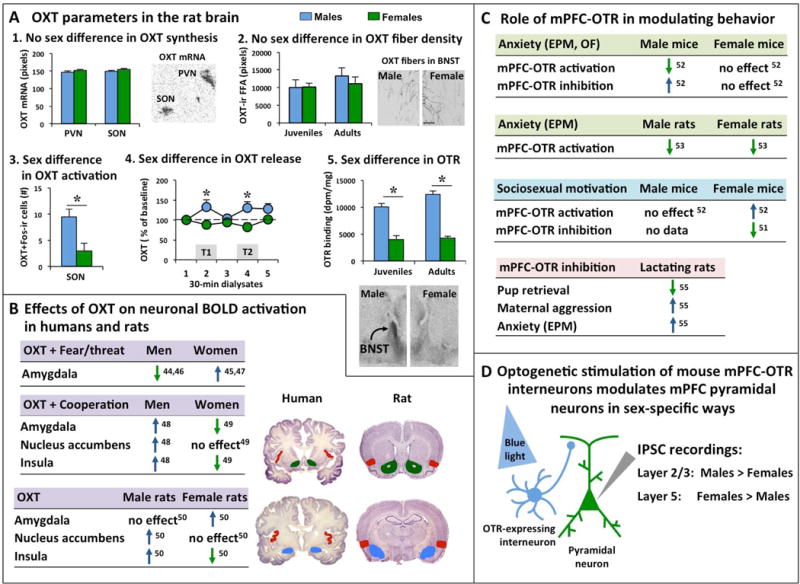
To understand how the brain regulates behavior, many variables must be taken into account, with sex as a prominent variable. In this review, we will discuss recent human and rodent studies showing the sex-specific involvement of the neuropeptides vasopressin and oxytocin in social and anxiety-related behaviors. We discuss that sex differences can be evident at pre-pubertal ages as seen in the sex-specific regulation of social recognition, social play, and anxiety by the vasopressin system in juvenile rats. We further discuss that the oxytocin system in humans and rodents alters brain activation, anxiety, and sociosexual motivation in sex-specific ways. Finally, we propose that knowledge of vasopressin and oxytocin mediated sex-specific brain mechanisms can provide essential insights into how these neuropeptide systems contribute to sex-specific vulnerability as well as resilience to perturbations, with subsequent relevance to social and emotional disorders.
为了了解大脑如何调节行为,必须考虑许多变量,而性别是一个突出的变量。在这篇综述中,我们将讨论最近的人类和啮齿动物研究,这些研究表明神经肽加压素和催产素在社会和焦虑相关行为中的性别特异性作用。我们讨论了性别差异可以在青春期前就表现出来,例如在幼年大鼠中,加压素系统对社会识别、社会游戏和焦虑的性别特异性调节。我们还进一步讨论了人类和啮齿动物的催产素系统以性别特异性的方式改变大脑活动、焦虑和社交动机。最后,我们提出,了解加压素和催产素介导的性别特异性大脑机制可以为这些神经肽系统如何导致性别特异性易感性以及对干扰的弹性提供重要的见解,随后与社会和情绪障碍有关。