Department of Radiology, Kyungpook National University Hospital, Daegu 41944, Korea.
Department of Radiology, Seoul National University Bundang Hospital, Seongnam 13620, Korea.
Korean J Radiol. 2018 Mar-Apr;19(2):320-327. doi: 10.3348/kjr.2018.19.2.320. Epub 2018 Feb 22.
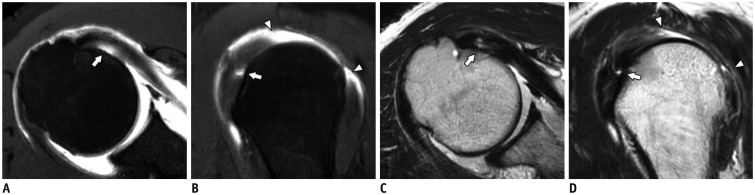
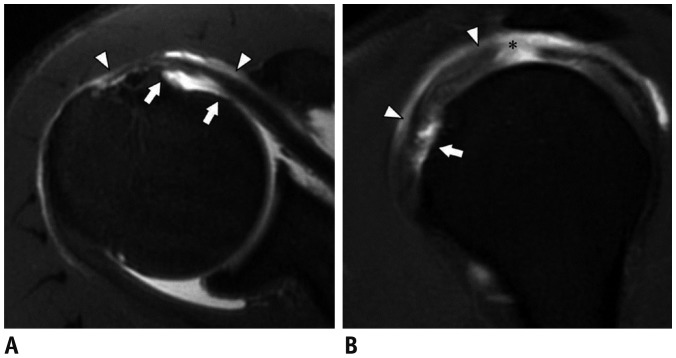
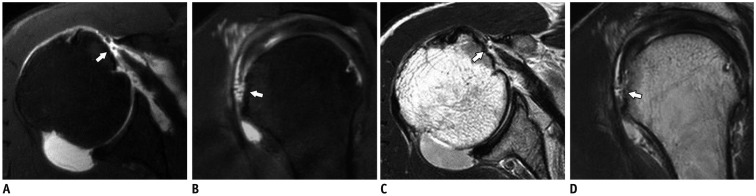
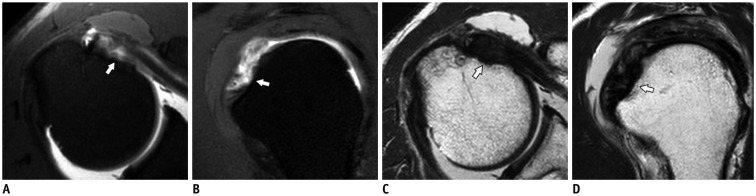
To compare the T1-weighted spectral presaturation with inversion-recovery sequences (T1 SPIR) with T2-weighted turbo spin-echo sequences (T2 TSE) on 3T magnetic resonance arthrography (MRA) in the evaluation of the subscapularis (SSC) tendon tear with arthroscopic findings as the reference standard.
This retrospective study included 120 consecutive patients who had undergone MRA within 3 months between April and December 2015. Two musculoskeletal radiologists blinded to the arthroscopic results evaluated T1 SPIR and T2 TSE images in separate sessions for the integrity of the SSC tendon, examining normal/articular-surface partial-thickness tear (PTTa)/full-thickness tear (FTT). Diagnostic performance of T1 SPIR and T2 TSE was calculated with arthroscopic results as the reference standard, and sensitivity, specificity, and accuracy were compared using the McNemar test. Interobserver agreement was measured with kappa (κ) statistics.
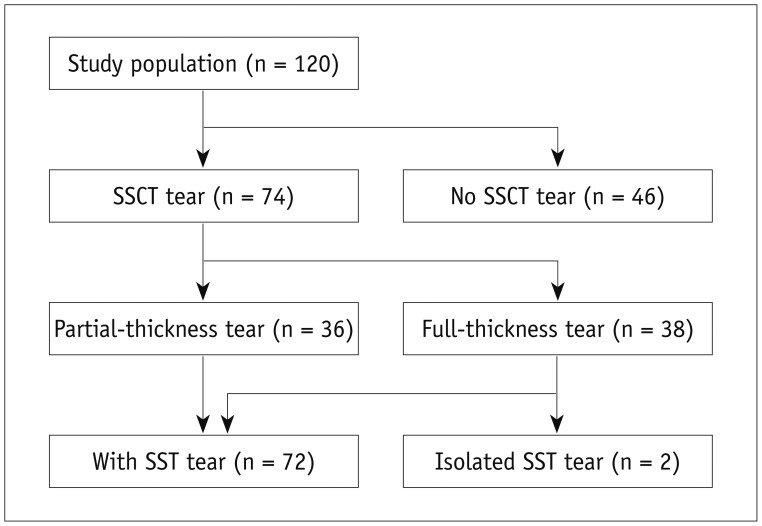
There were 74 SSC tendon tears (36 PTTa and 38 FTT) confirmed by arthroscopy. Significant differences were found in the sensitivity and accuracy between T1 SPIR and T2 TSE using the McNemar test, with respective rates of 95.9-94.6% vs. 71.6-75.7% and 90.8-91.7% vs. 79.2-83.3% for detecting tear; 55.3% vs. 31.6-34.2% and 85.8% vs. 78.3-79.2%, respectively, for FTT; and 91.7-97.2% vs. 58.3-61.1% and 89% vs. 78-79.3%, respectively, for PTTa. Interobserver agreement for T1 SPIR was almost perfect for T1 SPIR (κ = 0.839) and substantial for T2 TSE (κ = 0.769).
T1-weighted spectral presaturation with inversion-recovery sequences is more sensitive and accurate compared to T2 TSE in detecting SSC tendon tear on 3T MRA.
比较 T1 加权频谱预饱和反转恢复(T1 SPIR)与 T2 加权涡轮自旋回波(T2 TSE)序列在 3T 磁共振关节造影(MRA)中对肩胛下肌腱撕裂的评估,以关节镜检查结果为参考标准。
本回顾性研究纳入了 2015 年 4 月至 12 月期间在 3 个月内接受 MRA 检查的 120 例连续患者。两名对关节镜检查结果不知情的肌肉骨骼放射科医生在单独的检查中评估 T1 SPIR 和 T2 TSE 图像,以评估肩胛下肌腱的完整性,检查正常/关节面部分厚度撕裂(PTTa)/全厚度撕裂(FTT)。以关节镜检查结果为参考标准,计算 T1 SPIR 和 T2 TSE 的诊断性能,并使用 McNemar 检验比较敏感性、特异性和准确性。采用κ(κ)统计量评估观察者间的一致性。
关节镜检查证实 74 例肩胛下肌腱撕裂(36 例 PTTa 和 38 例 FTT)。使用 McNemar 检验发现 T1 SPIR 和 T2 TSE 在敏感性和准确性方面存在显著差异,分别为 95.9-94.6%比 71.6-75.7%和 90.8-91.7%比 79.2-83.3%用于检测撕裂;55.3%比 31.6-34.2%和 85.8%比 78.3-79.2%,分别用于检测 FTT;91.7-97.2%比 58.3-61.1%和 89%比 78-79.3%,分别用于检测 PTTa。T1 SPIR 的观察者间一致性近乎完美(κ=0.839),T2 TSE 的观察者间一致性较好(κ=0.769)。
与 T2 TSE 相比,3T MRA 上 T1 加权频谱预饱和反转恢复序列在检测肩胛下肌腱撕裂方面更敏感、更准确。