Shanghai Universal Medical Imaging Diagnostic Center, Shanghai 200233, China.
Department of Radiology, PET/CT Center, Shanghai 85 Hospital, Shanghai 200052, China.
Korean J Radiol. 2018 Mar-Apr;19(2):342-351. doi: 10.3348/kjr.2018.19.2.342. Epub 2018 Feb 22.
To assess clinical value of fluorine-18-fluorodeoxyglucose positron emission tomography/computed tomography (PET/CT) for differentiation of malignant from benign focal thyroid incidentaloma.
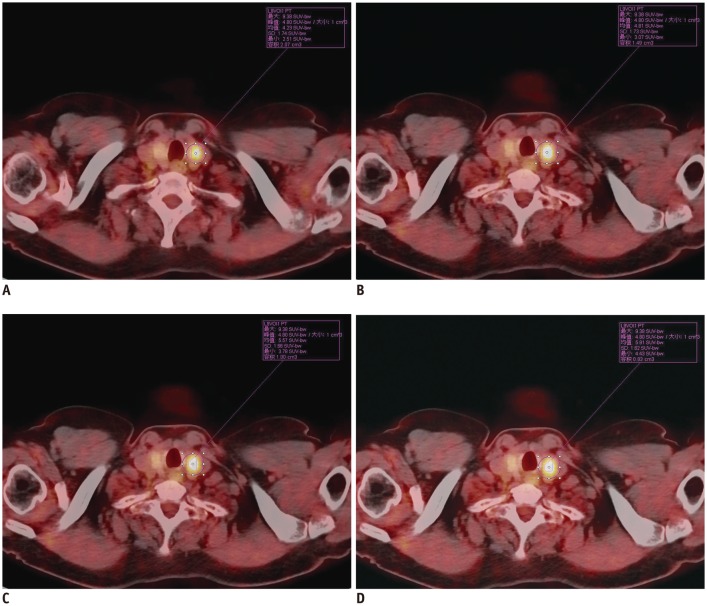
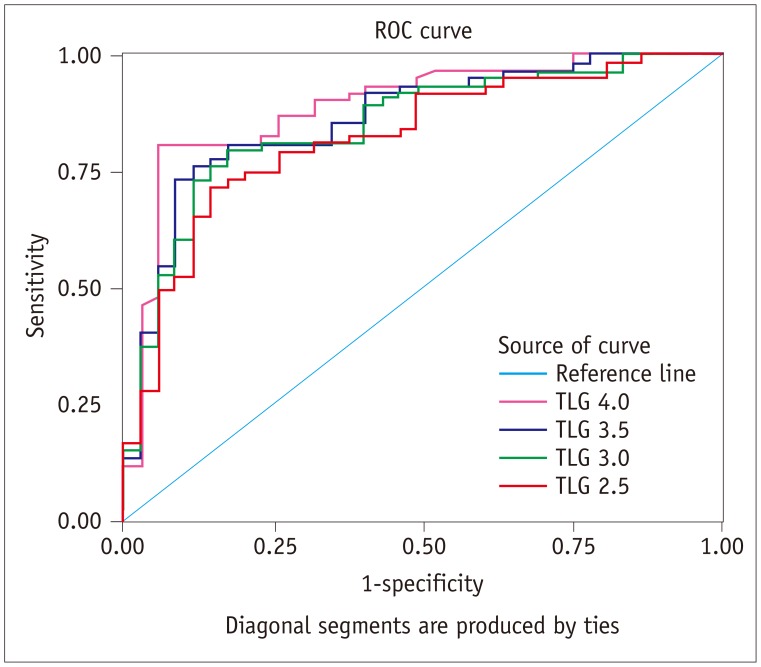
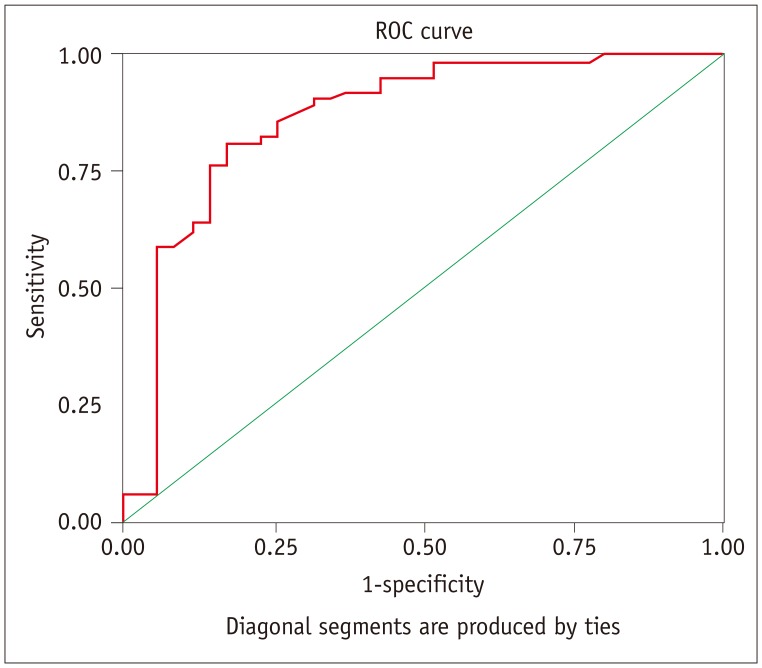
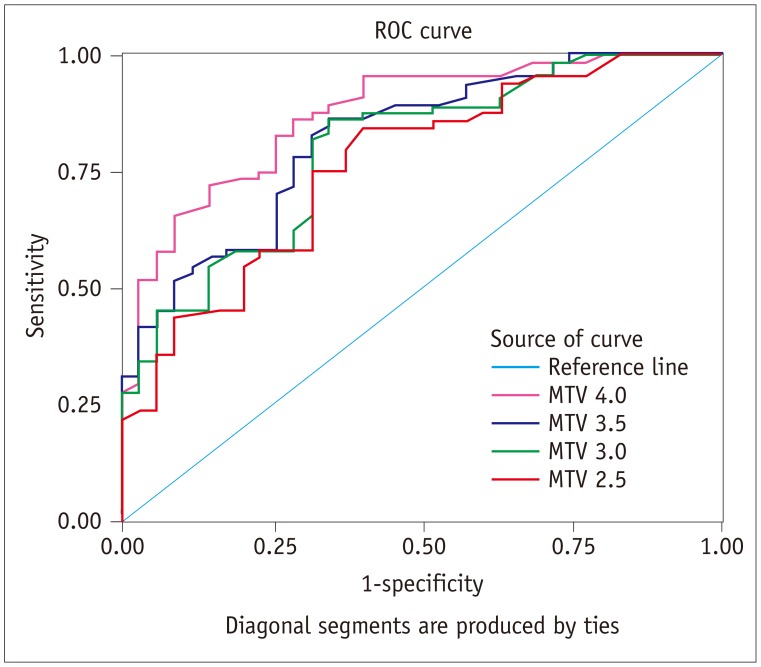
This retrospective study included 99 patients with focal thyroid incidentaloma of 5216 non-thyroid cancer patients that had undergone PET/CT. PET/CT semi-quantitative parameters, volume-based functional parameters, metabolic tumor volume (MTV), and total lesion glycolysis (TLG) of thyroid incidentaloma were assessed. Receiver-operating characteristic (ROC) analysis was conducted and areas under the curve (AUC) were compared by Hanley and McNeil test to evaluate usefulness of maximum standardized uptake value (SUVmax), MTV and TLG, as markers for differentiating malignant from benign thyroid incidentalomas.
Of 99 thyroid incidentalomas, 64 (64.6%) were malignant and 35 (35.4%) were benign. Malignant thyroid incidentalomas were larger (1.8 cm vs. 1.3 cm, = 0.006), and had higher SUVmax (11.3 vs. 4.8, < 0.001), MTV (all < 0.001) and TLG (all < 0.001) than benign. TLG 4.0 had the highest performance for differentiation of malignant from benign thyroid incidentaloma in all semi-quantitative parameters with AUC 0.895 by ROC curve analysis. AUC (TLG 4.0) was significantly larger than AUC (SUVmean), AUC (MTV 2.5), AUC (MTV 3.0), AUC (MTV 3.5), AUC (TLG 2.5), and AUC (TLG 3.0), respectively (all, < 0.05). There was no statistical difference between AUC (TLG 4.0) and AUC (SUVmax) ( > 0.05). A threshold TLG 4.0 of 2.475 had 81.3% sensitivity and 94.3% specificity for identifying malignant thyroid incidentalomas.
Volume-based PET/CT parameters could potentially have clinical value in differential diagnosis of thyroid incidentaloma along with SUVmax.
评估氟-18-氟代脱氧葡萄糖正电子发射断层扫描/计算机断层扫描(PET/CT)在鉴别良恶性甲状腺偶发瘤中的临床价值。
本回顾性研究纳入了 99 例 5216 例非甲状腺癌患者中经 PET/CT 检查发现的甲状腺偶发瘤患者。评估了甲状腺偶发瘤的 PET/CT 半定量参数、基于体积的功能参数、代谢肿瘤体积(MTV)和总病变糖酵解(TLG)。采用受试者工作特征(ROC)分析,Hanley 和 McNeil 检验比较曲线下面积(AUC),以评估最大标准化摄取值(SUVmax)、MTV 和 TLG 作为鉴别甲状腺偶发瘤良恶性的标志物的有用性。
99 例甲状腺偶发瘤中,64 例(64.6%)为恶性,35 例(35.4%)为良性。恶性甲状腺偶发瘤较大(1.8cm 比 1.3cm, = 0.006),SUVmax(11.3 比 4.8, < 0.001)、MTV(均 < 0.001)和 TLG(均 < 0.001)均较高。TLG 4.0 在所有半定量参数中对鉴别良恶性甲状腺偶发瘤的性能最高,ROC 曲线分析 AUC 为 0.895。AUC(TLG 4.0)明显大于 AUC(SUVmean)、AUC(MTV 2.5)、AUC(MTV 3.0)、AUC(MTV 3.5)、AUC(TLG 2.5)和 AUC(TLG 3.0)(均 < 0.05)。AUC(TLG 4.0)与 AUC(SUVmax)之间无统计学差异( > 0.05)。TLG 4.0 的阈值为 2.475 时,对恶性甲状腺偶发瘤的敏感性为 81.3%,特异性为 94.3%。
与 SUVmax 相比,基于体积的 PET/CT 参数在甲状腺偶发瘤的鉴别诊断中可能具有临床价值。