Paixão Rômulo V, Ribolli Josiane, Zaniboni-Filho Evoy
Laboratório de Biologia e Cultivo de Peixes de Água Doce, Departamento de Aquicultura, Universidade Federal de Santa Catarina, Florianópolis, Brazil.
Programa de Pós-Graduação em Aquicultura, Centro de Ciências Agrárias, Universidade Federal de Santa Catarina, Florianópolis, Brazil.
Front Genet. 2018 Feb 19;9:48. doi: 10.3389/fgene.2018.00048. eCollection 2018.
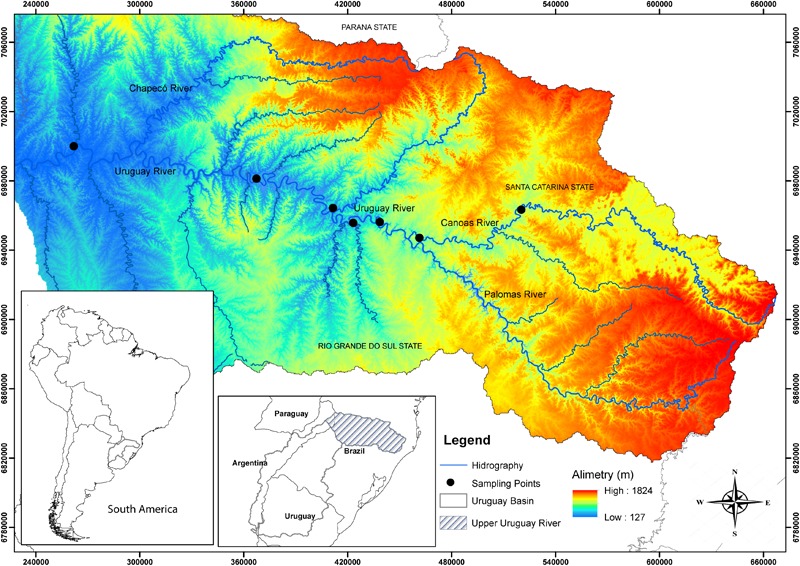
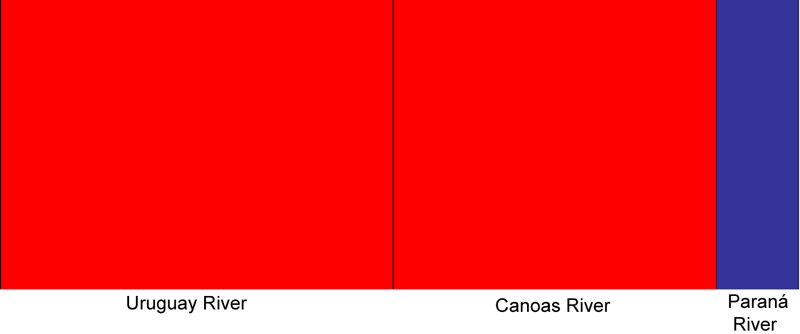
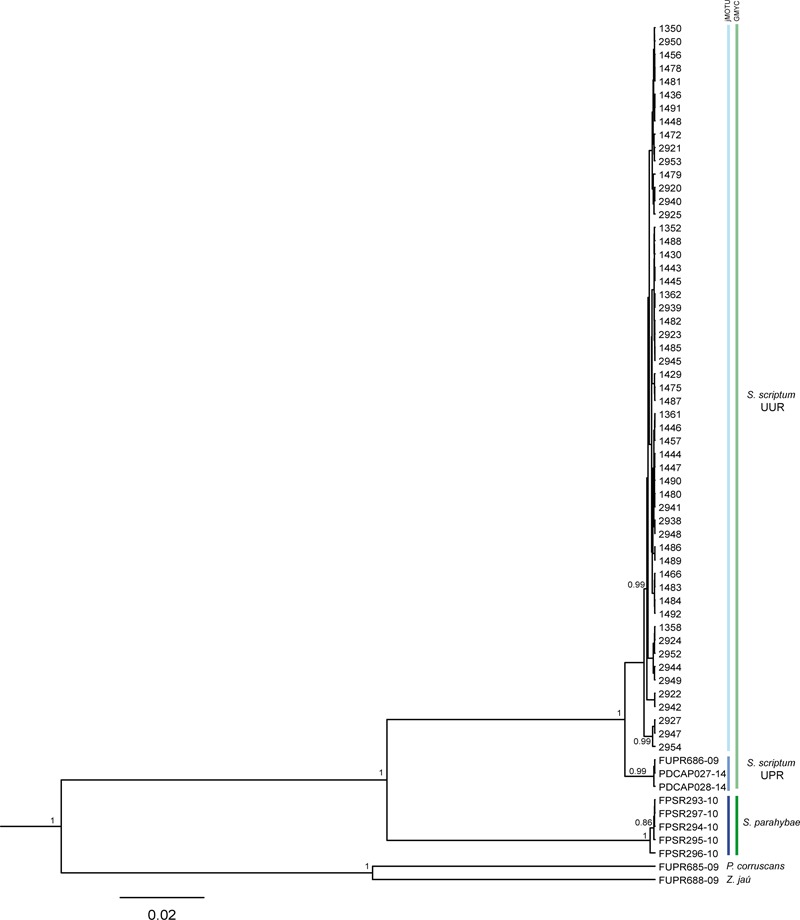
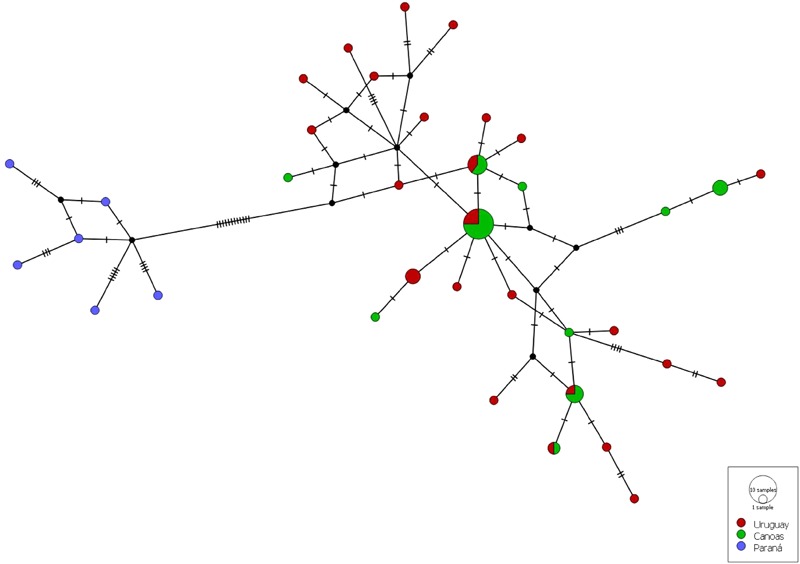
is an important species as a resource for fisheries and aquaculture; it is currently threatened and has a reduced occurrence in South America. The damming of rivers, overfishing, and contamination of freshwater environments are the main impacts on the maintenance of this species. We accessed the genetic diversity and structure of using the DNA barcode and control region (D-loop) sequences of 43 individuals from the Upper Uruguay River Basin (UUR) and 10 sequences from the Upper Paraná River Basin (UPR), which were obtained from GenBank. from the UUR and the UPR were assigned in two distinct molecular operational taxonomic units (MOTUs) with higher inter-specific K2P distance than the optimum threshold (OT = 0.0079). The COI Intra-MOTU distances of specimens from the UUR ranged from 0.0000 to 0.0100. The control region indicated a high number of haplotypes and low nucleotide diversity, compatible with a new population in recent expansion process. Genetic structure was observed, with high differentiation between UUR and UPR basins, identified by BAPS, haplotype network, AMOVA ( = 0.78, < 0.05) and Mantel test. from the UUR showed a slight differentiation ( = 0.068, < 0.05), but not isolation-by-distance. Negative values of Tajima's and Fu's s suggest recent demographic oscillations. The Bayesian skyline plot analysis indicated possible population expansion from beginning 2,500 years ago and a recent reduction in the population size. Low nucleotide diversity, spatial population structure, and the reduction of effective population size should be considered for the planning of strategies aimed at the conservation and rehabilitation of this important fisheries resource.
作为渔业和水产养殖的资源,它是一个重要物种;目前该物种受到威胁,在南美洲的分布范围已缩小。河流筑坝、过度捕捞以及淡水环境污染是对该物种生存的主要影响因素。我们利用来自乌拉圭河上游流域(UUR)的43个个体的DNA条形码和控制区(D-loop)序列以及来自巴拉那河上游流域(UPR)的10个序列(这些序列从GenBank获取),研究了[该物种]的遗传多样性和结构。来自UUR和UPR的[该物种]被划分到两个不同的分子操作分类单元(MOTUs)中,种间K2P距离高于最佳阈值(OT = 0.0079)。来自UUR的[该物种]标本的COI基因座内距离范围为0.0000至0.0100。控制区显示单倍型数量多但核苷酸多样性低,这与处于近期扩张过程中的新种群相符。观察到了遗传结构,UUR和UPR流域之间存在高度分化,这通过BAPS、单倍型网络、AMOVA(= 0.78,P < 0.05)和Mantel检验得以确定。来自UUR的[该物种]表现出轻微分化(FST = 0.068,P < 0.05),但不存在距离隔离现象。Tajima's D和Fu's Fs的负值表明近期存在种群动态波动。贝叶斯天际线图分析表明,可能从2500年前开始种群扩张,且近期种群规模有所减少。在制定旨在保护和恢复这一重要渔业资源的策略时,应考虑低核苷酸多样性、空间种群结构以及有效种群大小的减少等因素。