Li Xiaohang, Zhang Jialin, Meng Yiman, Yang Lei, Wang Fengshan, Li Baifeng, Zhang Xitong
Department of Hepatobiliary Surgery and Organ Transplant, First Affiliated Hospital, China Medical University, No.155, Nanjing North Street, Shenyang, Liaoning Province, 110001, People's Republic of China.
Department of Intervention, First Affiliated Hospital, China Medical University, No.155, Nanjing North Street, Shenyang, Liaoning Province, 110001, People's Republic of China.
BMC Nephrol. 2018 Mar 9;19(1):56. doi: 10.1186/s12882-018-0856-y.
Renal transplant is the preferred treatment option for these patients with end-stage renal disease. Transplant renal artery stenosis (TRAS) is one of the most common and serious vascular complications after renal transplantation, and most of the TRAS occurred in the anastomosis. The complication must be diagnosed and treated timely, otherwise the function of transplanted kidney may be losed.
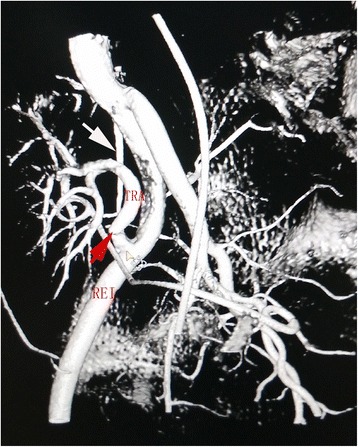
A 46-year-old male with end-stage renal disease of unknown cause received a cadaveric renal transplant one year ago. Although three antihypertensive medications were administrated, his blood pressure gradually increased to 190/120 mmHg 3 weeks posttransplantation. Also the level of creatinine increased to 194 μmol/L.Color Doppler ultrasonography indicated a decreased resistance index (RI) in intrarenal arteries and increased blood flow of the transplant renal artery, therefore, a vascular complication of TRAS was suspected. Arteriography was performed and demonstrated TRAS caused by stretch of an artery branch, and the TRAS occurred in the distal site of the anastomosis instead of the anastomosis. Percutaneous transluminal bare stent implantation treatment was successfully performed. Satisfactory clinical efficacy with improvement in transplant renal function and renovascular hypertension was achieved after the interventional treatment.
To our knowledge this is the first reported case of TRAS caused by stretch of an artery branch. When refractory hypertension and allograft dysfunction are presented posttransplantation, TRAS should be suspected. Color Doppler ultrasonography as a non-invasive examination may provide some valuable information, three-dimention CT can be useful for further diagnosis, but is seldom necessary. Arteriography provides the definitive diagnosis of TRAS. Percutaneous transluminal stent implantation treatment of TRAS has high success rate with minimal invasion and complications. When an artery branch situated on the stenosis, a bare stent rather than covered stent is the preferred choice.
肾移植是这些终末期肾病患者的首选治疗方案。移植肾动脉狭窄(TRAS)是肾移植后最常见且严重的血管并发症之一,且大多数TRAS发生在吻合口处。必须及时诊断和治疗该并发症,否则移植肾的功能可能会丧失。
一名46岁病因不明的终末期肾病男性患者于一年前接受了尸体肾移植。尽管使用了三种降压药物,但移植后3周其血压逐渐升至190/120 mmHg。肌酐水平也升至194 μmol/L。彩色多普勒超声显示肾内动脉阻力指数(RI)降低,移植肾动脉血流增加,因此怀疑为TRAS血管并发症。进行了动脉造影,显示为动脉分支牵拉导致的TRAS,且TRAS发生在吻合口远端而非吻合口处。成功实施了经皮腔内裸支架植入治疗。介入治疗后取得了满意的临床疗效,移植肾功能和肾血管性高血压均有所改善。
据我们所知,这是首例报道的由动脉分支牵拉导致的TRAS病例。移植后出现难治性高血压和移植肾功能不全时,应怀疑TRAS。彩色多普勒超声作为一种无创检查可能会提供一些有价值的信息,三维CT有助于进一步诊断,但很少有必要。动脉造影可对TRAS做出明确诊断。经皮腔内支架植入治疗TRAS成功率高,创伤小且并发症少。当狭窄部位有动脉分支时,首选裸支架而非覆膜支架。