Sekirnik Rok, Wilkins Sarah E, Bush Jacob, Tarhonskaya Hanna, Münzel Martin, Hussein Aayan, Flashman Emily, Mohammed Shabaz, McDonough Michael A, Loenarz Christoph, Schofield Christopher J
Chemistry Research Laboratory, Department of Chemistry, University of Oxford, 12 Mansfield Road, Oxford, OX1 3TA, UK.
Novartis Technical Operations, Biosimilars, BTDM Mengeš, Lek d.d., Kolodvorska 27, 1234, Mengeš, Slovenia.
Extremophiles. 2018 May;22(3):553-562. doi: 10.1007/s00792-018-1016-9. Epub 2018 Mar 9.
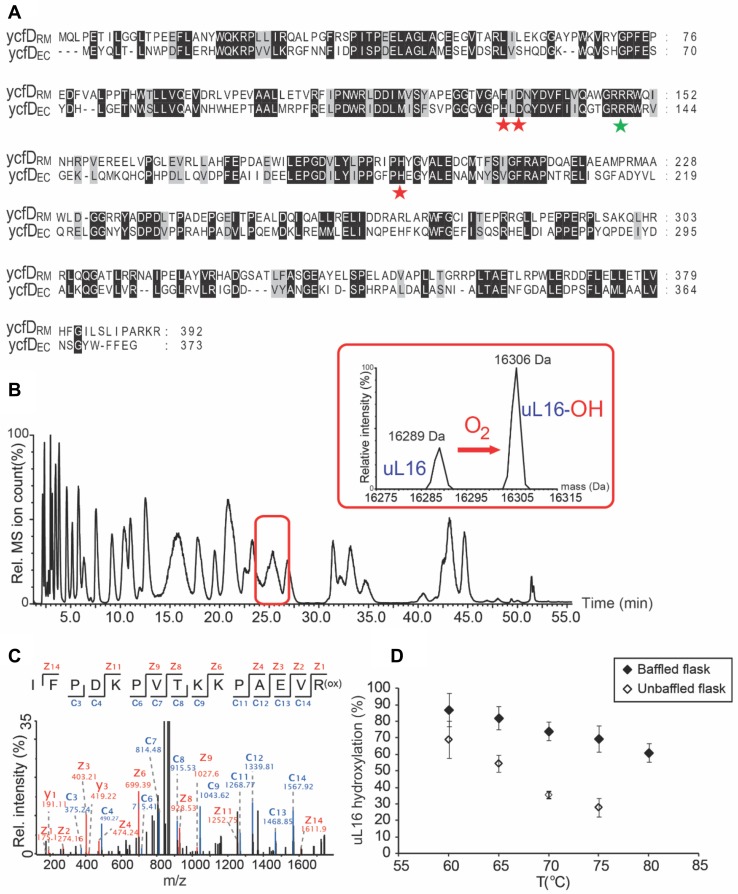
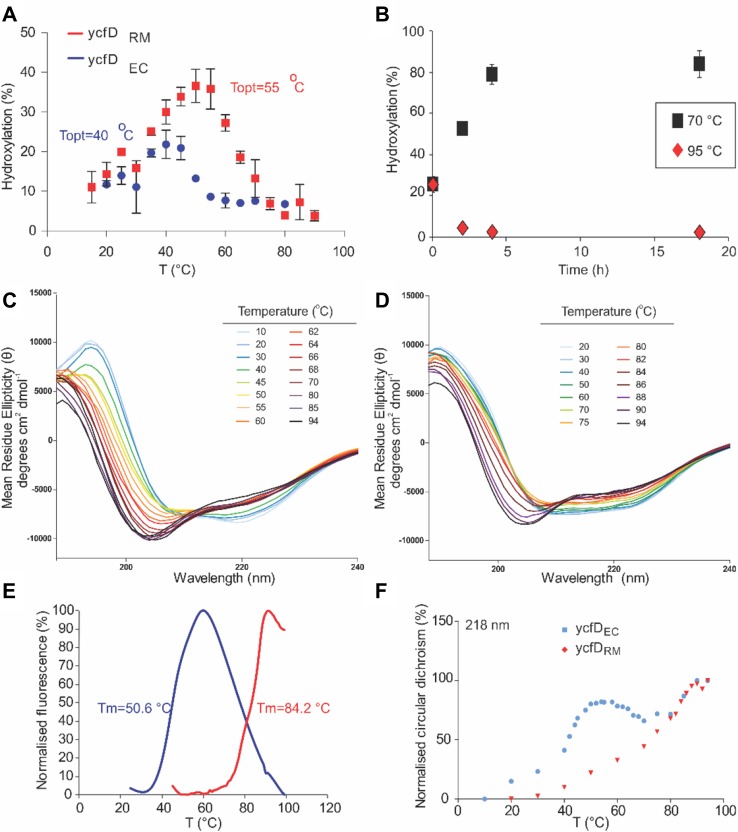
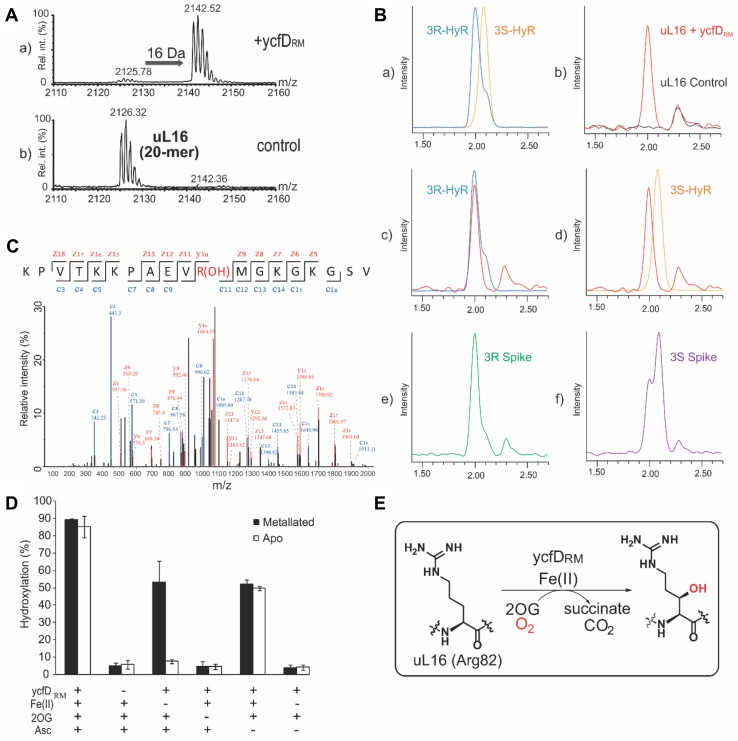
YcfD from Escherichia coli is a homologue of the human ribosomal oxygenases NO66 and MINA53, which catalyse histidyl-hydroxylation of the 60S subunit and affect cellular proliferation (Ge et al., Nat Chem Biol 12:960-962, 2012). Bioinformatic analysis identified a potential homologue of ycfD in the thermophilic bacterium Rhodothermus marinus (ycfD). We describe studies on the characterization of ycfD, which is a functional 2OG oxygenase catalysing (2S,3R)-hydroxylation of the ribosomal protein uL16 at R82, and which is active at significantly higher temperatures than previously reported for any other 2OG oxygenase. Recombinant ycfD manifests high thermostability (T 84 °C) and activity at higher temperatures (T 55 °C) than ycfD (T 50.6 °C, T 40 °C). Mass spectrometric studies on purified R. marinus ribosomal proteins demonstrate a temperature-dependent variation in uL16 hydroxylation. Kinetic studies of oxygen dependence suggest that dioxygen availability can be a limiting factor for ycfD catalysis at high temperatures, consistent with incomplete uL16 hydroxylation observed in R. marinus cells. Overall, the results that extend the known range of ribosomal hydroxylation, reveal the potential for ycfD-catalysed hydroxylation to be regulated by temperature/dioxygen availability, and that thermophilic 2OG oxygenases are of interest from a biocatalytic perspective.
来自大肠杆菌的YcfD是人类核糖体加氧酶NO66和MINA53的同源物,它们催化60S亚基的组氨酸羟基化并影响细胞增殖(Ge等人,《自然化学生物学》12:960 - 962,2012年)。生物信息学分析确定嗜热细菌海栖热袍菌中存在ycfD的潜在同源物(ycfD)。我们描述了对ycfD特性的研究,它是一种功能性的2 - 氧代戊二酸加氧酶,催化核糖体蛋白uL16的R82位点发生(2S,3R)- 羟基化,并且其活性温度比之前报道的任何其他2 - 氧代戊二酸加氧酶都要高得多。重组ycfD表现出高热稳定性(T 84°C),且在比ycfD更高的温度下(T 55°C,ycfD为T 50.6°C,T 40°C)仍具有活性。对纯化的海栖热袍菌核糖体蛋白进行的质谱研究表明,uL16羟基化存在温度依赖性变化。对氧依赖性的动力学研究表明,在高温下,氧气的可利用性可能是ycfD催化的限制因素,这与在海栖热袍菌细胞中观察到的uL16羟基化不完全一致。总体而言,这些结果扩展了已知的核糖体羟基化范围,揭示了ycfD催化的羟基化可能受温度/氧气可利用性调节的潜力,并且从生物催化的角度来看,嗜热2 - 氧代戊二酸加氧酶具有重要意义。