Department of Basic Sciences, College of Optometry, University of Houston, Houston, TX 77204, United States; The Ocular Surface Institute, College of Optometry, University of Houston, Houston, TX 77204, United States.
Department of Basic Sciences, College of Optometry, University of Houston, Houston, TX 77204, United States; Texas Institute for Measurement, Evaluation, and Statistics, College of Optometry, University of Houston, Houston, TX 77204, United States.
Acta Biomater. 2018 Apr 15;71:444-459. doi: 10.1016/j.actbio.2018.02.037. Epub 2018 Mar 7.
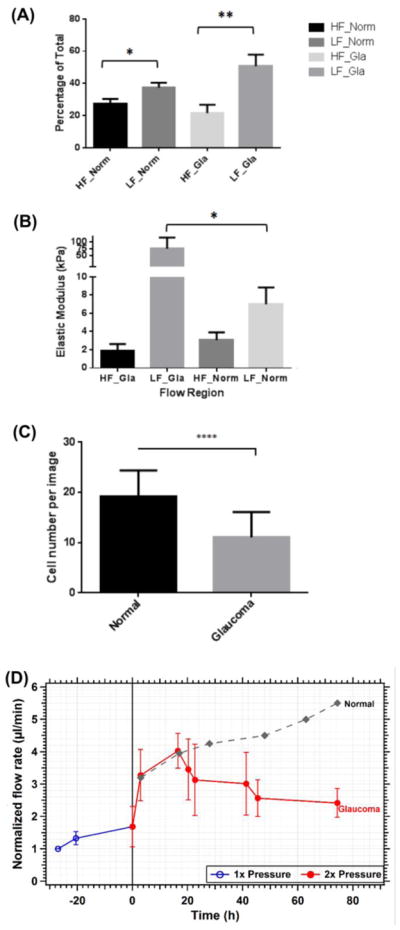
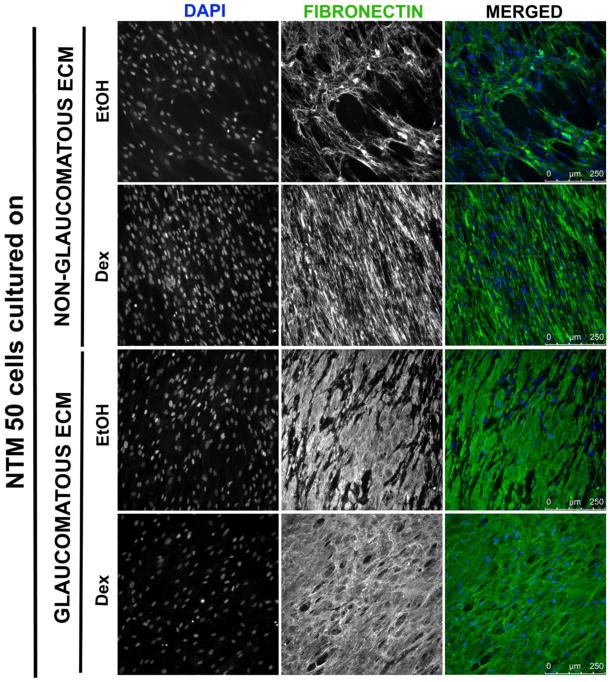
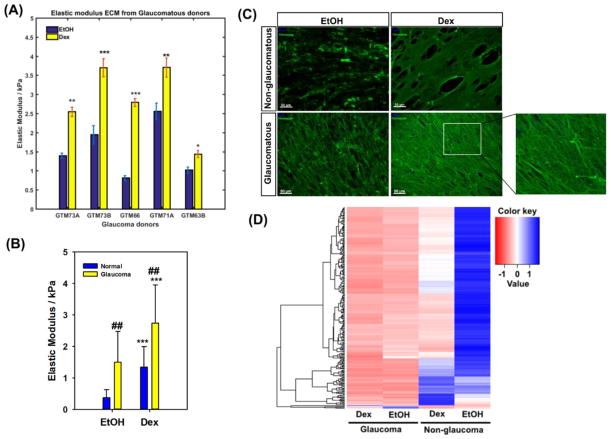
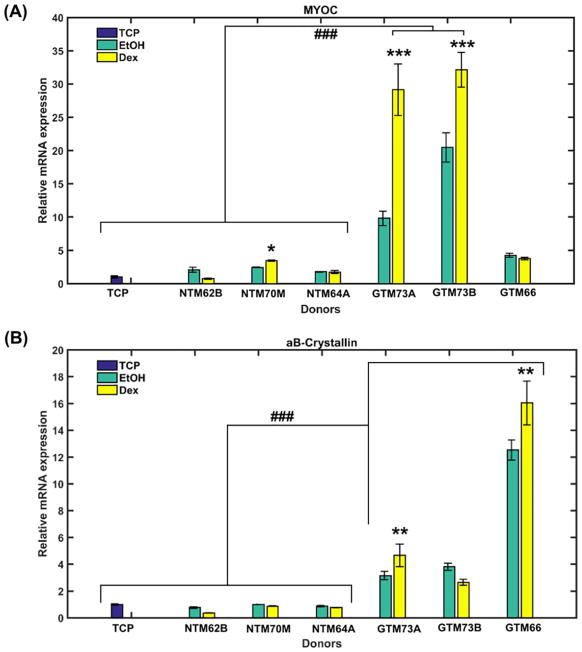
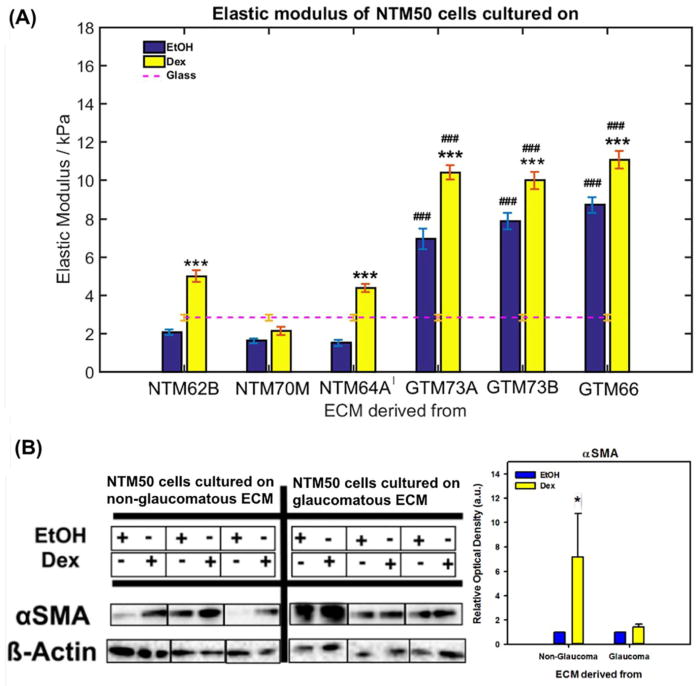
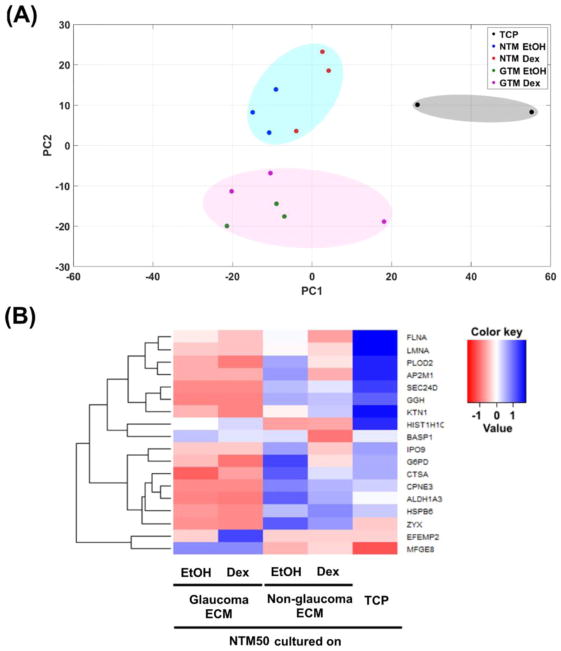
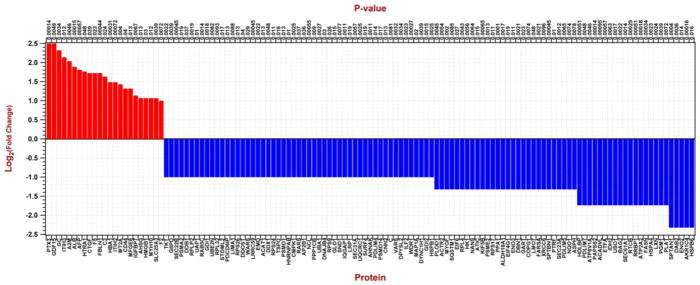
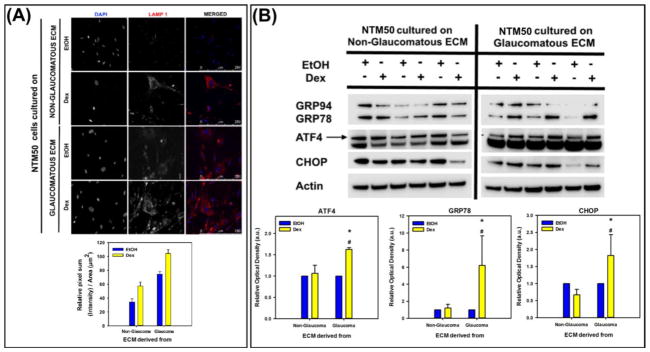
Ocular hypertension is a causal risk-factor to developing glaucoma. This is associated with stiffening of the trabecular meshwork (TM), the primary site of resistance to aqueous-humor-outflow. The mechanisms underlying this stiffening or how pathologic extracellular matrix (ECM) affects cell function are poorly understood. It is recognized that mechanotransduction systems allow cells to sense and translate the intrinsic biophysical properties of ECM into intracellular signals to control gene transcription, protein expression, and cell behavior. Using an anterior segment perfusion model, we document that there are significantly more low flow regions that are much stiffer, and fewer high flow regions that are less stiff in glaucomatous TM (GTM) when compared to non-glaucomatous TMs (NTM). GTM tissue also has fewer cells overall when compared with NTM tissue. In order to study the role of pathologic ECM in glaucoma disease progression, we conducted studies using cell derived matrices (CDM). First, we characterized the mechanics, composition and organization of fibronectin in ECM deposited by GTM and NTM cells treated with glucocorticosteroids. Then, we determined that these GTM-derived ECM are able to induce stiffening of normal NTM cells, and alter their gene/protein expression to resemble that of a glaucomatous phenotype. Further, we demonstrate that GTM-derived ECM causes endoplasmic reticular stress in NTM. They also became resistant to being reorganized by these NTM cells. These phenomena were exacerbated by ECMs obtained from steroid treated glaucoma model groups. Collectively, our data demonstrates that CDMs represent a novel tool for the study of bidirectional interactions between TM cells and their immediate microenvironment.
Extracellular matrix (ECM) changes are prevalent in a number of diseases. The precise mechanisms by which changes in the ECM contribute to disease progression is unclear, primarily due to absence of appropriate models. Here, using glaucoma as a disease model, we document changes in cell derived matrix (CDM) and tissue mechanics that contribute to the pathology. Subsequently, we determine the effect that ECMs from diseased and healthy individuals have on healthy cell behaviors. Data emanating from this study demonstrate that CDMs are a potent tool for the study of cell-ECM interactions.
眼内压升高是导致青光眼的一个因果危险因素。这与小梁网(TM)的僵硬有关,TM 是房水流出阻力的主要部位。导致这种僵硬的机制或病理性细胞外基质(ECM)如何影响细胞功能还知之甚少。人们认识到,力学转导系统使细胞能够感知和将 ECM 的固有生物物理特性转化为细胞内信号,以控制基因转录、蛋白质表达和细胞行为。我们使用前段灌注模型证明,与非青光眼 TM(NTM)相比,青光眼 TM(GTM)中有更多的低流量区域,这些区域的硬度明显更高,而高流量区域则更少。与 NTM 组织相比,GTM 组织的细胞总数也更少。为了研究病理性 ECM 在青光眼疾病进展中的作用,我们使用细胞衍生的基质(CDM)进行了研究。首先,我们对 GTM 和 NTM 细胞经糖皮质激素处理后沉积的 ECM 中的力学、组成和纤维连接蛋白的组织进行了描述。然后,我们确定这些 GTM 衍生的 ECM 能够诱导正常 NTM 细胞的僵硬,并改变它们的基因/蛋白质表达,使其类似于青光眼表型。此外,我们还证明 GTM 衍生的 ECM 会导致 NTM 中的内质网应激。这些细胞也变得对这些 NTM 细胞的重新组织有抗性。这些现象在来自类固醇处理的青光眼模型组的 ECM 中更为严重。总的来说,我们的数据表明,CDM 代表了研究 TM 细胞与其直接微环境之间双向相互作用的一种新工具。
细胞外基质(ECM)的变化在许多疾病中很常见。由于缺乏适当的模型,ECM 变化如何促进疾病进展的具体机制尚不清楚。在这里,我们以青光眼为疾病模型,记录了细胞衍生基质(CDM)和组织力学的变化,这些变化导致了病理学的发生。随后,我们确定了来自患病和健康个体的 ECM 对健康细胞行为的影响。这项研究的数据表明,CDM 是研究细胞-ECM 相互作用的有力工具。