Godse Kiran, De Abhishek, Zawar Vijay, Shah Bela, Girdhar Mukesh, Rajagopalan Murlidhar, Krupashankar D S
Department of Dermatology, D Y Patil Hospital, Navi Mumbai, Maharastra, India.
Department of Dermatology, Calcutta National Medical College, Kolkata, West Bengal, India.
Indian J Dermatol. 2018 Jan-Feb;63(1):2-15. doi: 10.4103/ijd.IJD_308_17.
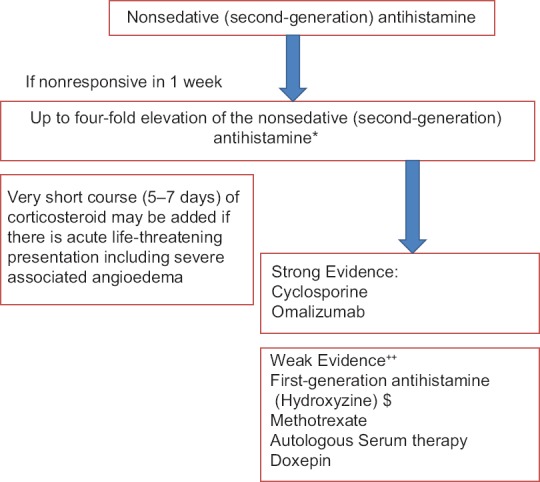
This article is developed by the Skin Allergy Research Society of India for an updated evidence-based consensus statement for the management of urticaria, with a special reference to the Indian context. This guideline includes updated definition, causes, classification, and management of urticaria. Urticaria has a profound impact on the quality of life and causes immense distress to patients, necessitating effective treatment. One approach to manage urticaria is by identification and elimination of the underlying cause(s) and/or eliciting trigger(s) while the second one is by treatment for providing symptomatic relief. This guideline recommends the use of second-generation nonsedating H1-antihistamines as the first-line treatment. The dose can be increased up to four times to meet the expected results. In case patients still do not respond, appropriate treatment options can be selected depending on the associated medical condition, severity of the symptoms, affordability of the drugs, and accessibility of modern biologics such as omalizumab.
本文由印度皮肤过敏研究协会编写,旨在为荨麻疹的管理制定一份最新的循证共识声明,特别参考了印度的实际情况。本指南涵盖了荨麻疹的最新定义、病因、分类和管理。荨麻疹对生活质量有深远影响,给患者带来极大痛苦,因此需要有效治疗。管理荨麻疹的一种方法是识别并消除潜在病因和/或诱发因素,另一种方法是进行治疗以缓解症状。本指南推荐使用第二代非镇静性H1抗组胺药作为一线治疗药物。剂量可增加至四倍以达到预期效果。如果患者仍无反应,可根据相关医疗状况、症状严重程度、药物可承受性以及诸如奥马珠单抗等现代生物制剂的可及性选择合适的治疗方案。