a Knee Research Australia , Gold Coast , Australia.
b Gold Coast Orthopaedic Research and Educational Alliance, Menzies Health Institute, Griffith University , Gold Coast , Australia.
Acta Orthop. 2018 Jun;89(3):329-335. doi: 10.1080/17453674.2018.1449466. Epub 2018 Mar 12.
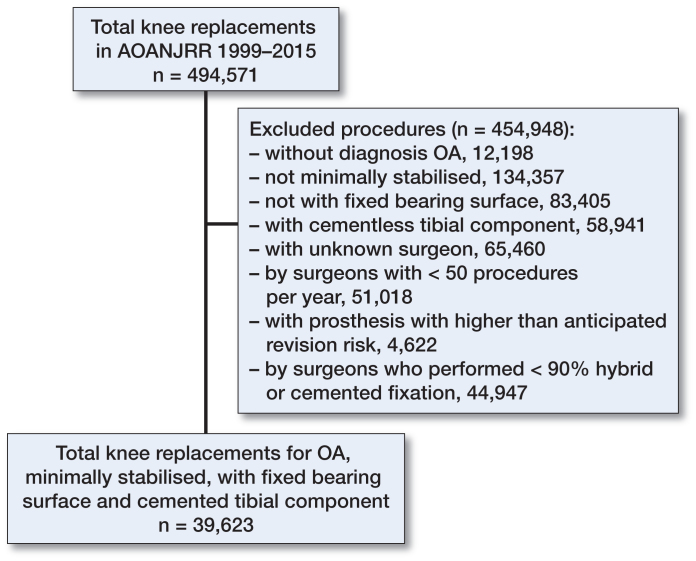
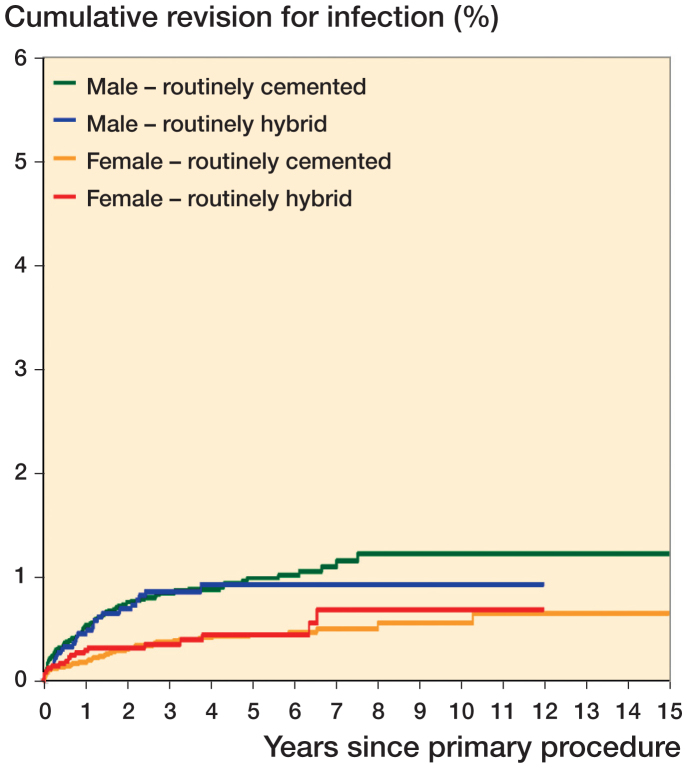
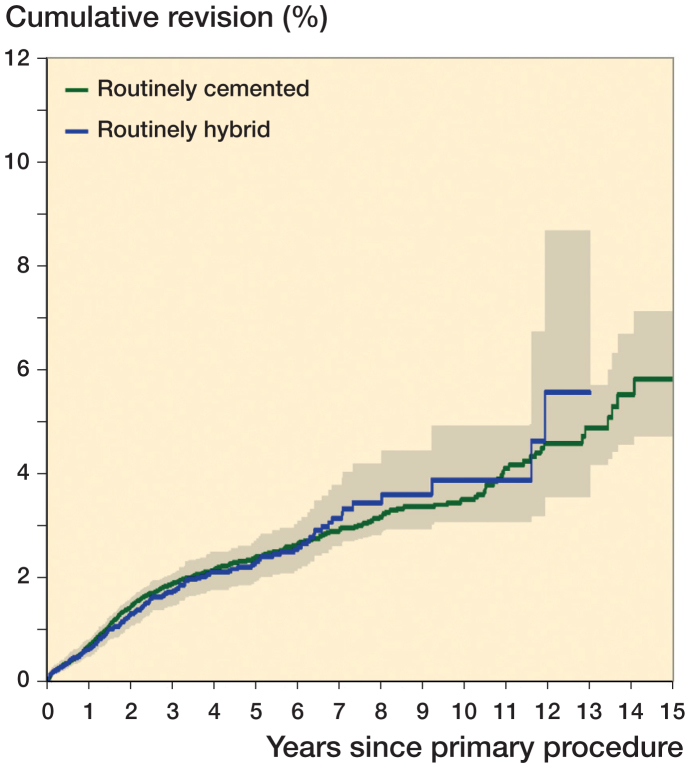
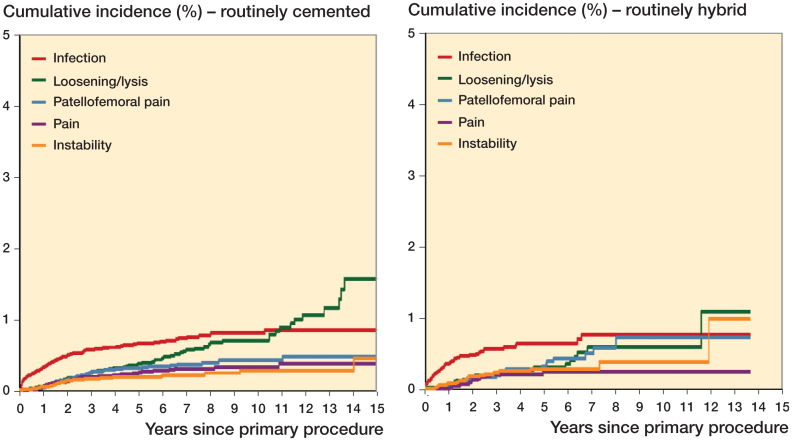
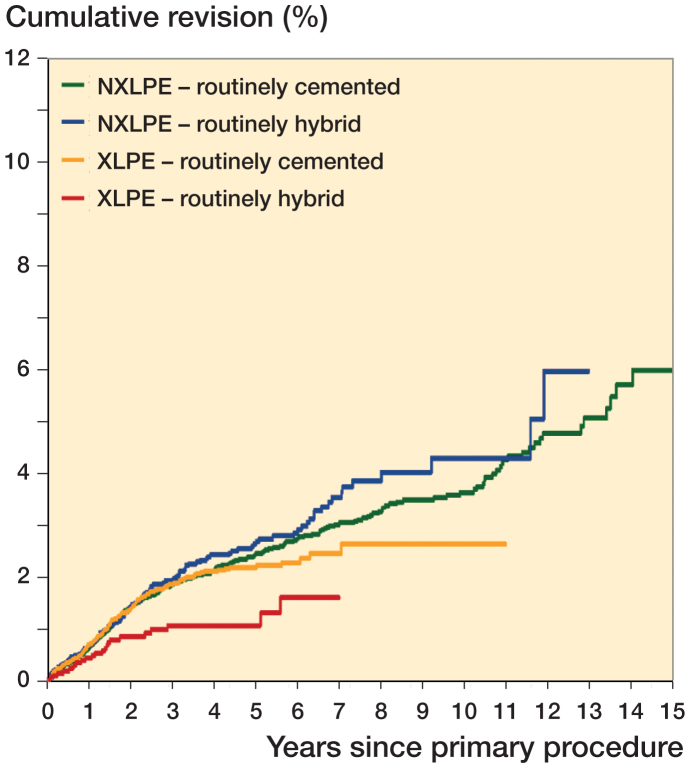
Background and purpose - Recent direct comparative reports suggest that hybrid fixation may have a similar or superior outcome to cemented fixation in total knee replacement (TKR); however, a paucity of long-term data exists. To minimize the confounders of a direct comparison, we performed an instrumental variable analysis examining the revision rate of 2 cohorts of patients based on their surgeon's preference for cemented or hybrid fixation. Methods - Registry data were obtained from 1999 until 2015 for 2 cohorts of patients who received minimally stabilized TKR, defined as those treated by high-volume hybrid fixation preferring surgeons, designated routinely hybrid (RH), and those treated by high-volume cemented fixation preferring surgeons, designated routinely cemented (RC). Results - At 13 years, the cumulative percentage revision of the RC cohort was 4.8% (CI 4.1-5.7) compared with 5.5% (CI 3.5-8.7) for the RH cohort. The revision risk for each cohort was the same for all causes (HR =1.0 (CI (0.84-1.20)), non-infective causes, and for infection. This finding was irrespective of patient age or sex, patella resurfacing, and with non-cross-linked polyethylene (NXLPE). The RH cohort who received cross-linked polyethylene (XLPE) had a lower revision risk than the RC cohort with XLPE (HR =0.57 (0.37-0.88), p = 0.01). Interpretation - The risk of revision for the patients of surgeons who prefer cemented fixation in minimally stabilized TKR is the same as for the patients of surgeons who prefer hybrid fixation, except when used with XLPE, where hybrid fixation has a lower revision risk.
背景与目的-最近的直接比较报告表明,在全膝关节置换术(TKR)中,混合固定可能具有相似或更优的结果;然而,长期数据仍然缺乏。为了最小化直接比较的混杂因素,我们进行了一项工具变量分析,根据医生对骨水泥固定或混合固定的偏好,检查了两组患者的翻修率。方法-从 1999 年到 2015 年,我们从两个患者队列中获得了注册数据,这些患者接受了最小化稳定 TKR 治疗,定义为那些由高容量混合固定偏好的医生治疗的患者,称为常规混合(RH),以及那些由高容量骨水泥固定偏好的医生治疗的患者,称为常规骨水泥固定(RC)。结果-在 13 年时,RC 队列的累计翻修率为 4.8%(CI 4.1-5.7),而 RH 队列为 5.5%(CI 3.5-8.7)。每个队列的翻修风险对于所有原因(HR=1.0(CI(0.84-1.20))、非感染性原因和感染)都是相同的。这一发现与患者年龄或性别、髌骨表面置换以及非交联聚乙烯(NXLPE)无关。接受交联聚乙烯(XLPE)的 RH 队列的翻修风险低于接受 XLPE 的 RC 队列(HR=0.57(0.37-0.88),p=0.01)。解释-在最小化稳定 TKR 中,喜欢使用骨水泥固定的医生的患者的翻修风险与喜欢使用混合固定的医生的患者相同,除了在使用 XLPE 时,混合固定的翻修风险较低。