Department of Ophthalmology, University of California, San Francisco, California, United States of America.
Howard Hughes Medical Institute, The Jackson Laboratory, Bar Harbor, ME, United States of America.
PLoS Genet. 2018 Mar 12;14(3):e1007244. doi: 10.1371/journal.pgen.1007244. eCollection 2018 Mar.
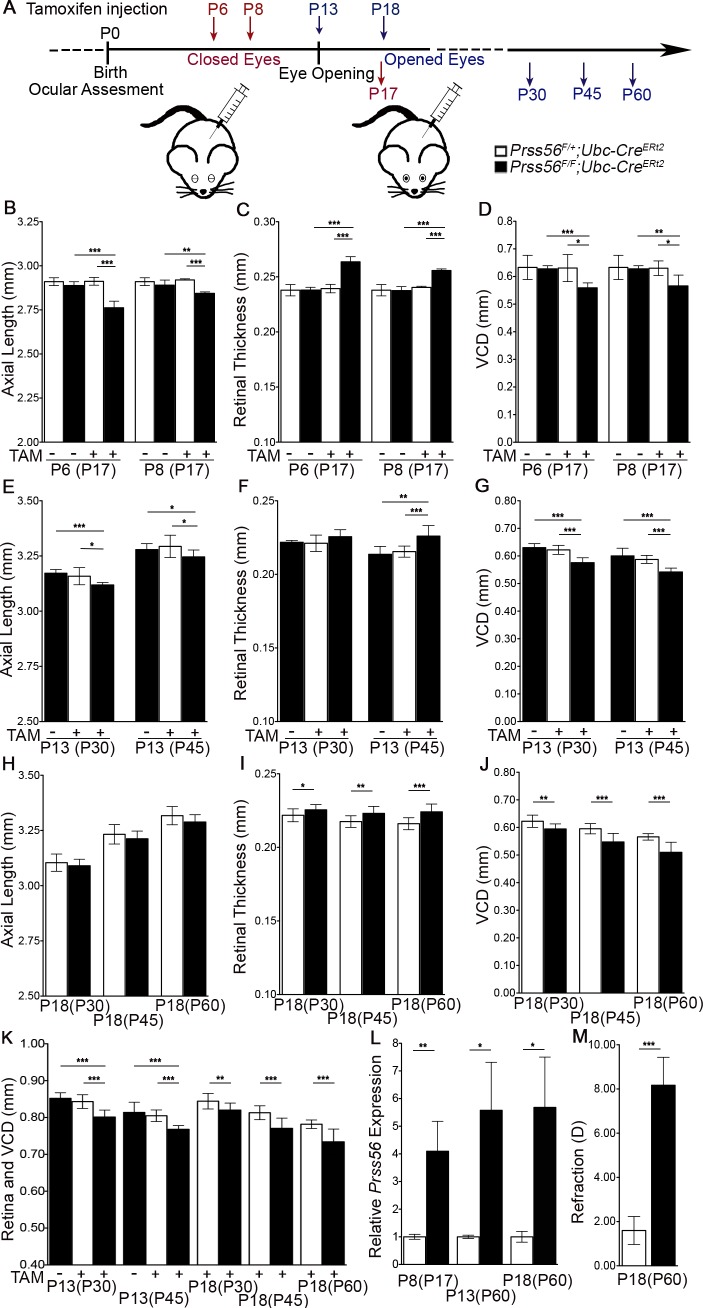
A mismatch between optical power and ocular axial length results in refractive errors. Uncorrected refractive errors constitute the most common cause of vision loss and second leading cause of blindness worldwide. Although the retina is known to play a critical role in regulating ocular growth and refractive development, the precise factors and mechanisms involved are poorly defined. We have previously identified a role for the secreted serine protease PRSS56 in ocular size determination and PRSS56 variants have been implicated in the etiology of both hyperopia and myopia, highlighting its importance in refractive development. Here, we use a combination of genetic mouse models to demonstrate that Prss56 mutations leading to reduced ocular size and hyperopia act via a loss of function mechanism. Using a conditional gene targeting strategy, we show that PRSS56 derived from Müller glia contributes to ocular growth, implicating a new retinal cell type in ocular size determination. Importantly, we demonstrate that persistent activity of PRSS56 is required during distinct developmental stages spanning the pre- and post-eye opening periods to ensure optimal ocular growth. Thus, our mouse data provide evidence for the existence of a molecule contributing to both the prenatal and postnatal stages of human ocular growth. Finally, we demonstrate that genetic inactivation of Prss56 rescues axial elongation in a mouse model of myopia caused by a null mutation in Egr1. Overall, our findings identify PRSS56 as a potential therapeutic target for modulating ocular growth aimed at preventing or slowing down myopia, which is reaching epidemic proportions.
光功率与眼球轴长不匹配会导致屈光不正。未经矫正的屈光不正构成了视力丧失的最常见原因,也是全球第二大致盲原因。尽管已知视网膜在调节眼球生长和屈光发育方面起着关键作用,但确切的相关因素和机制仍不清楚。我们之前已经确定了分泌丝氨酸蛋白酶 PRSS56 在确定眼球大小方面的作用,并且 PRSS56 变体与远视和近视的病因有关,这突出了它在屈光发育中的重要性。在这里,我们使用多种遗传小鼠模型来证明导致眼球变小和远视的 Prss56 突变是通过失活机制起作用的。使用条件性基因靶向策略,我们表明源自 Müller 胶质细胞的 PRSS56 有助于眼球生长,这表明视网膜中的一种新细胞类型在确定眼球大小方面具有重要作用。重要的是,我们证明了 PRSS56 的持续活性在跨越预眼期和睁眼后时期的不同发育阶段都是必需的,以确保最佳的眼球生长。因此,我们的小鼠数据为存在一种分子同时参与人类眼球生长的产前和产后阶段提供了证据。最后,我们证明了在 Egr1 缺失突变引起的近视小鼠模型中,Prss56 的基因失活可挽救眼轴伸长。总的来说,我们的研究结果确定了 PRSS56 作为一种潜在的治疗靶点,用于调节眼球生长,以预防或减缓近视的发展,因为近视的发病率正在不断上升。