Zambrano-Estrada Xóchitl, Landaverde-Quiroz Brianda, Dueñas-Bocanegra Andrés A, De Paz-Campos Marco A, Hernández-Alberto Gerardo, Solorio-Perusquia Benjamín, Trejo-Mandujano Manuel, Pérez-Guerrero Laura, Delgado-González Evangelina, Anguiano Brenda, Aceves Carmen
Instituto de Neurobiología, Universidad Nacional Autónoma de México, Boulevard Juriquilla 3001, CP 76230, Querétaro, Mexico.
Facultad de Estudios Superiores Cuautitlán, Universidad Nacional Autónoma de México, Mexico City, Mexico.
BMC Vet Res. 2018 Mar 12;14(1):87. doi: 10.1186/s12917-018-1411-6.
Mammary cancer has a high incidence in canines and is an excellent model of spontaneous carcinogenesis. Molecular iodine (I) exerts antineoplastic effects on different cancer cells activating re-differentiation pathways. In co-administration with anthracyclines, I impairs chemoresistance installation and prevents the severity of side effects generated by these antineoplastic drugs. This study is a random and double-blind protocol that analyzes the impact of I (10 mg/day) in two administration schemes of Doxorubicin (DOX; 30 mg/m2) in 27 canine patients with cancer of the mammary gland. The standard scheme (sDOX) includes four cycles of DOX administered intravenously for 20 min every 21 days, while the modified scheme (mDOX) consists of more frequent chemotherapy (four cycles every 15 days) with slow infusion (60 min). In both schemes, I or placebo (colored water) was supplemented daily throughout the treatment.
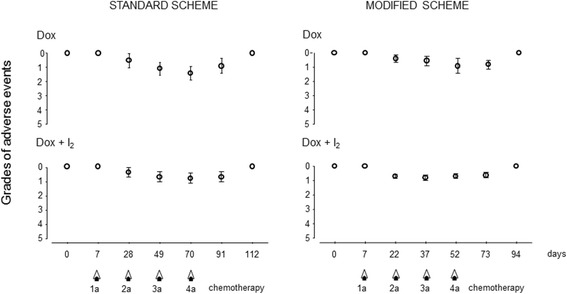
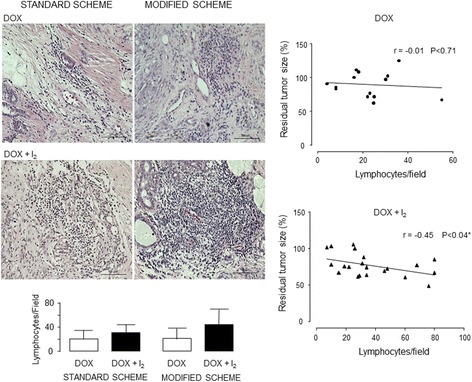
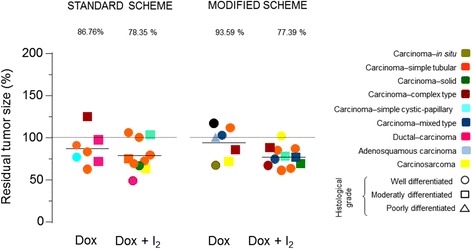
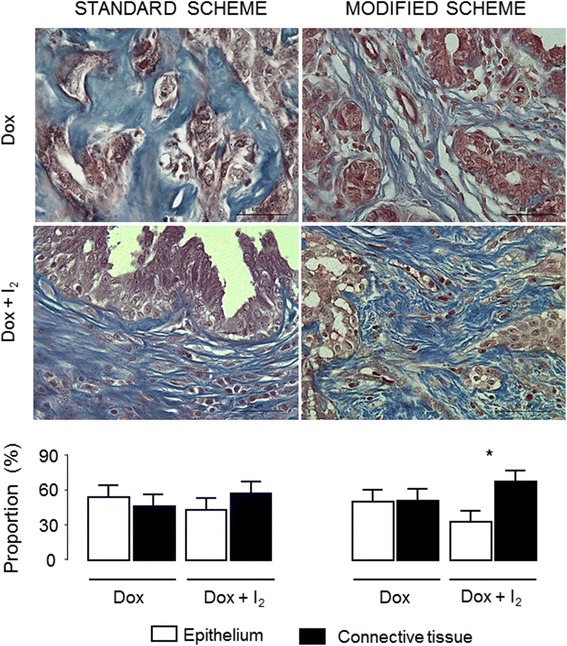
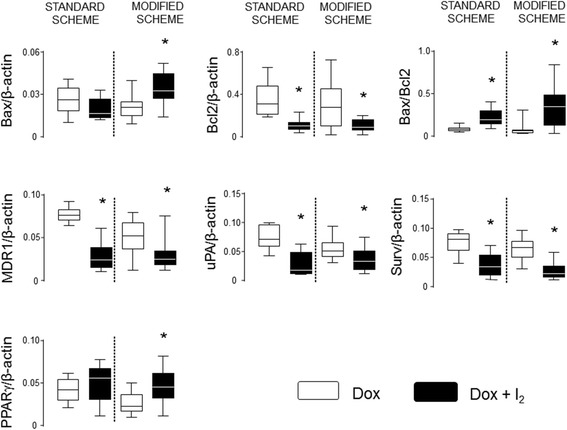
mDOX attenuated the severity of adverse events (VCOG-CTCAE) in comparison with the sDOX group. The overall tumor response rate (RECIST criteria) for all dogs was 18% (interval of reduction 48-125%), and no significant difference was found between groups. I supplementation enhances the antineoplastic effect in mDOX, exhibiting a significant decrease in the tumor epithelial fraction, diminished expression of chemoresistance (MDR1 and Survivin) and invasion (uPA) markers and enhanced expression of the differentiation factor known as peroxisome proliferator-activated receptors type gamma (PPARγ). Significant tumor lymphocytic infiltration was also observed in both I-supplemented groups. The ten-month survival analysis showed that the entire I supplementation (before and after surgery) induced 67-73% of disease-free survival, whereas supplementation in the last period (only after surgery) produced 50% in both schemes.
The mDOX+I scheme improves the therapeutic outcome, diminishes the invasive capacity, attenuates the adverse events and increases disease-free survival. These data led us to propose mDOX+I as an effective treatment for canine mammary cancer.
乳腺癌在犬类中发病率较高,是自发致癌的优秀模型。分子碘(I)对不同癌细胞发挥抗肿瘤作用,激活再分化途径。与蒽环类药物联合使用时,碘可削弱化疗耐药性的形成,并预防这些抗肿瘤药物产生的副作用的严重程度。本研究是一项随机双盲方案,分析了碘(10毫克/天)在两种阿霉素(DOX;30毫克/平方米)给药方案中对27例犬乳腺肿瘤患者的影响。标准方案(sDOX)包括每21天静脉注射DOX四个周期,每次20分钟,而改良方案(mDOX)包括更频繁的化疗(每15天四个周期)和缓慢输注(60分钟)。在两种方案中,整个治疗过程中每天补充碘或安慰剂(有色水)。
与sDOX组相比,mDOX减轻了不良事件(VCOG-CTCAE)的严重程度。所有犬的总体肿瘤反应率(RECIST标准)为18%(缩小区间48-125%),两组之间未发现显著差异。补充碘增强了mDOX的抗肿瘤作用,肿瘤上皮分数显著降低,化疗耐药性(MDR1和Survivin)和侵袭(uPA)标志物的表达减少,称为过氧化物酶体增殖物激活受体γ(PPARγ)的分化因子表达增强。在两个补充碘的组中也观察到显著的肿瘤淋巴细胞浸润。十个月的生存分析表明,整个补充碘过程(手术前后)诱导了67-73%的无病生存率,而仅在最后阶段(仅手术后)补充碘在两种方案中均产生了50%的无病生存率。
mDOX+I方案改善了治疗效果,降低了侵袭能力,减轻了不良事件,并提高了无病生存率。这些数据使我们提出mDOX+I作为犬乳腺癌的有效治疗方法。