HIV and AIDS Program, Population Council, 142 Golf Links, New Delhi, 110003, India.
UNAIDS, Formerly with Population Council, New Delhi, India.
Health Res Policy Syst. 2018 Mar 12;16(1):22. doi: 10.1186/s12961-018-0291-3.
The Knowledge Network project was launched in 2010 to build evidence on the HIV epidemic by using the data generated by HIV programme implementing organisations in India. This paper describes the implementation of the programme and the strategies adopted to enhance the capacity of individuals to document and publish HIV prevention programme learnings. Further, it discusses the outcomes of the initiative.
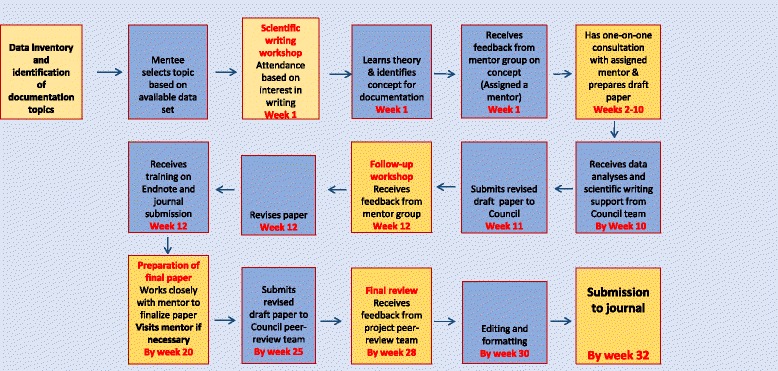
A multipronged approach was adopted, where a group of experts were brought together to collaborate with programme implementing organisations, review available data, develop research questions and guide peer-reviewed publications. Further, scientific writing courses were conducted to support individuals from HIV programme implementing organisations as well as educational and government organisations (mentees) to build the documentation capacity of individuals leading programme implementation and current and future researchers. The impact and quality of evidence generated was measured by examining the number of papers published, the number of citations, and the number of papers with at least 10 citations. Additionally, course participants' responses to open-ended questions in the anonymous course evaluation questionnaires are presented as verbatim quotes.
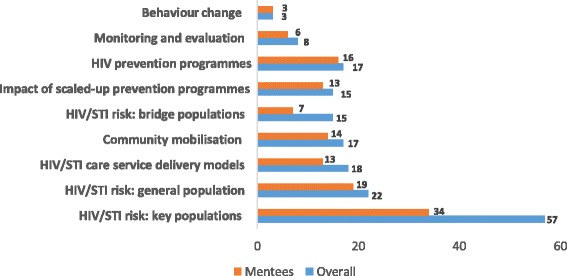
Overall, 99 papers on HIV programmatic learnings from India were finalised under the programme, of which 95 have been published. In all, 67 papers were co-authored by mentees. Most papers were published in high-impact factor (1 or more) journals and 72% were cited at least once in the literature. The main themes documented include key populations' HIV risk, HIV risk of general population groups, HIV/STI service delivery models and community mobilisation interventions.
The study demonstrates that an integrated approach, involving partnership, capacity-building and mentorship, can maximise the use of available data and build the evidence base on HIV programmatic learnings. The capacity-building model adopted in the programme can be used to build scientific writing and documentation capacity in other public health programmes that are implemented at scale.
知识网络项目于 2010 年启动,旨在利用印度艾滋病毒规划实施组织生成的数据,构建艾滋病毒流行情况的证据。本文描述了该项目的实施情况以及为增强个人记录和发表艾滋病毒预防规划学习成果的能力而采用的策略。此外,本文还讨论了该倡议的成果。
采用了多管齐下的方法,召集了一组专家与规划实施组织合作,审查现有数据,提出研究问题并指导同行评议的出版物。此外,还举办了科学写作课程,为艾滋病毒规划实施组织以及教育和政府组织的个人(学员)提供支持,以建立负责规划实施的个人以及现有和未来研究人员的文件编制能力。通过检查发表的论文数量、引用次数以及至少有 10 次引用的论文数量,衡量所产生证据的影响和质量。此外,还以逐字引语的形式呈现课程参与者在匿名课程评估问卷中对开放式问题的回答。
总体而言,该项目共完成了 99 篇关于印度艾滋病毒规划学习成果的论文,其中 95 篇已发表。共有 67 篇论文由学员共同撰写。大多数论文发表在高影响力因子(1 分或以上)的期刊上,72%的论文在文献中至少被引用过一次。记录的主要主题包括重点人群的艾滋病毒风险、一般人群的艾滋病毒风险、艾滋病毒/性传播感染服务提供模式和社区动员干预措施。
该研究表明,采用伙伴关系、能力建设和指导相结合的综合方法,可以最大限度地利用现有数据并构建关于艾滋病毒规划学习成果的证据基础。该项目采用的能力建设模式可用于为在大规模实施的其他公共卫生规划中建立科学写作和文件编制能力。