
Capture Hi-C 鉴定出 33 个乳腺癌风险位点的潜在靶基因。
Capture Hi-C identifies putative target genes at 33 breast cancer risk loci.
机构信息
Breast Cancer Now Toby Robins Research Centre, The Institute of Cancer Research, London, SW3 6JB, UK.
Department of Non-communicable Disease Epidemiology, The London School of Hygiene and Tropical Medicine, London, WC1E 7HT, UK.
出版信息
Nat Commun. 2018 Mar 12;9(1):1028. doi: 10.1038/s41467-018-03411-9.
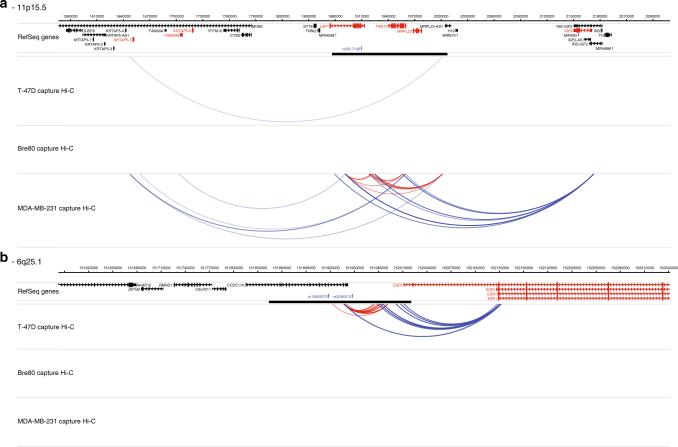
Genome-wide association studies (GWAS) have identified approximately 100 breast cancer risk loci. Translating these findings into a greater understanding of the mechanisms that influence disease risk requires identification of the genes or non-coding RNAs that mediate these associations. Here, we use Capture Hi-C (CHi-C) to annotate 63 loci; we identify 110 putative target genes at 33 loci. To assess the support for these target genes in other data sources we test for associations between levels of expression and SNP genotype (eQTLs), disease-specific survival (DSS), and compare them with somatically mutated cancer genes. 22 putative target genes are eQTLs, 32 are associated with DSS and 14 are somatically mutated in breast, or other, cancers. Identifying the target genes at GWAS risk loci will lead to a greater understanding of the mechanisms that influence breast cancer risk and prognosis.
全基因组关联研究(GWAS)已经确定了大约 100 个乳腺癌风险位点。将这些发现转化为对影响疾病风险的机制的更深入了解,需要确定介导这些关联的基因或非编码 RNA。在这里,我们使用捕获高分辨率染色体构象(CHi-C)来注释 63 个位点;我们在 33 个位点中确定了 110 个潜在的靶基因。为了评估这些靶基因在其他数据源中的支持情况,我们测试了表达水平和 SNP 基因型(eQTLs)之间的关联,以及疾病特异性生存(DSS),并将其与体细胞突变的癌症基因进行了比较。22 个潜在的靶基因是 eQTLs,32 个与 DSS 相关,14 个在乳腺癌或其他癌症中发生体细胞突变。鉴定 GWAS 风险位点的靶基因将有助于深入了解影响乳腺癌风险和预后的机制。



 Zotero 插件