SIREDO oncology center (Care, Innovation and Research for Children, Adolescents and Young Adults with cancer), Institut Curie, PSL university, Paris, France.
Department of Biostatistics, Institut Curie, Paris, France.
Cancer Med. 2018 Apr;7(4):1384-1393. doi: 10.1002/cam4.1415. Epub 2018 Mar 13.
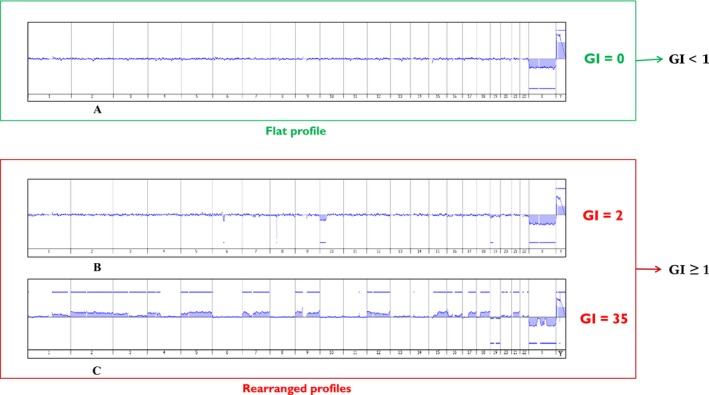
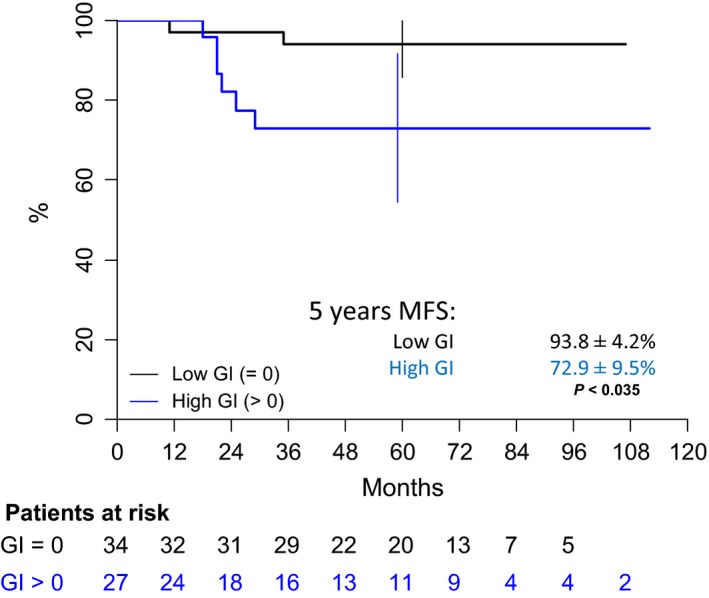
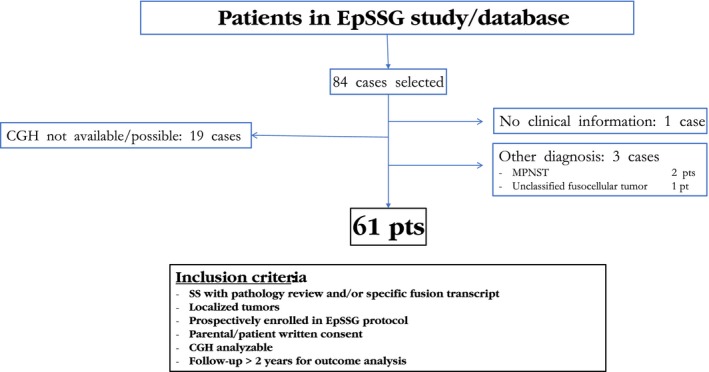
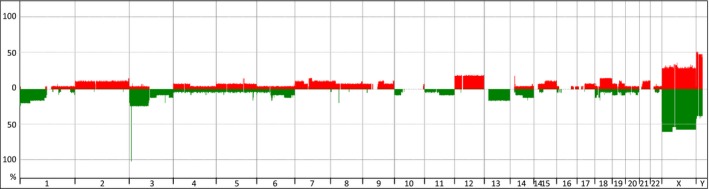
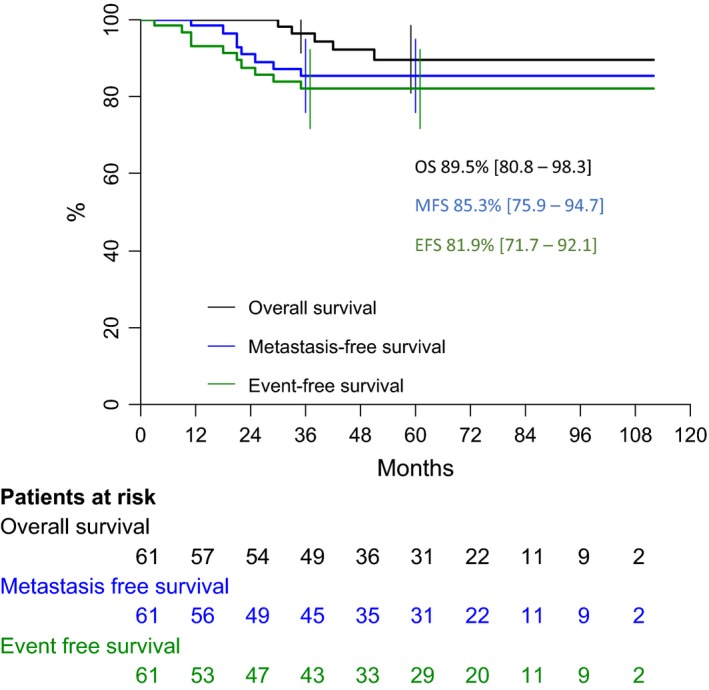
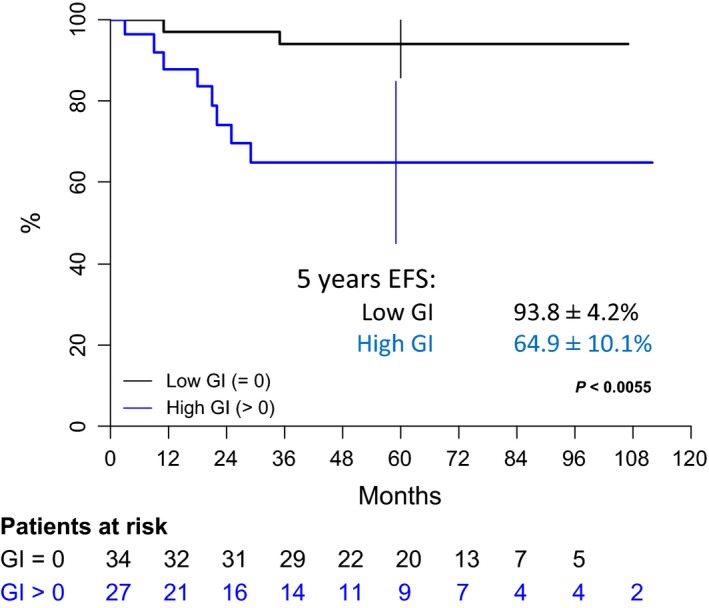
A genomic index (GI) tool using array comparative genomic hybridization (aCGH) on tumor cells has emerged as independent prognostic factor associated with the risk of metastatic relapse in synovial sarcoma (SS). The aim was to assess GI in pediatric patients with SS, to determine its value as a prognostic factor. All pediatric/adolescent/young adults' (<25 years) with localized SS prospectively included in the European EpSSG-NRSTS05 protocol with a contributive aCGH were selected. Definition of GI was A /C, where A is the total number of alterations (segmental gains and losses) and C is the number of involved chromosomes on aCGH results. GI group corresponds to cases with no copy number alterations (flat profile, GI = 0) and GI group cases with at least one or more copy number alterations (rearranged profile; GI ≥ 1). Samples were available from 61 patients. The median age of the cohort was 13 years (range: 4-24). Overall, 55.7% were GI group, and 44.3% GI . After a median follow-up of 62 months (range: 0.1-112), 10 tumor events occurred and five patients died. Respectively, for GI versus GI groups, five-year event-free survival (EFS) was 93.8 ± 4.2% versus 64.9 ± 10.1% (P < 0.006) and five-year Metastatic-Free Survival (MFS) 93.8 ± 4.2% versus 72.9 ± 9.5% (P < 0.04). In multivariate analysis, GI status as adjusted for IRS group, patient age, site, and tumor size remain independent prognostic for EFS with a relative risk (RR) of 6.4 [1.3-31.9] (P < 0.01) and RR for MFS is 4.8 [0.9-25.7] (P < 0.05). Genomic complexity evaluated through GI may explain the metastatic behavior of pediatric SS.
一种使用肿瘤细胞阵列比较基因组杂交(aCGH)的基因组指数(GI)工具已成为与滑膜肉瘤(SS)转移复发风险相关的独立预后因素。目的是评估小儿 SS 患者的 GI,以确定其作为预后因素的价值。所有符合欧洲 EpSSG-NRSTS05 方案且具有辅助 aCGH 的局限性 SS 前瞻性患儿/青少年/年轻成人(<25 岁)均被纳入研究。GI 的定义为 A/C,其中 A 是总改变数(片段增益和缺失),C 是 aCGH 结果中涉及的染色体数。GI 组对应于无拷贝数改变的病例(平坦谱,GI=0)和至少有一个或多个拷贝数改变的病例(重排谱;GI≥1)。61 例患者的样本可用。队列的中位年龄为 13 岁(范围:4-24 岁)。总体而言,55.7%为 GI 组,44.3%为 GI 组。中位随访 62 个月(范围:0.1-112)后,发生 10 例肿瘤事件,5 例患者死亡。分别来看,GI 组与 GI 组的 5 年无事件生存率(EFS)分别为 93.8±4.2%与 64.9±10.1%(P<0.006),5 年无转移生存率(MFS)分别为 93.8±4.2%与 72.9±9.5%(P<0.04)。多因素分析显示,调整 IRS 组、患者年龄、部位和肿瘤大小后,GI 状态仍是 EFS 的独立预后因素,相对风险(RR)为 6.4[1.3-31.9](P<0.01),MFS 的 RR 为 4.8[0.9-25.7](P<0.05)。通过 GI 评估的基因组复杂性可能解释了小儿 SS 的转移行为。