Department of Emergency Medicine, Johns Hopkins University School of Medicine, Baltimore, MD, United States of America.
Department of Medicine, Faculty of Health Sciences, Walter Sisulu University, Mthatha, South Africa.
PLoS One. 2018 Mar 13;13(3):e0193858. doi: 10.1371/journal.pone.0193858. eCollection 2018.
South Africa has the largest HIV epidemic in the world, with 19% of the global number of people living with HIV, 15% of new infections and 11% of AIDS-related deaths. Even though HIV testing is mandated in all hospital-based facilities in South Africa (SA), it is rarely implemented in the Emergency Department (ED). The ED provides episodic care to large volumes of undifferentiated who present with unplanned injury or illness. Thus, the ED may provide an opportunity to capture patients with undiagnosed HIV infection missed by clinic-based screening programs.
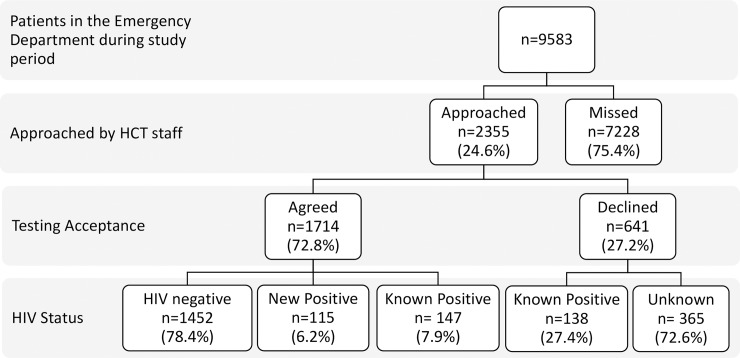
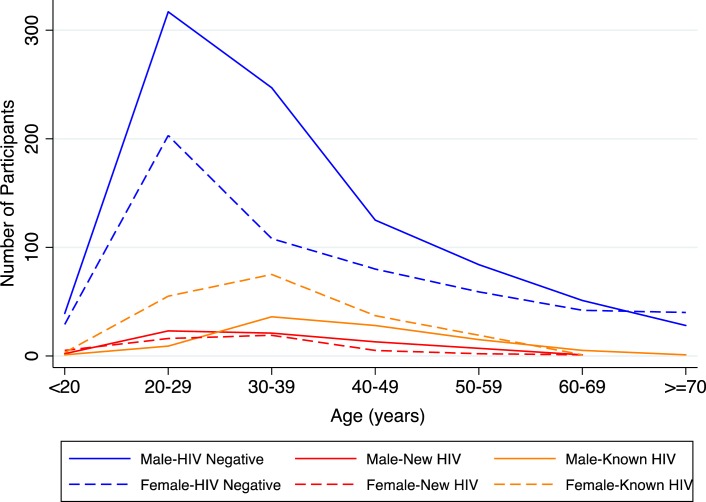
In this prospective exploratory study, we implemented the National South African HIV testing guidelines (counselor initiated non-targeted universal screening with rapid point of care testing) for 24-hours a day at Frere Hospital in the Eastern Cape from September 1st to November 30th, 2016. The purpose of our study was to quantify the burden of undiagnosed HIV infection in a South African ED setting. Furthermore, we sought to evaluate the effectiveness of the nationally recommended HIV testing strategy in the ED. All patients who presented for care in the ED during the study period, and who were clinically stable and fully conscious, were eligible to be approached by HIV counseling and testing (HCT) staff to receive a rapid point-of-care HIV test. A total of 2355 of the 9583 (24.6%) patients who presented to the ED for care during the study period were approached by the HCT staff, of whom 1714 (72.8%) accepted HIV testing. There was a high uptake of HIV testing (78.6%) among a predominantly male (58%) patient group who mostly presented with traumatic injuries (70.8%). Four hundred (21.6%) patients were HIV positive, including 115 (6.2%) with newly diagnosed HIV infection. The overall prevalence of HIV infection was twice as high in females (29.8%) compared to males (15.4%). Both sexes had a similar prevalence of newly diagnosed HIV infection (6.0% for all females and 6.4% for all males) in the ED.
Overall there was high HIV testing acceptance by ED patients. A non-targeted testing approached revealed a high HIV prevalence with a significant burden of undiagnosed HIV infection in the ED. Unfortunately, a counselor-driven HIV testing approach fell short of meeting the testing needs in this setting, with over 75% of ED patients not approached by HCT staff.
南非是世界上 HIV 疫情最严重的国家,拥有全球 19%的 HIV 感染者,占全球新感染人数的 15%,艾滋病相关死亡人数的 11%。尽管南非所有医院都必须进行 HIV 检测,但急诊科(ED)很少实施。ED 为大量未确诊的患者提供偶发性护理,这些患者因无计划的伤害或疾病而就诊。因此,ED 可能有机会发现错过诊所筛查计划的未确诊 HIV 感染患者。
在这项前瞻性探索性研究中,我们于 2016 年 9 月 1 日至 11 月 30 日在东开普省弗里尔医院实施了南非国家 HIV 检测指南(咨询师发起的非目标性普遍筛查,快速即时检测),每天 24 小时进行。我们的研究目的是量化南非 ED 环境中未确诊 HIV 感染的负担。此外,我们还评估了国家推荐的 ED 中 HIV 检测策略的有效性。在研究期间,所有在 ED 就诊的临床稳定且意识完全清醒的患者均有资格接受 HIV 咨询和检测(HCT)工作人员的咨询和检测,以接受快速即时检测。在研究期间,共有 9583 名到 ED 就诊的患者中有 2355 名(24.6%)被 HCT 工作人员接触,其中 1714 名(72.8%)接受了 HIV 检测。在以男性(58%)为主、主要因创伤就诊(70.8%)的患者中,HIV 检测的接受率很高(78.6%)。400 名(21.6%)患者 HIV 阳性,其中 115 名(6.2%)为新诊断的 HIV 感染。女性(29.8%)的 HIV 感染率是男性(15.4%)的两倍。在 ED 中,无论男女,新诊断的 HIV 感染率均相似(女性为 6.0%,男性为 6.4%)。
总体而言,ED 患者对 HIV 检测的接受度很高。非目标检测方法揭示了 ED 中 HIV 流行率很高,且未确诊的 HIV 感染负担沉重。不幸的是,咨询师主导的 HIV 检测方法未能满足该环境下的检测需求,超过 75%的 ED 患者未被 HCT 工作人员接触。