Department of Neurology, Medical Faculty, Heinrich Heine University, Moorenstrasse 5, 40225, Düsseldorf, Germany.
J Neuroinflammation. 2018 Mar 13;15(1):76. doi: 10.1186/s12974-018-1110-z.
Multiple sclerosis (MS) is a neuroinflammatory autoimmune disease of the central nervous system (CNS) which in most cases initially presents with episodes of transient functional deficits (relapsing-remitting MS; RRMS) and eventually develops into a secondary progressive form (SPMS). Aside from neuroimmunological activities, MS is also characterized by neurodegenerative and regenerative processes. The latter involve the restoration of myelin sheaths-electrically insulating structures which are the primary targets of autoimmune attacks. Spontaneous endogenous remyelination takes place even in the adult CNS and is primarily mediated by activation, recruitment, and differentiation of resident oligodendroglial precursor cells (OPCs). However, the overall efficiency of remyelination is limited and further declines with disease duration and progression. From a therapeutic standpoint, it is therefore key to understand how oligodendroglial maturation can be modulated pharmacologically. Teriflunomide has been approved as a first-line treatment for RRMS in the USA and the European Union. As the active metabolite of leflunomide, an established disease-modifying anti-rheumatic drug, it mainly acts via an inhibition of de novo pyrimidine synthesis exerting a cytostatic effect on proliferating B and T cells.
We investigated teriflunomide-dependent effects on primary rat oligodendroglial homeostasis, proliferation, and differentiation related to cellular processes important for myelin repair hence CNS regeneration in vitro. To this end, several cellular parameters, including specific oligodendroglial maturation markers, in vitro myelination, and p53 family member signaling, were examined by means of gene/protein expression analyses. The rate of myelination was determined using neuron-oligodendrocyte co-cultures.
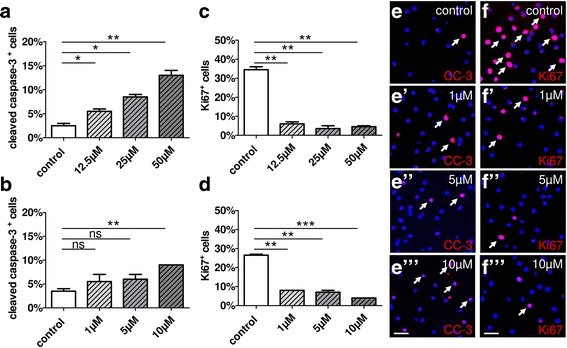
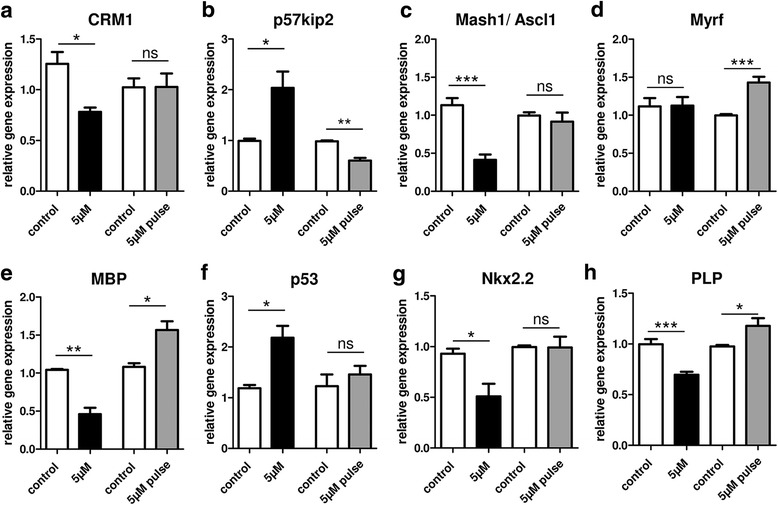
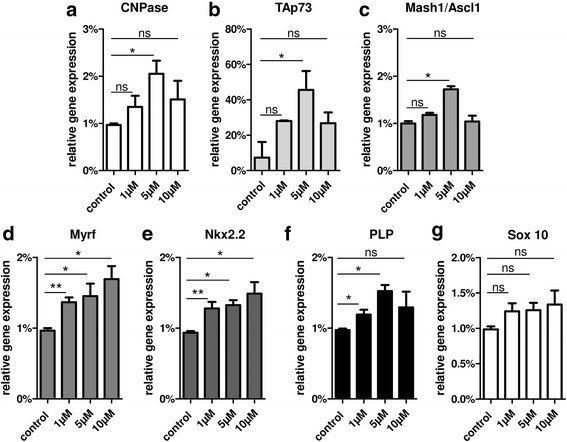
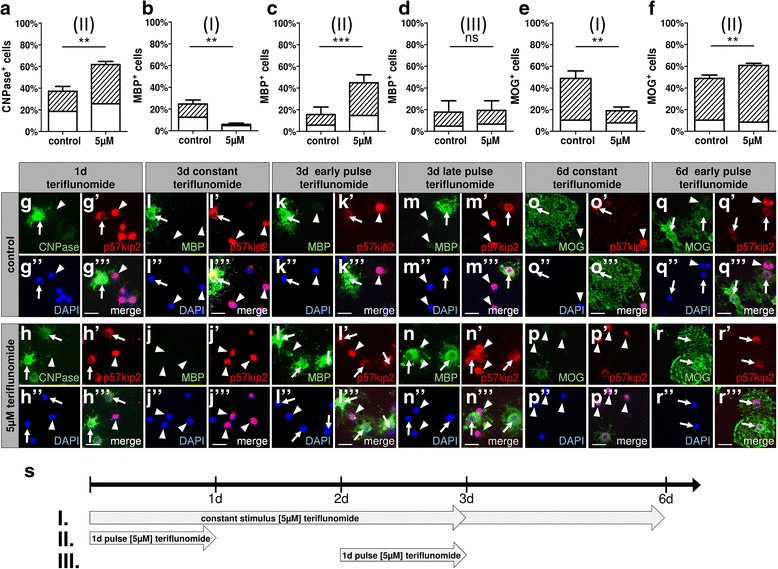
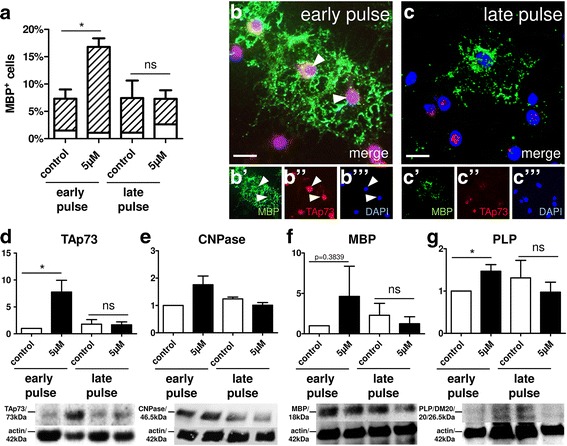
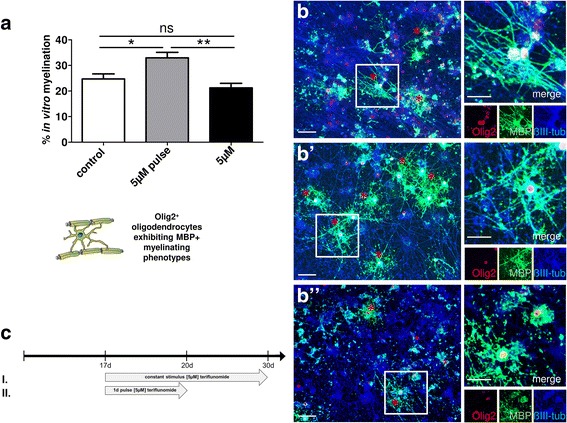
Low teriflunomide concentrations resulted in cell cycle exit while higher doses led to decreased cell survival. Short-term teriflunomide pulses can efficiently promote oligodendroglial cell differentiation suggesting that young, immature cells could benefit from such stimulation. In vitro myelination can be boosted by means of an early stimulation window with teriflunomide. p73 signaling is functionally involved in promoting OPC differentiation and myelination.
Our findings indicate a critical window of opportunity during which regenerative oligodendroglial activities including myelination of CNS axons can be stimulated by teriflunomide.
多发性硬化症(MS)是一种中枢神经系统(CNS)的神经炎症自身免疫性疾病,在大多数情况下,最初表现为短暂的功能缺陷发作(复发缓解型 MS;RRMS),最终发展为继发性进行性形式(SPMS)。除了神经免疫活性外,MS 还具有神经退行性和再生性过程的特征。后者涉及髓鞘的修复 - 电绝缘结构,这是自身免疫攻击的主要靶标。即使在成人中枢神经系统中,自发的内源性髓鞘再生也会发生,主要由激活、募集和分化驻留少突胶质前体细胞(OPC)介导。然而,髓鞘再生的整体效率是有限的,并且随着疾病持续时间和进展而进一步下降。从治疗的角度来看,因此关键是要了解如何通过药理学调节少突胶质细胞的成熟。特立氟胺已在美国和欧盟被批准为 RRMS 的一线治疗药物。作为来氟米特的活性代谢物,一种已确立的疾病修饰抗风湿药物,它主要通过抑制从头嘧啶合成来发挥作用,对增殖的 B 和 T 细胞产生细胞抑制作用。
我们研究了特立氟胺依赖性对原代大鼠少突胶质细胞稳态、增殖和分化的影响,这些影响与髓鞘修复和中枢神经系统再生的细胞过程有关。为此,通过基因/蛋白质表达分析,检查了几个细胞参数,包括特定的少突胶质细胞成熟标志物、体外髓鞘形成和 p53 家族成员信号。使用神经元-少突胶质细胞共培养物测定髓鞘形成率。
低浓度的特立氟胺导致细胞周期退出,而高浓度的特立氟胺导致细胞存活率降低。短期特立氟胺脉冲可以有效地促进少突胶质细胞分化,这表明年轻的、不成熟的细胞可以从这种刺激中受益。通过特立氟胺的早期刺激窗口,可以促进体外髓鞘形成。p73 信号在促进 OPC 分化和髓鞘形成中具有功能作用。
我们的研究结果表明,在再生性少突胶质细胞活动期间,包括中枢神经系统轴突的髓鞘形成,可以通过特立氟胺刺激一个关键的机会窗口。