Fujio Kimiya, Obata Hiroki, Kitamura Taku, Kawashima Noritaka, Nakazawa Kimitaka
Department of Rehabilitation Science, Faculty of Health Care Science, Chiba Prefectural University of Health Sciences, Chiba, Japan.
Department of Rehabilitation for Movement Functions, Research Institute of National Rehabilitation Center for Persons with Disabilities, Saitama, Japan.
Front Hum Neurosci. 2018 Feb 27;12:68. doi: 10.3389/fnhum.2018.00068. eCollection 2018.
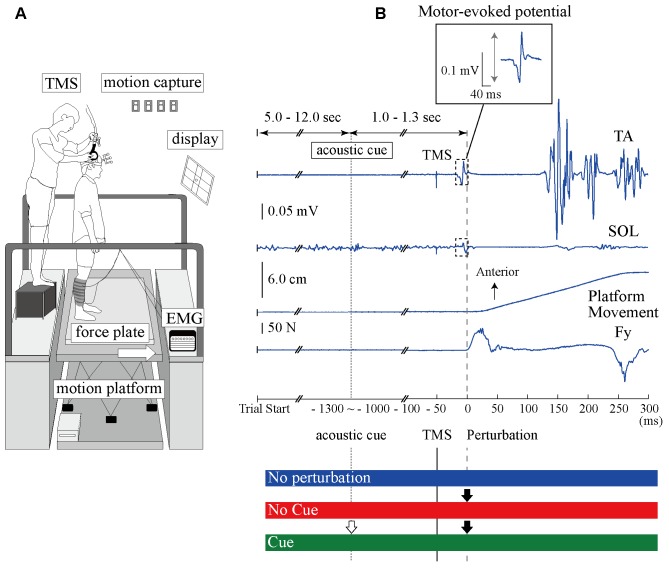
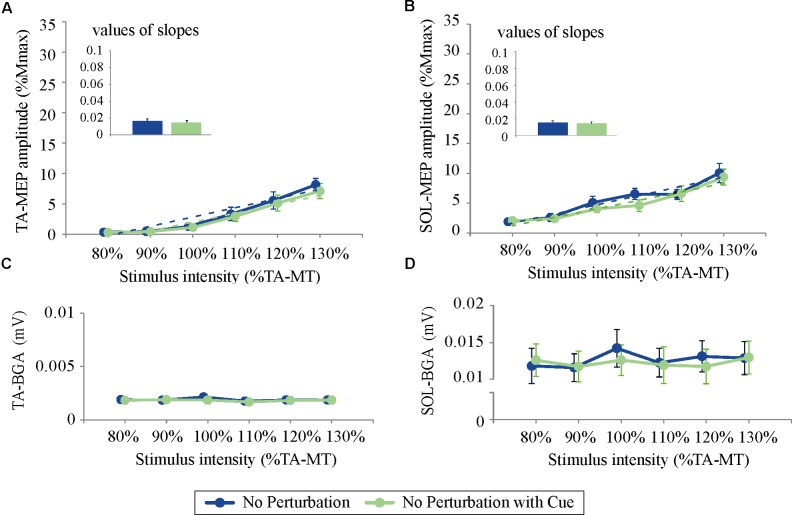
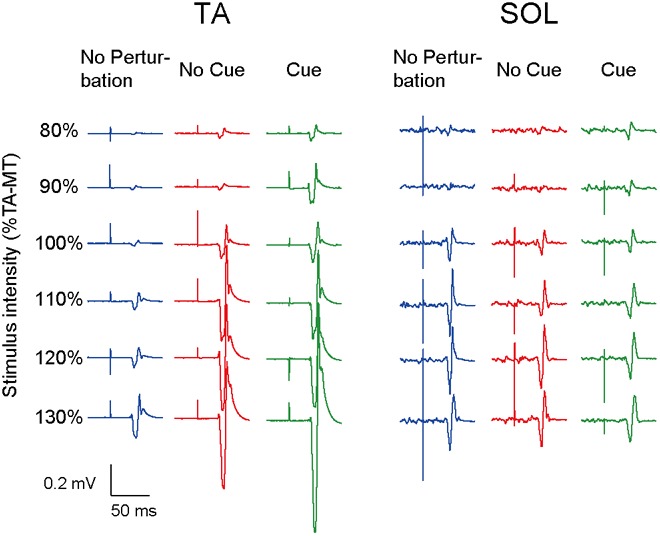
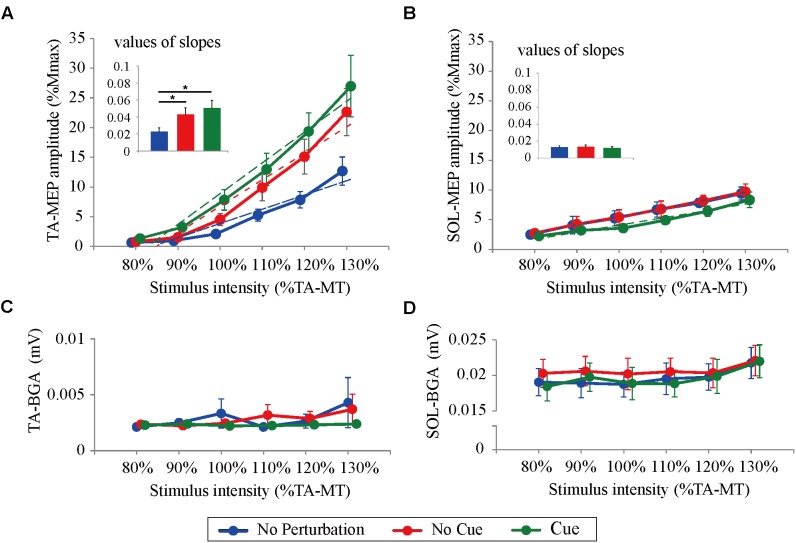
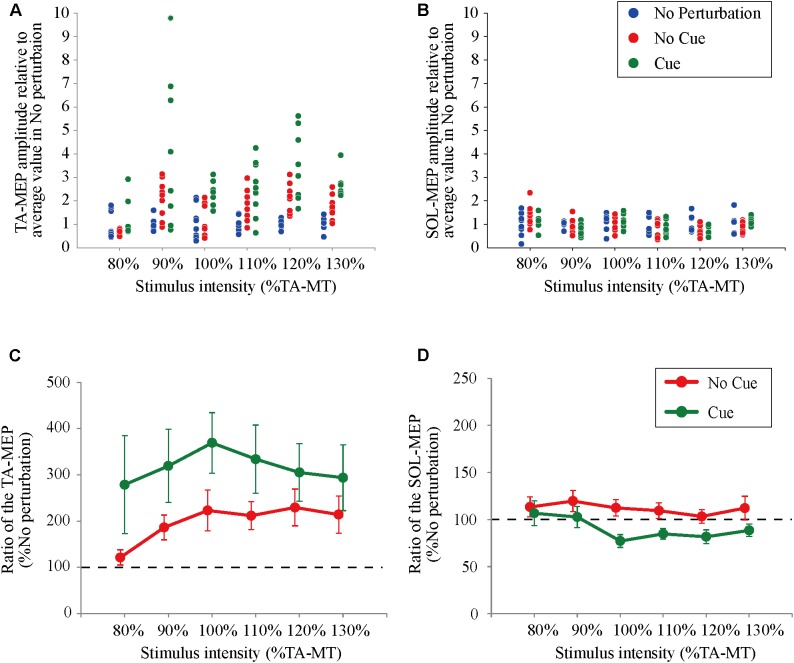
Recent studies demonstrated that the corticospinal pathway is one of the key nodes for the feedback control of human standing and that the excitability is flexibly changed according to the current state of posture. However, it has been unclear whether this pathway is also involved in a predictive control of human standing. Here, we investigated whether the corticospinal excitability of the soleus (SOL) and tibialis anterior (TA) muscles during standing would be modulated anticipatorily when perturbation was impending. We measured the motor-evoked potential (MEP) induced by transcranial magnetic stimulation over the motor cortex at six stimulus intensities. Three experimental conditions were set depending on predictabilities about perturbation occurrence and onset: No perturbation, No Cue, and Cue conditions. In the Cue condition, an acoustic signal was given as timing information of perturbation. The slope of the stimulus-response relation curve revealed that the TA-MEP was enhanced when postural perturbation was expected compared to when the perturbation was not expected (No Perturbation vs. No Cue, 0.023 ± 0.004 vs. 0.042 ± 0.007; No Perturbation vs. Cue, 0.023 ± 0.004 vs. 0.050 ± 0.009; Bonferroni correction, = 0.01, respectively). In addition, two-way analysis of variance (intensity × condition) revealed the main effect of condition ( = 6.31, = 0.03) but not intensity and interaction when the MEP amplitude of the Cue and No Cue conditions was normalized by that in No Perturbation, suggesting the enhancement more apparent when timing information was given. The SOL-MEP was not modulated even when perturbation was expected, but it slightly reduced due to the timing information. The results of an additional experiment confirmed that the acoustic cue by itself did not affect the TA- and SOL-MEPs. Our findings suggest that a prediction of a future state of standing balance modulates the corticospinal excitability in the TA, and that the additional timing information facilitates this modulation. The corticospinal pathway thus appears to be involved in mechanisms of the predictive control as well as feedback control of standing posture.
最近的研究表明,皮质脊髓通路是人体站立反馈控制的关键节点之一,其兴奋性会根据当前姿势状态灵活变化。然而,尚不清楚该通路是否也参与人体站立的预测控制。在此,我们研究了站立时比目鱼肌(SOL)和胫骨前肌(TA)的皮质脊髓兴奋性在即将发生扰动时是否会被提前调节。我们在六个刺激强度下测量了经颅磁刺激运动皮层诱发的运动诱发电位(MEP)。根据扰动发生和开始的可预测性设置了三种实验条件:无扰动、无提示和提示条件。在提示条件下,给出一个声音信号作为扰动的时间信息。刺激 - 反应关系曲线的斜率显示,与未预期到扰动时相比,预期到姿势扰动时TA - MEP增强(无扰动与无提示,0.023±0.004对0.042±0.007;无扰动与提示,0.023±0.004对0.050±0.009;Bonferroni校正,P均 = 0.01)。此外,当将提示和无提示条件下的MEP幅度通过无扰动条件下的幅度进行归一化时,双向方差分析(强度×条件)显示出条件的主效应(F = 6.31,P = 0.03),但未显示出强度和交互作用,这表明在给出时间信息时增强更为明显。即使预期到扰动,SOL - MEP也未被调节,但由于时间信息它略有降低。额外实验的结果证实,声音提示本身不会影响TA - MEP和SOL - MEP。我们的研究结果表明,对站立平衡未来状态的预测会调节TA中的皮质脊髓兴奋性,并且额外的时间信息会促进这种调节。因此,皮质脊髓通路似乎参与了站立姿势的预测控制以及反馈控制机制。