a Department of Orthopaedic Surgery , Herlev Hospital, University of Copenhagen , Herlev , Denmark.
b Department of Orthopaedic Surgery , Aarhus University Hospital , Aarhus , Denmark.
Acta Orthop. 2018 Jun;89(3):345-350. doi: 10.1080/17453674.2018.1450207. Epub 2018 Mar 14.
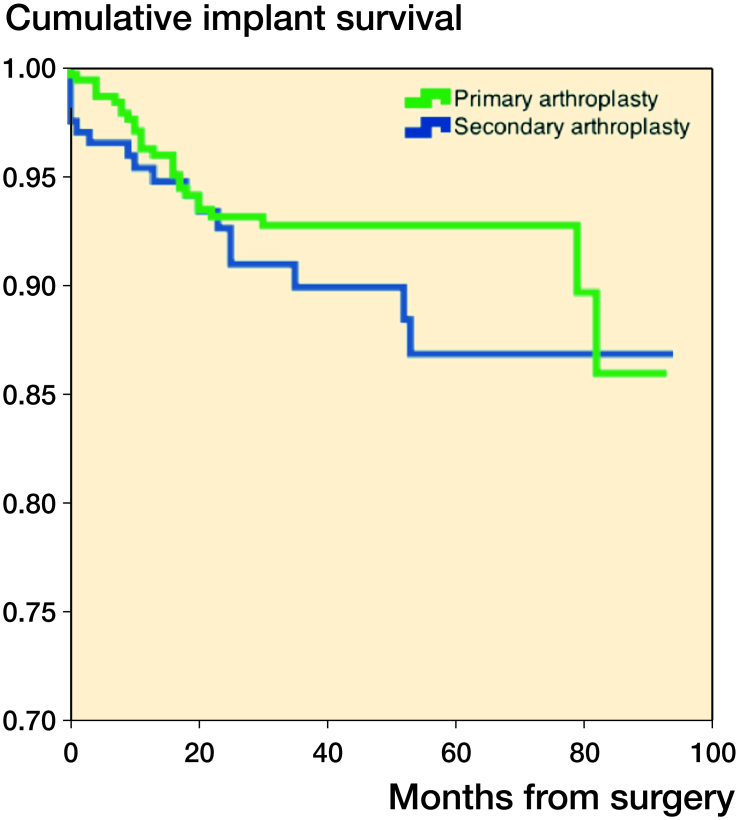
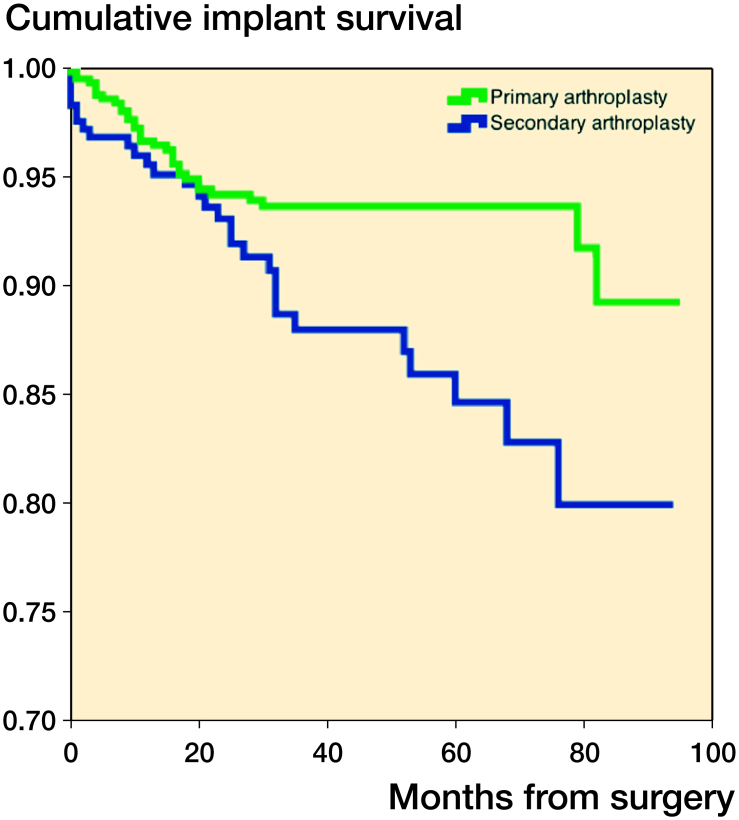
Background and purpose - It is unclear whether previous osteosynthesis is a risk factor for inferior outcome following shoulder arthroplasty for a proximal humeral fracture. We used data from the Danish Shoulder Arthroplasty Registry (DSR) to examine this question. Patients and methods - All 285 patients treated with a shoulder arthroplasty after failed osteosynthesis of a proximal humeral fracture reported to DSR from 2006 to 2013 were included. Each case was matched with 2 controls (570) treated with a primary shoulder arthroplasty for an acute proximal humeral fracture. Patient reported outcome was assessed using the Western Ontario Osteoarthritis of the Shoulder index (WOOS) and the relative risk of revision was reported. Results - The mean WOOS was 46 (SD 25) for a shoulder arthroplasty after failed osteosynthesis and 52 (27) after a primary shoulder arthroplasty. The relative risk of revision for a shoulder arthroplasty after failed osteosynthesis was 2 with a primary arthroplasty for fracture as reference. In a separate analysis of patients treated by locking plate the mean WOOS was 46 (24), with a relative risk of revision at 1.5 with a primary arthroplasty as reference. Interpretation - Compared with primary arthroplasty for proximal humeral fracture, we found an inferior patient-reported outcome and a substantial risk of revision for patients treated with a shoulder arthroplasty after failed osteosynthesis for a proximal humeral fracture. The risk and burdens of additional surgery should be accounted for when deciding on the primary surgical procedure.
背景与目的 - 既往骨折内固定是否是肱骨头骨折行肩关节置换术后预后不良的危险因素尚不清楚。我们使用丹麦肩关节置换登记系统(DSR)的数据来检验这一问题。
患者与方法 - 2006 年至 2013 年期间,所有因肱骨头骨折内固定失败而在 DSR 登记的行肩关节置换术的 285 例患者均被纳入研究。每例患者匹配 2 例(570 例)因急性肱骨头骨折行初次肩关节置换术的患者作为对照。采用 Western Ontario 肩关节炎指数(WOOS)评估患者报告的结局,报告了翻修的相对风险。
结果 - 骨折内固定失败后行肩关节置换术的患者 WOOS 平均为 46(SD 25),初次肩关节置换术患者 WOOS 平均为 52(27)。与初次肩关节置换术相比,骨折内固定失败后行肩关节置换术的患者翻修的相对风险为 2。单独分析采用锁定钢板治疗的患者,WOOS 平均为 46(24),与初次肩关节置换术相比,翻修的相对风险为 1.5。
结论 - 与初次肩关节置换术治疗肱骨头骨折相比,我们发现骨折内固定失败后行肩关节置换术的患者报告的患者结局较差,翻修风险较高。在决定初次手术方案时,应考虑到额外手术的风险和负担。