Reilly John J
Physical Activity for Health Group, University of Strathclyde Glasgow, Glasgow G1 1XQ, Scotland, United Kingdom.
J Exerc Sci Fit. 2016 Jun;14(1):1-6. doi: 10.1016/j.jesf.2016.05.002. Epub 2016 Jun 11.
OBJECTIVE/BACKGROUND: There is a widespread belief that moderate-to-vigorous-intensity physical activity (MVPA) declines markedly in adolescence, particularly in girls. This belief has led to substantial research and policy effort aimed at reducing the perceived decline in MVPA during adolescence. The main aim of this review is to critically examine the belief that MVPA declines during adolescence.
Review of evidence from studies with objective measures of physical activity, systematic reviews of longitudinal studies, insights from recent longitudinal studies, and evidence from the International Children's Accelerometry Database (ICAD).
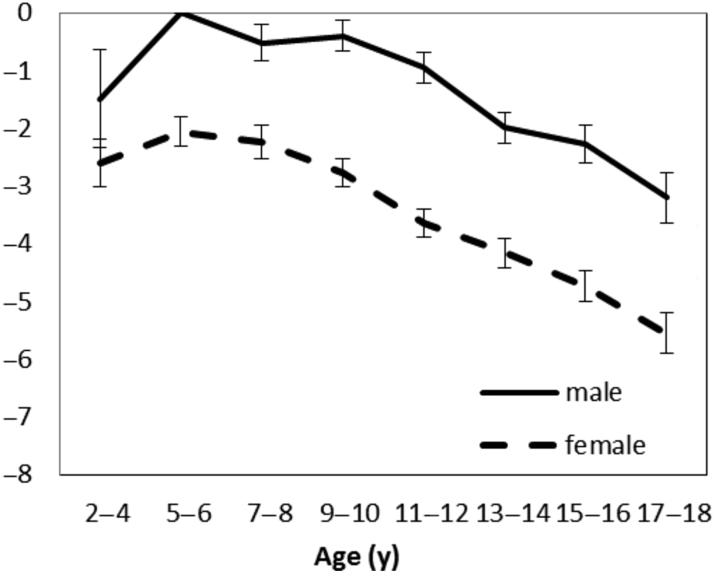
Existing systematic review evidence, four recent longitudinal studies from England, and ICAD data all failed to support the hypothesis that MVPA declines particularly markedly during adolescence, or that an MVPA decline begins at adolescence, or that declines in MVPA during adolescence are greater in girls than in boys. Systematic reviews, longitudinal studies, and ICAD data in fact suggest that MVPA begins to decline, and sedentary behavior begins to increase, from around the age of school entry. Recent longitudinal studies also suggest that increasing sedentary behavior during adolescence displaces light-intensity physical activity. An emerging body of evidence from longitudinal studies that use trajectory analysis is providing important new insights into marked between-individual differences in the trajectories of MVPA across childhood and adolescence.
Although gaps in the evidence remain, particularly from low- to middle-income countries, and additional longitudinal studies are required, this review suggests that efforts to promote and/or maintain MVPA should begin well before adolescence.
目的/背景:人们普遍认为,中等到高强度身体活动(MVPA)在青少年期会显著下降,尤其是在女孩中。这种观点促使了大量研究和政策努力,旨在减少青少年期MVPA的明显下降。本综述的主要目的是批判性地审视MVPA在青少年期会下降这一观点。
回顾来自有身体活动客观测量的研究证据、纵向研究的系统评价、近期纵向研究的见解以及国际儿童加速度计数据库(ICAD)的证据。
现有的系统评价证据、来自英国的四项近期纵向研究以及ICAD数据均未能支持以下假设:MVPA在青少年期会特别明显地下降,或MVPA的下降始于青少年期,或青少年期女孩的MVPA下降幅度大于男孩。系统评价、纵向研究和ICAD数据实际上表明,MVPA从入学前后开始下降,久坐行为开始增加。近期纵向研究还表明,青少年期久坐行为的增加取代了低强度身体活动。一系列使用轨迹分析的纵向研究的新证据,正在为儿童期和青少年期MVPA轨迹中显著的个体差异提供重要的新见解。
尽管证据仍存在差距,特别是来自低收入和中等收入国家的证据,且需要更多纵向研究,但本综述表明,促进和/或维持MVPA的努力应在青春期之前就开始。