Marynak Kristy, Gentzke Andrea, Wang Teresa W, Neff Linda, King Brian A
Office on Smoking and Health, National Center for Chronic Disease Prevention and Health Promotion, CDC.
MMWR Morb Mortal Wkly Rep. 2018 Mar 16;67(10):294-299. doi: 10.15585/mmwr.mm6710a3.
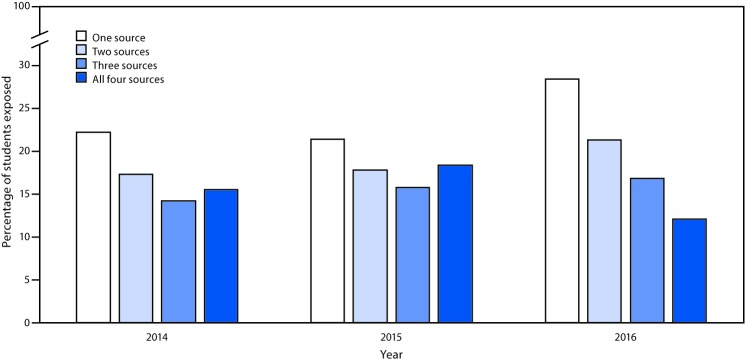
Electronic cigarettes (e-cigarettes) are the most commonly used tobacco product among U.S. middle and high school students (1). Exposure to e-cigarette advertisements is associated with higher odds of current e-cigarette use among middle and high school students (2-4). To assess patterns of self-reported exposure to four e-cigarette advertising sources (retail stores, the Internet, television, and newspapers and magazines), CDC analyzed data from the 2014, 2015, and 2016 National Youth Tobacco Surveys (NYTSs). Overall, exposure to e-cigarette advertising from at least one source increased each year during 2014-2016 (2014: 68.9%, 18.3 million; 2015: 73.0%, 19.2 million; 2016: 78.2%, 20.5 million). In 2016, exposure was highest for retail stores (68.0%), followed by the Internet (40.6%), television (37.7%), and newspapers and magazines (23.9%). During 2014-2016, youth exposure to e-cigarette advertising increased for retail stores (54.8% to 68.0%), decreased for newspapers and magazines (30.4% to 23.9%), and did not significantly change for the Internet or television. A comprehensive strategy to prevent and reduce youth use of e-cigarettes and other tobacco products includes efforts to reduce youth exposure to e-cigarette advertising from a range of sources, including retail stores, television, the Internet, and print media such as newspapers and magazines (5).
电子烟是美国初高中学生中最常用的烟草产品(1)。接触电子烟广告与初高中学生当前使用电子烟的较高几率相关(2 - 4)。为评估自我报告的接触四种电子烟广告来源(零售店、互联网、电视以及报纸和杂志)的模式,美国疾病控制与预防中心(CDC)分析了2014年、2015年和2016年全国青少年烟草调查(NYTSs)的数据。总体而言,2014 - 2016年期间,来自至少一种来源的电子烟广告接触率逐年上升(2014年:68.9%,1830万;2015年:73.0%,1920万;2016年:78.2%,2050万)。2016年,零售店的接触率最高(68.0%),其次是互联网(40.6%)、电视(37.7%)以及报纸和杂志(23.9%)。在2014 - 2016年期间,零售店的青少年电子烟广告接触率上升(从54.8%升至68.0%),报纸和杂志的接触率下降(从30.4%降至23.9%),互联网和电视的接触率无显著变化。预防和减少青少年使用电子烟及其他烟草产品的综合策略包括努力减少青少年接触来自一系列来源的电子烟广告,这些来源包括零售店、电视、互联网以及报纸和杂志等印刷媒体(5)。